Coming back to St Maarten I had to realize that I came back to the island in the right middle of the hurricane season. After I looked up Beryl’s work last year on the southern islands, especially in Carriacou, it made me second guess if I want to be out on the open sea, while having big weather systems forming.
So I started to have a chat with sailors of all sorts to gather more information how they feel about the season.
The majority of the sailors have already left St Maarten, because the boat insurance is not covering the boats’ damages, that stay in the northern Caribbean region, so it was time to get my head around the topic in a bit more detail.
Something I have to acknowledge upfront, that I came back too late for my travel project. There is no regrets, because I had a beautiful time in the US, that I would not exchange for anything, but facts are facts. My no-fly travel project got out of sight, I’ve distracted myself and some things turned out to be more important than pursuing my travel project goal blindfoldedly.
First things first. How are hurricanes forming?
There is a cool 2 minutes visual on Youtube about this, see link
As per the National Ocean and Atmospheric Administration’s website (NOAA) (see link), spicy tropical cyclones or in other words hurricanes have 4 key ingredients:
1. forming in tropical areas over the ocean, where the ocean water temperature exceeds 26.5C;
2. there is a pre-existing tropical disturbance (in other words, existing wind that moves the atmospheric air)
3. The ocean heat is fueling the thunderstorm activity
4. Low wind shear, which means that the wind speed and direction is changing rapidly within the 600 meter (2000 ft) height in the atmosphere
Hurricanes are considered to be weather systems that form as an interplay of the above 4 points, exceeding 74mph. Even the interplay of these 4 factors don’t always end up in hurricanes though.
So let’s look at the ocean water temperatures
Hurricanes form around the equator, and the ones that hit the Caribbeans and the US coastline, start from the African coast heading west, so I’ll hit Gabon as it’s starting point, let’s look at the current ocean water temperatures, to have a guess of what can be expected in the upcoming weeks.
Around Gabon, the current average ocean water temperature is 25.3 C, today’s temperature is 24.6 C.
In August, the forecasted max temperate is 26.8 C, but the average is 25.5 C.
In my translation, and based on the conversations I had with sailors in St Maarten, this means there is no big tropical disturbance expected in the near future, but at least not in the upcoming weeks.
This is quite a difference compared to last year, where Beryl has hit the Caribbeans in July.
Possible route down from St Maarten to Central or South America by boat
I’ve been looking around talking to a few people, among others, Erik, my former captain, to get a feel for how the route could be possibly done down to Panama or Colombia at this point, being so late in the season.
I sent out several Facebook posts, Whatsapp notes in local Whatsapp sailor groups, talked to some sailors, to get a feel for, if someone wants to head west at this point, but there is absolutely no one – at least I didn’t come across anybody, who wants to go west and hit Guatemala or any northern islands or mainland at this point.
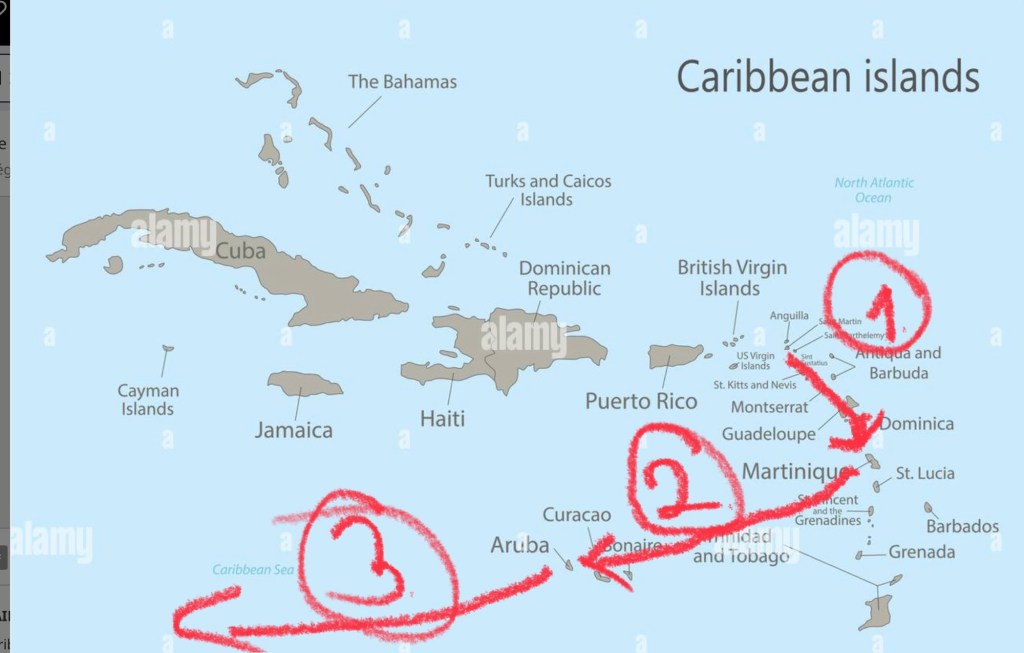
So an alternative route came up, that I have also backed up by ChatGPT going down south to Martinique, which is considered as a hurricane haul.
Martinique is not just an earthly paradise, but an island over 10 times bigger than St Maarten, with an enormous marina, which makes it highly possible, from the island to catch a boat heading to the ABC islands.
Actively monitoring the weather forecast with 5-7 days clean weather windows, it would be highly likely to be able to reach Martinique, and then hit the ABC islands.
The ABC islands of Aruba, Bonaire and Curacao, are not just important strategic points that lay somewhere 30-50 miles off the Venezuelan coast, outside of the hurricane hot zones, but they are just 1-3 days sail away from Cartagena, Colombia. From Cartagena, through another 1-3 days sail Panama could be reached.
The possible route to go down from St Maarten, to Panama or Colombia through Martinique and/or the ABCs during hurricane season by boat
Link for source
Okay, let’s look at how the same discussion looks like with ChatGPT.
First, I wanted to understand what is the impact of a hurricane (don’t forget, we call a weather system a hurricane, that exceeds 74mph) on a sailing boat.
From the first question it’s clear, that 41+knots winds substantially increase the capsizing risks of a boat.
Q: First of all, what is the capsizing point (when a sailing boat turns upside down) of an average sailing boat?
The capsizing point of an average sailing boat depends on multiple factors including:
– Hull design and beam-to-length ratio
– Ballast and keel type
– Sail configuration
– Boat displacement
– Sea state and wave direction
That said, here’s a general breakdown:
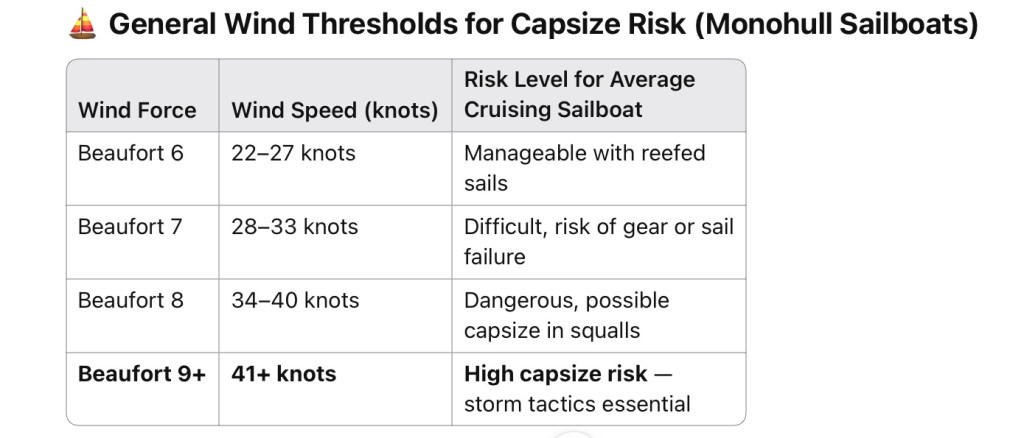
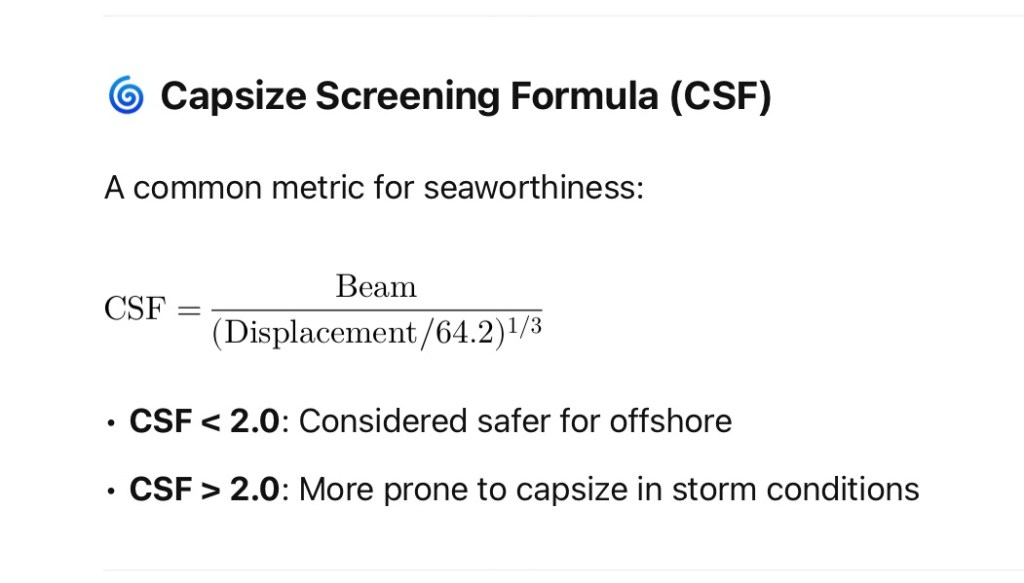
⚓ Approximate Capsizing Point
For modern monohull cruising sailboats (30–45 ft), the capsizing moment can occur in wind over 40–50 knots (especially if hit beam-on by a gust or wave). In real terms, the capsize usually results from a combination of wind and waves, not wind alone. A wave can knock down a boat even in 30–35 knots if it strikes at the wrong angle.
🛟 Safety Mitigations
Reef early (reduce sail area) Use storm sails or heave to Maintain proper weight distribution Avoid sailing beam-on to large breaking waves
If you have a specific boat type or size in mind (e.g., 36 ft fiberglass monohull), I can give a more tailored capsize wind range.
Yes, sailing from St. Maarten to Central America on July 15th is risky, primarily because you are entering the core of the Atlantic hurricane season.
Q: From St Maarten, I want to cross the Caribbean Sea to Central America on July 15th, is there a risk?
🌪️ Risk Overview for July 15
🔺 Key Concerns:
Mid-July marks the ramp-up of hurricane activity in the Atlantic Basin. The Caribbean Sea is a hot zone for tropical storms and hurricanes starting in July through October. Warm water, low wind shear, and tropical waves from Africa create the perfect breeding ground for cyclones. Storms can form quickly, often with little advance warning.
📍 St. Maarten to Central America Route (General West-Southwest)
📊 Historical Data
From July 10–20, the Atlantic has seen many named storms, including several major hurricanes (e.g., Hurricane Emily 2005, Category 4, struck the Yucatán in mid-July). On average, 1–2 tropical systems may form in July, with increasing frequency each week.
🧭 Can it be done safely?
Only under strict conditions:
With real-time weather routing support (e.g., PredictWind, Weather4D, or via satellite services like Iridium GO). A boat capable of handling strong squalls and confused seas. A flexible route — prepared to divert south (e.g., to ABC islands) or north (e.g., to Cuba) if a storm forms. A tight 3–5 day weather window, with a clean forecast before departure.
🧭 Safer Alternatives:
Delay until November–December, after hurricane season, to cross westward. If you must move now, consider: Short hop to a safer zone like Aruba, Curaçao, or Bonaire, which lie below the hurricane belt. Wait there until the season ends or move on via Colombia’s coast with tighter windows.
✅ Summary:
Factor
July 15 Condition
Hurricane risk
High (escalating weekly)
Safe weather window
Rare, short-term only
Recommendation
Not advised unless urgent, with full satellite weather support and an escape plan
What if I go down from St Maarten to Martinique and then from there to Panama
Sailing from St. Maarten to Panama via Martinique is technically possible, but in mid-July, it remains risky due to increasing hurricane activity, especially through the Eastern and Central Caribbean.
That said, your adjusted plan — heading south to Martinique first — is a smarter and slightly safer strategy than going directly west across the Caribbean Sea from St. Maarten.
🧭 Updated Route: St. Maarten → Martinique → Panama (July 15+)
🌊 Leg 1: St. Maarten to Martinique
Distance: ~250–300 nautical miles (approx. 2–3 days) Conditions: Trade winds, manageable seas, standard island-hopping route Risk: Moderate — you’ll still be in the hurricane belt, but can anchor in safe harbors if needed
🛑 Wait and Watch Option in Martinique:
Martinique has hurricane moorings, reliable forecasts, and good provisioning. Use it as a launching point to time a weather window for the crossing to Panama.
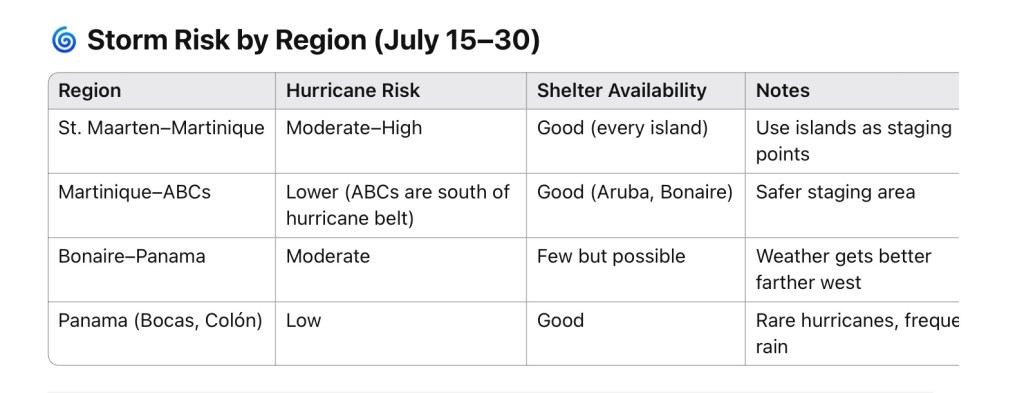
🌊 Leg 2: Martinique → Panama (via ABCs or direct)
You have two main route options:
Option A: Martinique → Bonaire → Aruba → Colombia coast → Panama
Longer but safer: stays closer to coastlines, below the hurricane belt Stops allow for flexibility and shelter Sail with or near the trades, calmer the farther south you go Key ports: Bonaire (Kralendijk), Aruba (Oranjestad), Santa Marta (Colombia), Cartagena
Option B: Martinique → Direct to Panama (approx. 1,100 NM, 7–10 days)
Faster but riskier due to open water and potential for tropical development Very few shelter options en route Must monitor weather via satellite (e.g., Iridium GO, Garmin inReach)
✅ Recommended Strategy
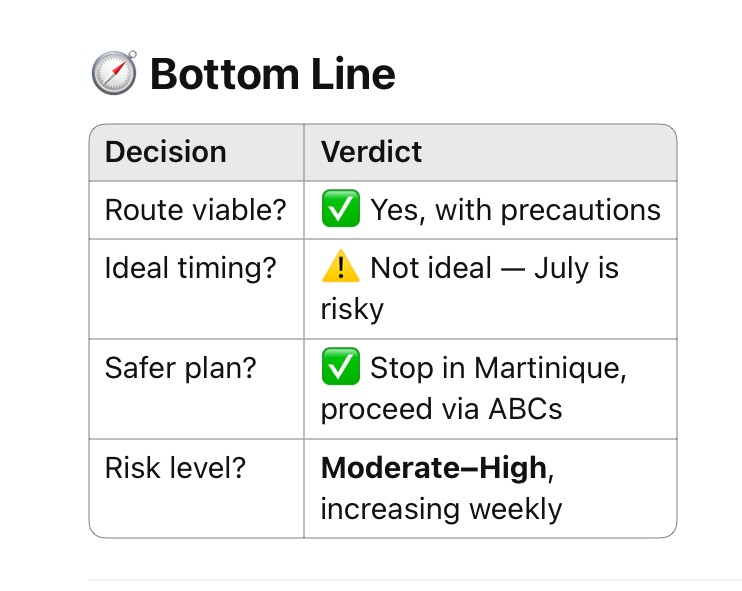
Sail St. Maarten → Martinique (mid-July) Use this to position south and prepare. Monitor the 10-day weather window. If a calm period opens: Option A (ABCs) is safer and gives more exit points. Option B (direct) only if highly experienced with weather routing. Stay flexible: if a storm brews, stay put in Martinique or hide in ABCs. Do not attempt to outrun a system.
🧾 What You Need
Storm tactics plan (Jordan series drogue or sea anchor) Real-time weather (Iridium GO, Starlink + PredictWind, or Garmin inReach) Safe ports list along the way Hurricane holes: Le Marin (Martinique), Kralendijk (Bonaire), Santa Marta marina
———-———-———-———-———-
Summary
Okay, it seems like the different sources are backing up each other.
This means, as long as there is no bigger weather system forming, the passage towards Martinique, and from Martinique through the ABCs either to Panama or Colombia, on paper should be doable.
This info is aligned with the next few weeks’ weather forecast, and with the sailors and ChatGPT has been generally sharing about the conditions.
BUT
If you have got so far reading this blog, that means you are an extremely loyal reader of mine, or reading in the title that there is an easter egg, you have simply figured it out that it should be at the end, for which I still need to give the credit to you.
And that means, if you fall under either of the two above categories – which is technically still possible, I owe you the truth.
The truth and my next steps
The truth is, I’m hitting the last nail into my no-fly project’s coffin, as I have already bought my flight tickets to Mexicocity and I’m flying out next Wednesday to meet my friend Pepe, who I’ve met during my college scholarship years. And then I’m descending down on land targetting Panama.
Apparently my tour guide in Guatemala only has a few weeks free in August, and I just couldn’t miss out on meeting her. So if there is someone to blame, that I have failed on my no-fly travel project big time, that’s her and her only. I’ll probably open up the floor for public blaming at one point. I’ll think about it.
If it wasn’t up to this meeting, I would have probably risked trying to get down by boat to Martinique, which in the end is a highly calculated risk, under the current moderate ocean water temperature conditions, as no high hurricane risks are at sight currently.
Forming thoughts about my travels and the Kiss.the.journey
It’s interesting, how this travel has started, fueled by anxieties towards flights and climate change. Somewhere, maybe, it wanted to be a testimony for environmental consciousness, that I have failed upon big time.
In fact, honestly, I don’t even know what it wanted to be. Looking back at myself 8-9 months ago, I was just a heartbroken guy after a long-term relationship break-up, with a lot of anxieties and with no future plans just wanting to live for the present, realizing that we are all mortal beings and we won’t live forever, so there is no real point of taking this life way too serious.
I managed to cross the ocean, I won’t cross the Caribbean sea for now, which leaves me with a bittersweet taste in my mouth, because somewhere, I know I could do it, I’ve been proven in multiple sea conditions and while it’s risky, the risks are still calculated and there is a fair amount of data to forecast the forming of hurricanes timely. So in short, I know it’s doable, I just won’t do it, because I have decided to prioritize other things, over the aim of this project.
So at this point, I’m kind of puzzled what my travels really are about. I know for sure, that it’s still a beautiful journey, that I’m forever grateful for to have happened to me. I honor every single moment I have, over the privilege of being able to do this.
A year ago I’ve been counting every dime in my pocket building up saving budgets, managing my savings and now I’m on the path of systematically burning it all up what I’ve been saving up. I just realized money is just a printed paper, nothing more. It’s still good, because it gave me access to this trip, but for that, I had to realize how it could be used beneficially. I have been building an empire of material things over my past years just to realize it’s all creating an illusion of comfort. And comfort is killing the human soul. My soul felt dried out last year and now it’s reviving. In fact, my heart got frozen and was incapable of producing normal human emotions, and it happened to me just a few weeks ago, probably after 10-11 months, that I’ve just started to cry desperately. Didn’t cry for a long time and it felt beautiful and relieving, that I’m still human.
So in short, something human is happening to me on this trip, that was not something I have necessarily anticipated to happen in such form.
But I guess that’s the absolute beauty about it, that I just didn’t see it coming.
I definitely came into this trip with an open heart and compassion to every living being, to see how far kindness can take me.
Let’s see how will it play out in the next chapter starting from Mexico!

