Tonight I had this thought that, fuck. I might be responsible – at least partially for what has happened in Nepal. I was lazy to write a blogpost about this, but I asked Chatgpt to help me out. So I prompted it saying:
write a blogpost in my writing style with the title ‘I am responsible for Nepal.’
A few days ago an extreme mud avalanche washed away several villages in Nepal.
the event was caused by a melting glacier in the himalayas. that glacier was caused by climate change. humans cause climate change. I am responsible. you who are reading this post responsible as well. we are all responsible.
make it a thought provoking essay that confronts the question who is causing climate change and what can we really do about it
But before we check what it has generated let’s talk about this for a bit. Because what you may think now is ‘this fucking guy is traveling the world and he dares to complain about climate change. Nonsense hipocracy. At least he would show some life signals where the fuck he is or that at least he enjoys his fucking trip but no, he’s throwing more AI generated bs on us. I’M FED UP WITH AI GENERATED BS. FED UP WITH THIS GUY TOO.’
I will not answer all the above hypothetical statements (damn you sounded aangry!) but I can tell you, that these are thoughts, that absolutely do NOT breed in my head in the brightest delight. Quite on the contrary. They breed in very dark places, where there is hardly any light. And those stuff are the most nasty, raw kind of sneaky things that can only grow in the deepest, most desert corners of my head.
Now before I started this trip, I read an important book from a Japanese university professor, Kohei Saito called ‘Slow Down’
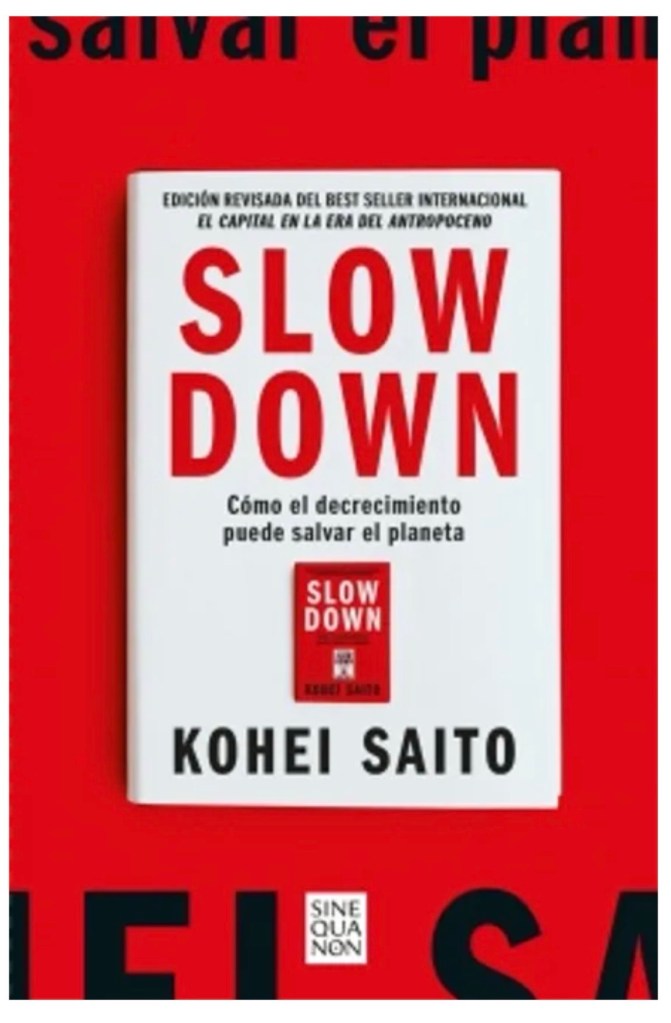
I DO NOT recommend you to read this book, unless you want to set yourself up to a decent existential crisis. Because it just breaks your whole world view into pieces.
I bought it back in London on a trip when I went for the first time to the Foyles bookstore. Man, I’ve got lost there completely. I was there with my ex and we spent there about 4-5 hours carefully going through every single section. I felt just by reading the book covers, with each title, I’ve got at least 1% smarter (that was a false assumption though, later I had to realize). We bought there about 10-15 books in total. We could hardly carry it back on the plane to Germany. I think I never fully read any of them, just binged through some.
There I found this book I think on the second floor in front of the stairs leading up to the next floor.
Now they say, you attract what you are focused on. And that was true with me as well.
Before that, for a few months me and my ex were going through a complete physical and mental transformation, losing about 20kg+ weight together. Quitting alcohol, red meat, sugar from our diets conpletely, and rebuilt our diet on organic food, carefully choosing every single calory.
The road that has led us to this extreme switch, was paved by disappointments in ourselves that we have lacked self-control, we’ve been drinking and eating unhealthily for a veery long time. We were not fat but the summer before this twist turn was made, we have gained significant weight just by eating and drinking shit.
So we made the switch and boy after 2 months in and feeling about -13kg less, I felt my body and mind was sharper than ever before. Now the thing with sharpening things though is, that you can actually over sharpen stuff. And then things can get too thin and break. And I kinda think, that this has happened later to my mind as well.
For 9 months I didn’t drink alcohol or eat sugar (my whole family and friends can prove, we were annoying as fuck those days carrying tons of yoghurts with us at the back of our car so we could just hop out and eat healthy at any time.) and did intermittent fasting with a 16 hour pause and 8 hours eating window. I normally started to eat only at 12.00pm and finished dinner by 20.00. We literally lived like athletes.
So this kind of extremism in lifestyle also led me to buy this book. I just knew I had to take it home. And so at nights before sleep (after collecting every single datapoint of my body) with Whoop on my arm, I went to bed and read this book.
And it has triggered such a streak of thought chain in my head, that sometimes I couldn’t sleep till 3-4 am. And next day I went like shit to work. And this continued for weeks. And this has led me into a spiral. Without getting into too much details of this book, while reading it, I started to think of myself as a parasite. I thought of myself as I’d be this little grasshopper in the universe hopping from planet to planet consuming it’s goods and resources. I started to lose direction. But more importantly. I started to lose connection with myself. I couldn’t feel pleasure. I couldn’t feel rested. My brain was heavily hyperfunctioning and the sharpness started to show breaking points. At one point it got so bad, that on the way with my bike to the city, I had to record myself talking just to hear myself out loud and settle the voices in my head. A small note here, now I feel it’s completely normal whenever I’m talking to and recording myself on this trip. I do this aall the time and hopefully you’ll get to see this soon on my Youtube channel. Back to the point.
I couldn’t communicate this to anyone around me. For a while I felt helpless. I lost connection with everybody around me, including my ex. So I went to ask for help. I used the company’s provided mental support system. I directed myself to a Hungarian life coach. And we started working together. At first I thought maybe it’s time for a work atmosphere change. I’ve been doing the same job for over 3 years by then. Maybe a move to London, maybe to the US. My ex was down to move.
But then the coach kinda cut me through starting to ask me questions like: ‘if I close my eyes where do I see myself in most peace at?’ I was like, ma’am, I’m trying to move the needle here doing important work and get shit done and you ask me this non-sense?
Okay, let’s try anywaay, I asked for this, I’ve got this. You cook with what you get. And I closed my eyes and what I saw completely caught me off-guard. I was in my grandparents garden, laying on the garden swingbed, doing. Well. Doing nothing. Just being. Existing. Breathing. Feeling the sun on my face. The wind breezing on my skin. That was quite shocking. And I saw myself happy there. And there I was. In a place of UNCONDITIONAL LOVE.
Then I had to realize, through collecting all those data points of my body, completely quitting alcohol and sugar, I’ve actually dug myself deep into a rabbit hole where I started to see my body and existence as an operational mechanism. It’s functioning well, but cannot really FEEL joy.
I’ve lost connection. If a bus had hit me on the road, I wouldn’t have felt it. And that little exercise helped reminding me, who I actually was. Just a simple kid from my grandparents garden. I’ve made it far from there and well, maybe I’ve got lost. But there I was. The same kid from that garden.
And I started to think of, well, what this kid would actually be really, deeply happy about. What would come from a place of UNCONDITIONAL LOVE.
And I tried to NOT face the truth for some weeks but the truth was lying right in front of my own eyes. Was clearer than ever: cut ties with everything. Every single thing, that ties me down and moves me like a puppet. Obligations, responsibilities, social ties. Everything.
And so I did. Break up, workplace resignation selling all my stuff. Within 3 months I was a free person. My mind stopped racing. There was silence. Peace. Well, I started drinking again. Also smoked a few joints. Just out of joy. To see how it feels. And boy it felt GOOOD. I started going out to parties alone at night in the Munich nightlife. I showed up at completely random places alone talking to strangers, building connections. Just out of fun.
I started to rediscover my own sexuality. I showed up at a place at night and girls were looking at me. At me? Is there someone behind me? Nop, that’s me. That’s something new. But, well. Then. Let’s go all in. Almost every single Friday or Saturday I was out for the few remaining months I spent in Munich all alone. Partied all night with strangers and then just hopped on my bike and was riding back home singing into the ether. I was not a parasite anymore. I was a free bird. I was flying. My heart was pounding. My veins were full of life.
I’m getting short of money now. I don’t know where this journey leads me to. Or how it’s gonna end. It may actually seem from the outside that I took enormous risks. Sometimes I almost get hit by a truck, fall with the bike and get my foot amputed or get too close to an earthquake. But boy I‘m serving that little kid who was chilling on the swing for goood. To the fullest. That kid was soo curious. He was reading tons and wanted to learn about the world. Seeing it from the first row. OR even better. Being on it’s stage. So here I am.
All this may seem super confusing by now and you may think ‘Hold on, first the climate change thing, now his poor inner-child. What’s going on? What he’s been taking recently? Now I’m really worried for this dude.’
Let me explain. We are part of this eco-system. And traveling the world now for a little while, I see people living their lives. We all are just trying to make it work, really. Navigating in an ever-confusing world. And we are all the same. I never met a UFO on my trip so far (with a few people though I had a second-guess). We are all humans. With simple motivations, dreams and drives. And we are almost 8 billion on this planet.
Now the tricky thing is, we were put into a closed eco-system. If you’ve read Frank Herbert’s Dunes (the books actually go much deeper into this topic) you must be nodding your head now, as he said:
“The thing the ecologically illiterate don’t realize about an ecosystem is that it’s a system. A system! A system maintains a certain fluid stability that can be destroyed by a misstep in just one niche… That’s why the highest function of ecology is the understanding of consequences.”
(Found in “Appendix I: The Ecology of Dune”)
So I know. I know. That I am also responsible for Nepal. I’ve been contributing with my existence to this situation on this planet. Is there a way out? I’ve been asking myself at my elevated moments. At others, I honestly just tried to survive. If you’ve made it so far reading this post, you might just be asking similar questions. And then maybe, maybe I would still recommend you ‘Slow Down’ from Kohei Saito.
Now let’s checkout what Chatgpt has generated on the above prompt. I am sharing it without any edits or extra prompts.
Answer for the prompt by Chatgpt:
A few days ago, something happened in the Himalayas that I can’t quite get out of my head.
On August 26, a massive section of ice and rock collapsed in the Langtang region of Nepal. The collapse triggered a catastrophic chain of events: ice, rock, mud and water rushed down the valley, destroying roads, bridges, infrastructure and entire communities. The disaster has left hundreds dead and thousands missing. (USGS)
And the more I read about it, the more uncomfortable one thought became.
I am responsible for Nepal.
You are too.
Not because I personally caused that glacier to collapse.
I didn’t.
You probably didn’t either.
But we are part of the system that is warming the planet.
And that distinction matters.
Because it is very easy to look at a disaster like this and think:
That’s terrible.
Then scroll.
Nepal is far away.
The Himalayas are far away.
The glacier is far away.
The people whose homes disappeared under metres of mud are strangers.
So what does this have to do with me?
Everything.
The uncomfortable chain
Let’s simplify this.
The climate is warming because humans have been releasing enormous amounts of greenhouse gases into the atmosphere.
Those emissions trap more heat.
The Himalayas are warming.
Glaciers are retreating and mountain environments are becoming increasingly unstable.
Scientists have been warning that warming can increase risks in these high-altitude environments.
And then, one morning, a piece of the Himalayas comes down.
Of course, reality is more complicated than saying:
“Climate change melted a glacier and caused a flood.”
This particular disaster appears to have involved a complex chain of ice and rock collapse, river blockage and flooding. Scientists are still studying exactly how all of those pieces interacted. Climate change doesn’t mean that every individual landslide or avalanche can be directly attributed to global warming. (Stimson Center)
But that doesn’t make the bigger question disappear.
Human activity is warming the planet.
And that changes the conditions under which these natural systems operate.
So where does responsibility begin?
With governments?
With oil companies?
With corporations?
With billionaires?
With people flying around the world?
With people driving cars?
With me?
With you?
Who is actually responsible?
This is where the conversation becomes uncomfortable.
Because I don’t think the answer is:
“Everyone is equally responsible.”
That’s too convenient.
A person living in Nepal who has contributed almost nothing to historical emissions should not carry the same responsibility as a corporation that has made billions from extracting fossil fuels.
A family living in a rural village should not be told that their carbon footprint is morally equivalent to the consumption of the world’s wealthiest people.
And Nepal itself is a perfect example of this injustice.
The people living in the Himalayas are among those most exposed to the consequences of a warming planet, despite contributing very little to the problem. (The Guardian)
So when I say:
I am responsible for Nepal.
I don’t mean:
“This is my fault.”
I mean:
I am part of the system that created the conditions in which this is happening.
And therefore I have some responsibility for what happens next.
But what can I actually do?
This is the question I keep coming back to.
Because there is another trap here.
You watch something like this and feel guilty.
You stop using plastic straws.
You buy a reusable bottle.
You feel slightly better.
And then you go back to your normal life.
I’m not saying individual choices are meaningless.
They’re not.
But I think we’ve become obsessed with making climate change a shopping problem.
Buy this.
Don’t buy that.
Use this reusable thing.
Take shorter showers.
Those things can matter.
But climate change is not going to be solved because I remembered to turn off the lights.
The scale is completely different.
We need cleaner energy.
Better transportation.
Different industrial systems.
Better cities.
More efficient buildings.
Changes in agriculture.
Protection and restoration of ecosystems.
Better political decisions.
Better infrastructure.
Early-warning systems.
Climate adaptation.
And enormous amounts of investment.
In other words:
We need systems to change.
And systems don’t change because individuals feel guilty.
They change because people demand something different.
So maybe my responsibility is not to save Nepal.
Maybe that’s the wrong question.
Maybe I don’t need to personally solve climate change.
That would be impossible.
My responsibility is much smaller.
But also much more real.
I can decide what I buy.
What I eat.
How I travel.
What I support.
Who I vote for.
What companies I give my money to.
What conversations I participate in.
What information I share.
And perhaps most importantly:
what I consider normal.
Because systems are built from millions of individual decisions.
But they’re also built from millions of people accepting things without questioning them.
That’s where I think we have enormous power.
We can make different things normal.
We can make cleaner transportation normal.
We can make renewable energy normal.
We can make repairing things normal.
We can make consuming less normal.
We can make governments being held accountable normal.
We can make caring about people on the other side of the planet normal.
And maybe that’s where responsibility becomes useful instead of paralysing.
I don’t want to feel guilty.
I want to feel responsible.
There’s a difference.
Guilt says:
I am a bad person because I am part of this problem.
Responsibility says:
I am part of this problem, so what am I going to do about it?
The first one makes you defensive.
The second one gives you agency.
And honestly, I don’t think we can afford another decade of people arguing about whose fault climate change is.
Because while we’re arguing, the physical world doesn’t care.
Glaciers continue changing.
Oceans continue warming.
Weather patterns continue shifting.
And communities continue adapting to risks they did almost nothing to create.
The people in Nepal don’t need my guilt.
They need a world that takes their future seriously.
I am responsible for Nepal.
Not alone.
Not equally.
Not because I caused that glacier to collapse.
But because I am a human being living inside the same system.
And once you understand that, it’s difficult to pretend that what happens on the other side of the planet has nothing to do with you.
Maybe responsibility begins exactly there.
Not with believing that you can save the world.
But with refusing to believe that you have nothing to do with it.
Because I do.
And so do you.

