Day 645: What did I learn after making 2 Youtube videos and where I need to improve

She sells seashells on the seashore.

Funny where inspiration can come from. Somewhere October 2025, while still in Guatemala, I’ve been going through a darker period of my trip, this heartbreak thing, that I detailed in one of the earlier posts.

I’ve been heavily listening to Ren, an otherworldly talented Welsh rapper, whose song Money Game pt 2 had these lines. Going through this heavier period, I could incredibly resonate with his songwriting.

Once I listened to these lines, I came to an awkward realization.

I have to keep the footage I make for myself, because it only has value, if it gets presented in a format, that worths watching. Instagram stories have the potential to keep your attention span for 10 seconds tops to boost your dopamine level instead of the morning coffee, while sitting on the metro trying to kill your time, but not much more. And the more I’ve invested into creating content, the more impact I wanted to make. At one point you just have to draw the line if something worths putting your effort into. So I’ve just stopped sharing any information of where I went for the following year. Even my closest circle hardly knew about anything about where I went. It wasn’t easy – especially not for my mom who hasn’t seen his child (I know I’m a big ass grown man but I’m still her child) for almost 2 years – you can imagine. And I did continue my trip though, but I intentionally shared photos that gave you very little context of where I was, what I was going through or what I was doing, simply because I wanted to boost the value of the raw footage I was making. I’ve been going through these videos a few weeks ago, and without being biased (or trying not to) I can say, that it has potential.

I heavily invested into making better footage as well.

I bought some action cameras that sit well on my motobike (also upgraded the motobike to a proper tourbike over time) and a drone too, so I can make fancy 4k aerial footage. Now, after hundreds of hours of footage taken during this period, I’m working on to make this presentable for you in a meaningful way. You might not care, I do. It’s a bigger challenge for me at this point than going down to Patagonia. Patagonia is not all that far away anymore. I could drive down from here in about 3 stretched weeks if I wanted.

Down with 2 youtube episodes, and I already have an imaginery future lunch date.

If all goes as planned, I can start releasing episodes soon on a weekly basis. I haven’t been putting so much effort into things like into this one for a long time.

And I’m on a slippery slope, because there is absolutely no guarantee if this will work out. Burning my own cash in a foreign country, my mom says, I’m wasting my time. I want to see that I don’t. And honestly, I always had a vision with this. I’ve been filming through the past almost 2 years while on this trip and it’s only a matter of how a story is being presented. I’m a maniac making this vision a reality.

While I’ve been already working on videos in Guatemala for a language school and in Honduras for a coffee farm and for a dive school, but – and I wasn’t expecting this, launching my own Youtube channel is an exponentially bigger effort.

I could reduce the prod cycle turnover time, but I would need a team around me.

An editor, someone who goes through the raw footage, someone who gives directorial directions, a team I obviously don’t have. So here I am the one man army with Chatgpt.

I’m fighting with my own perfectionism.

Perfectionist me tries to get every single music, video transition, animation, effect, coloring, every single micro-second right. And that’s why I only have 2 videos done after almost 3 weeks of staying where I’m at right now.

And now I need to speed up because I’ve wasted so much time. Okay, I haven’t wasted it, I’m learning. But it still takes more time, than what I’ve initially expected.

They will obviously don’t look always right, because I hardly have any experience on this field, but at least I can try. And trying costs me time, money and energy.

I want to produce at least 6-10 more episodes while I’m here.

I’ve transformed into this strategist Youtuber guy without having any videos on my Youtube channel. Or there were, but they either didn’t add up to the storyline or they were just so bad quality that I had to delete them. Funny, isn’t it? I’m the first Youtuber without Youtube videos.

Since I’m at about day 550 going from Hungary to Patagonia, I won’t be able to make a classical travel vlog, but maybe that’s my actual advantage. Because I already have so many experiences from this trip under my belt, that I can start reframing them into actual learnings and conclusions drawn, that are part of a bigger transformation and personal growth.

I realized the prod-cycle for a video took me too long, so I need to cut it and stick to it, whatever it takes.

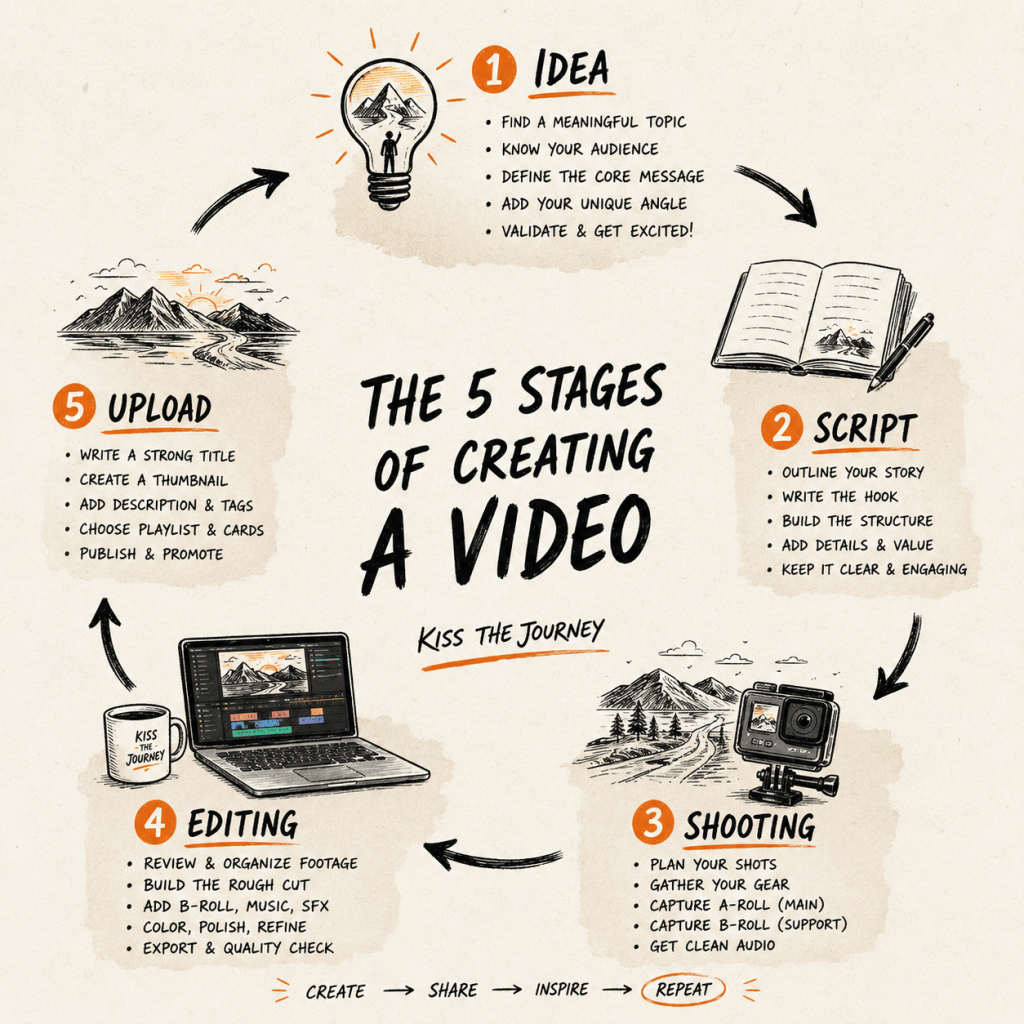
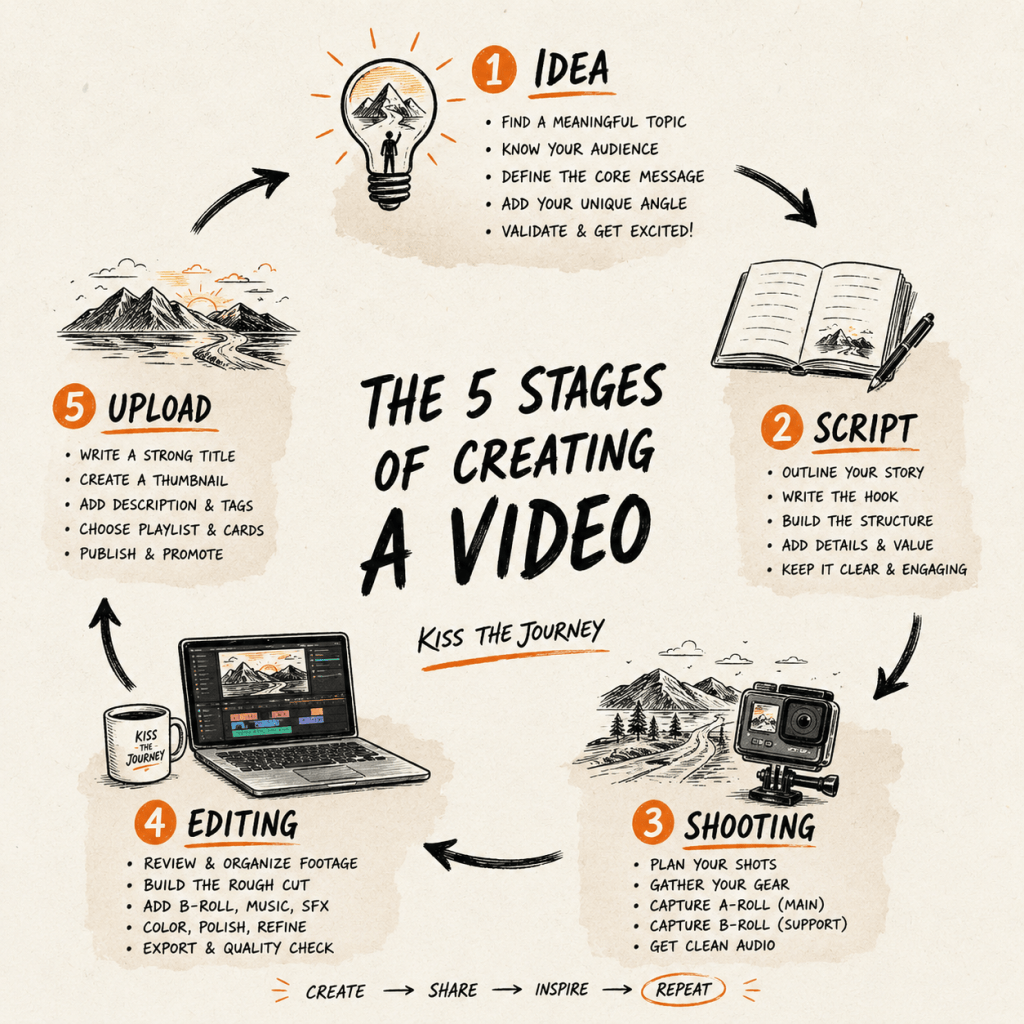
I’m working with Chatgpt to build a sustainable-cycle that is followable also, if I get to continue my travels. I have to say, I’ve been improving with each video, ever since I’ve started this trip. My first video had 5 pictures and one motion picture jointed together and in these Youtube episodes there is a production plan followed by a complete production cycle.

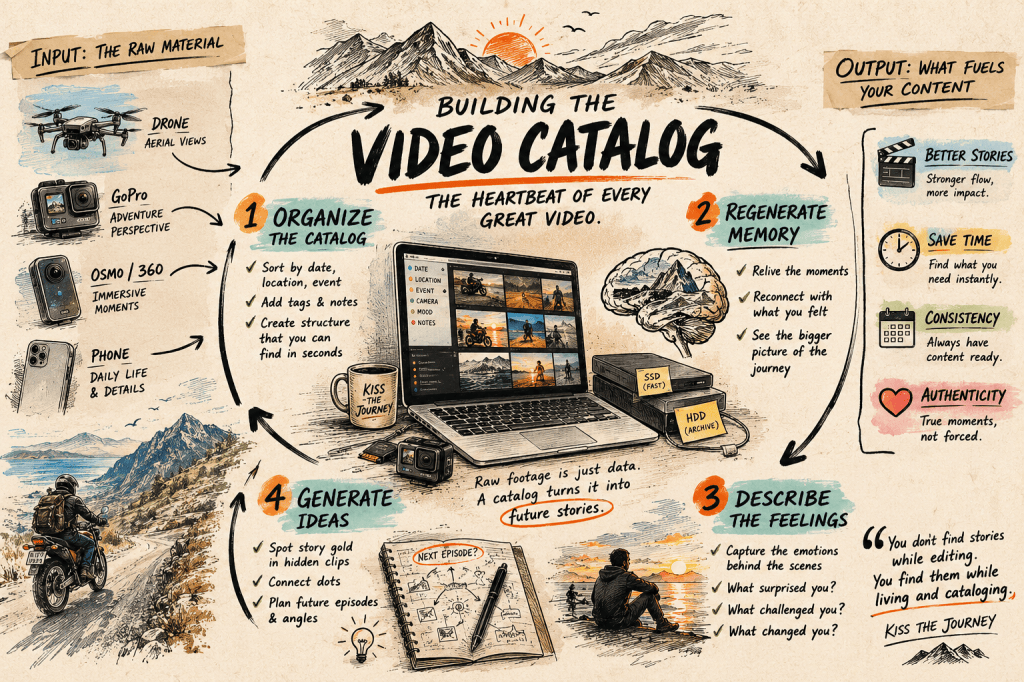
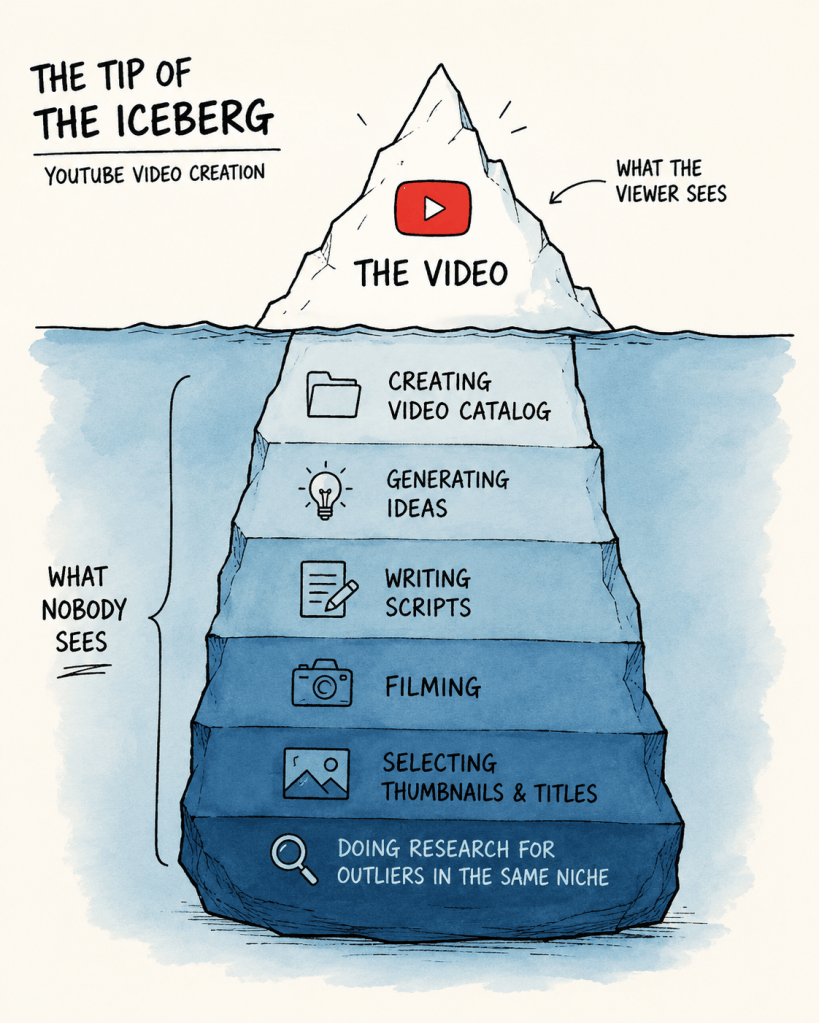
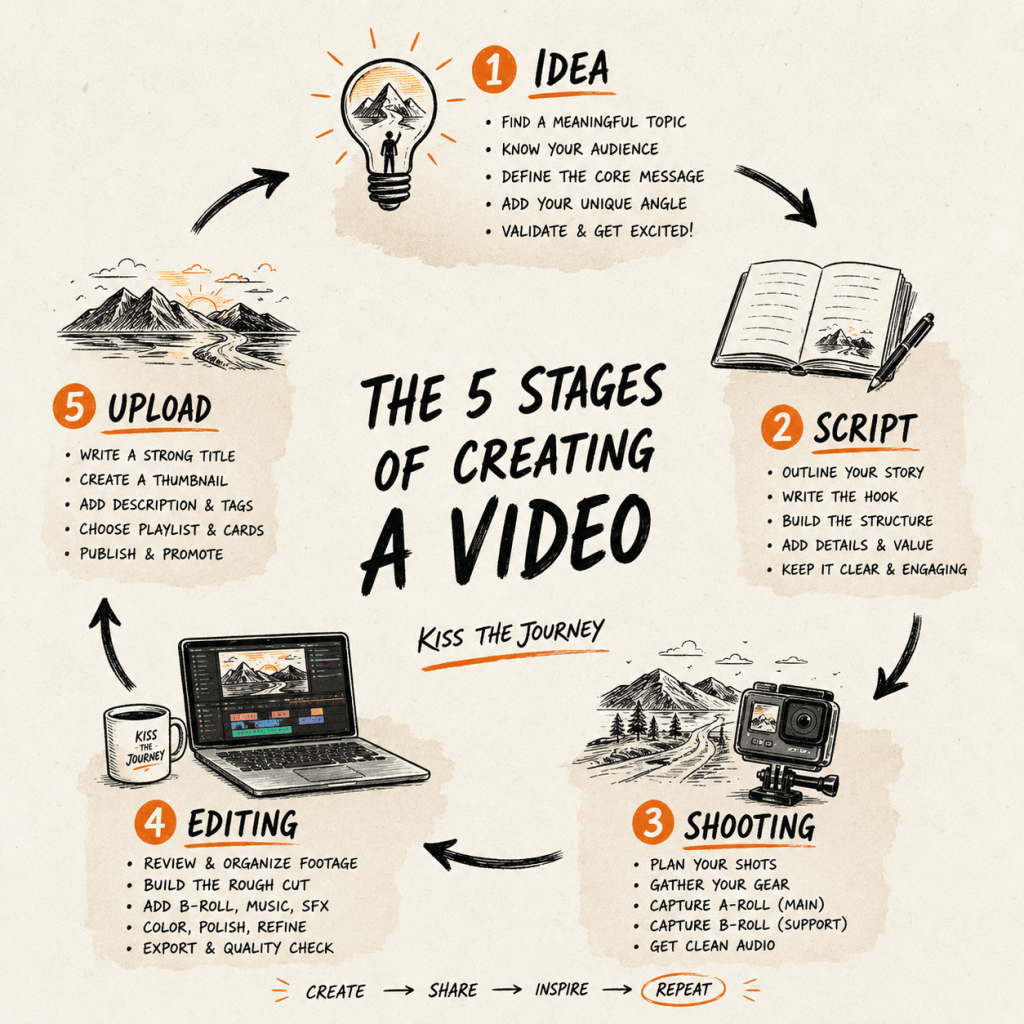
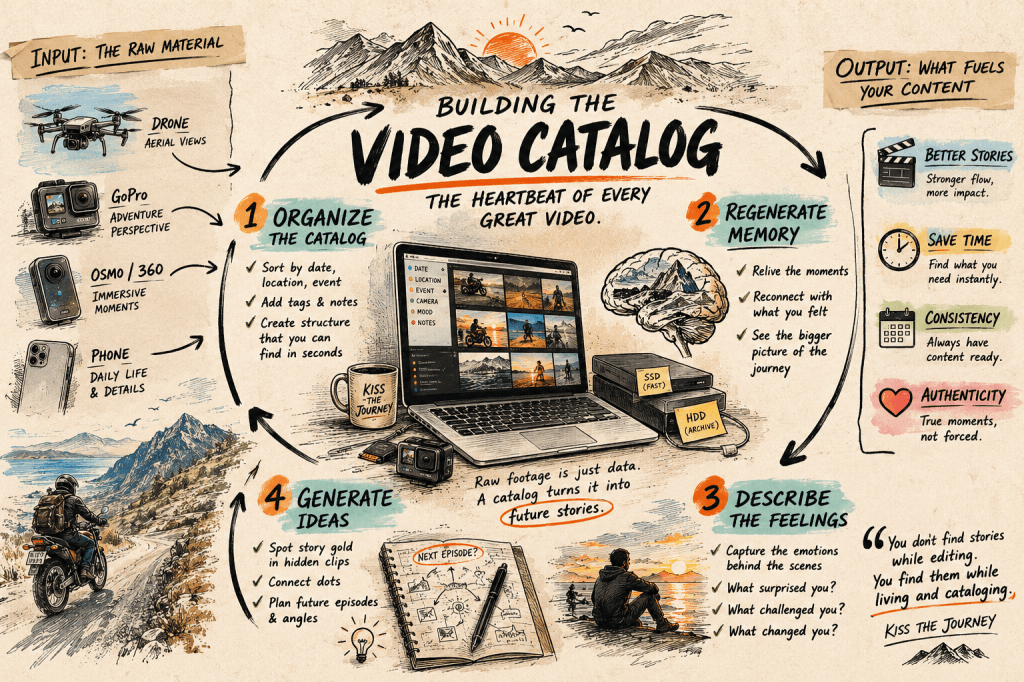
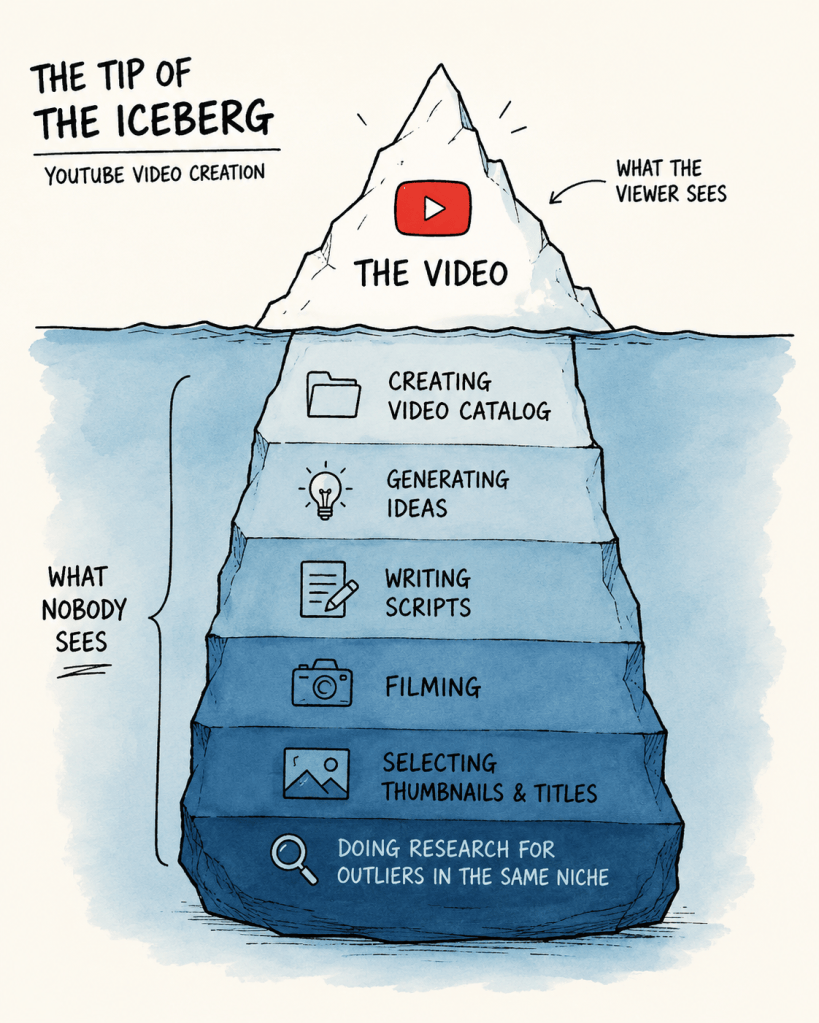
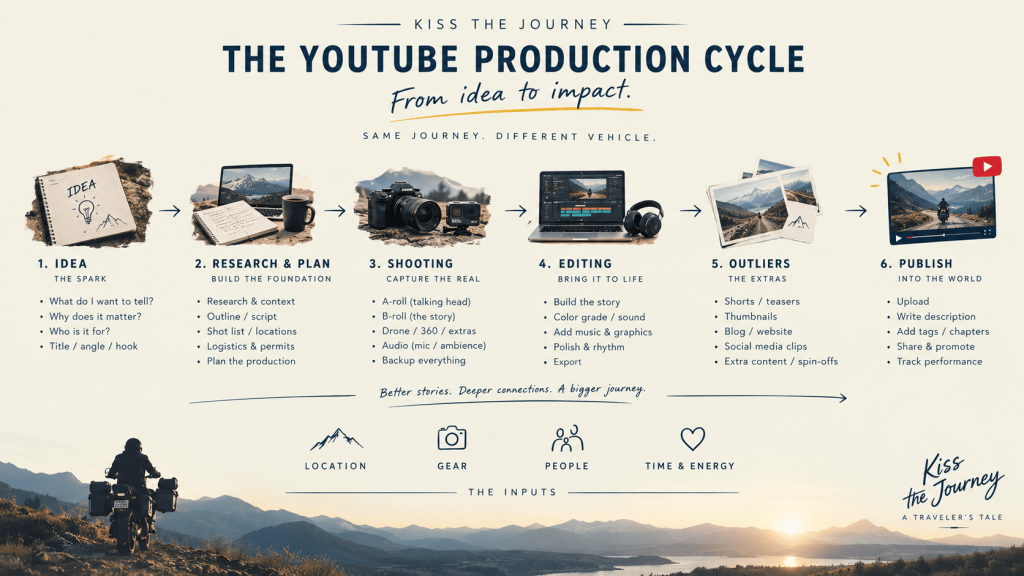
Youtube videos work well, if they follow an up-to downstream cycle, where everything starts with an idea and the last piece is the video itself.
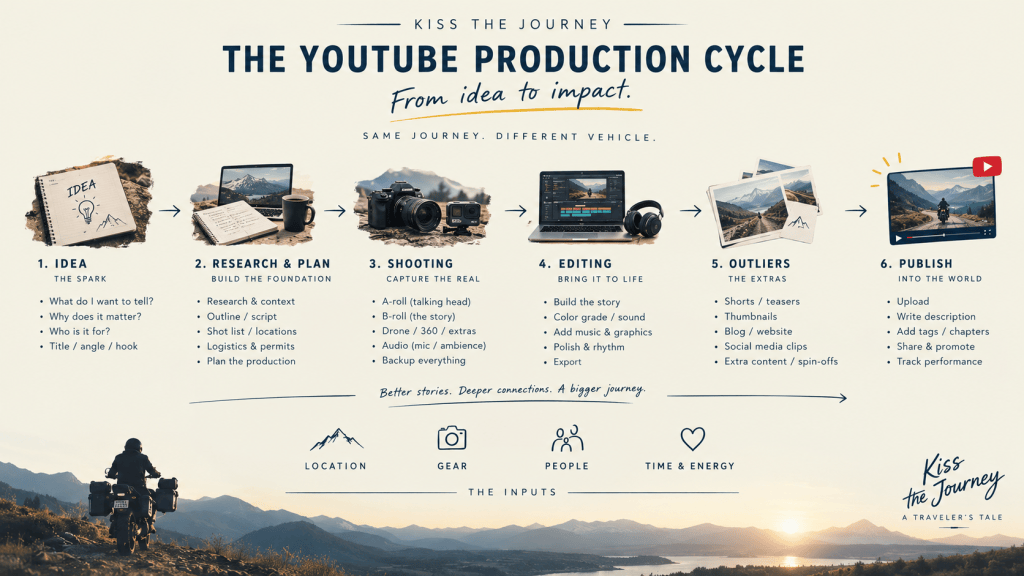
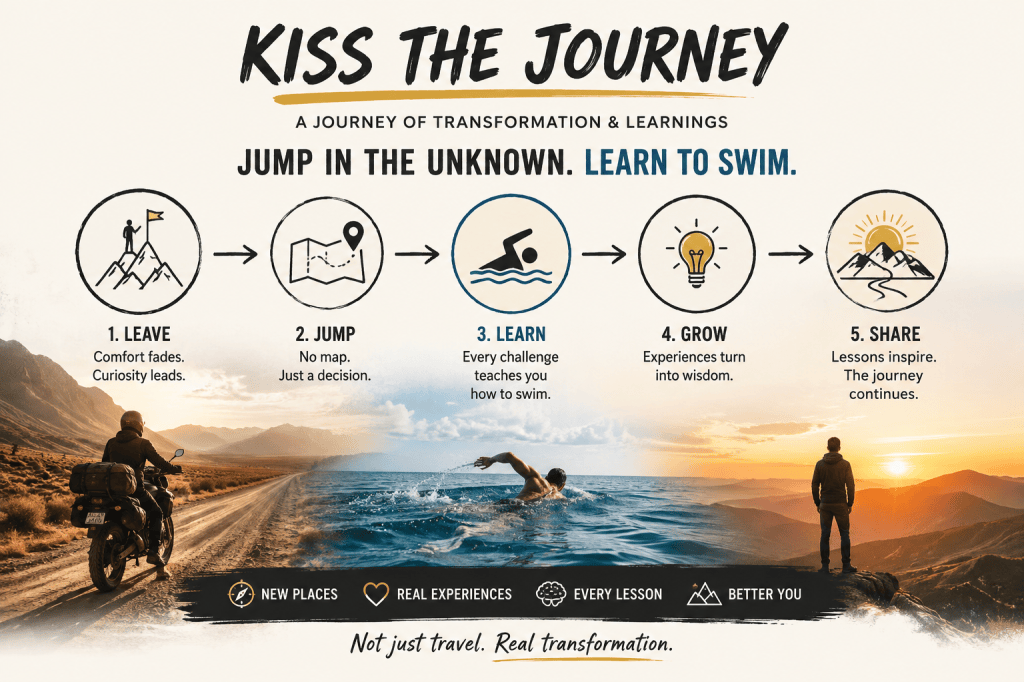
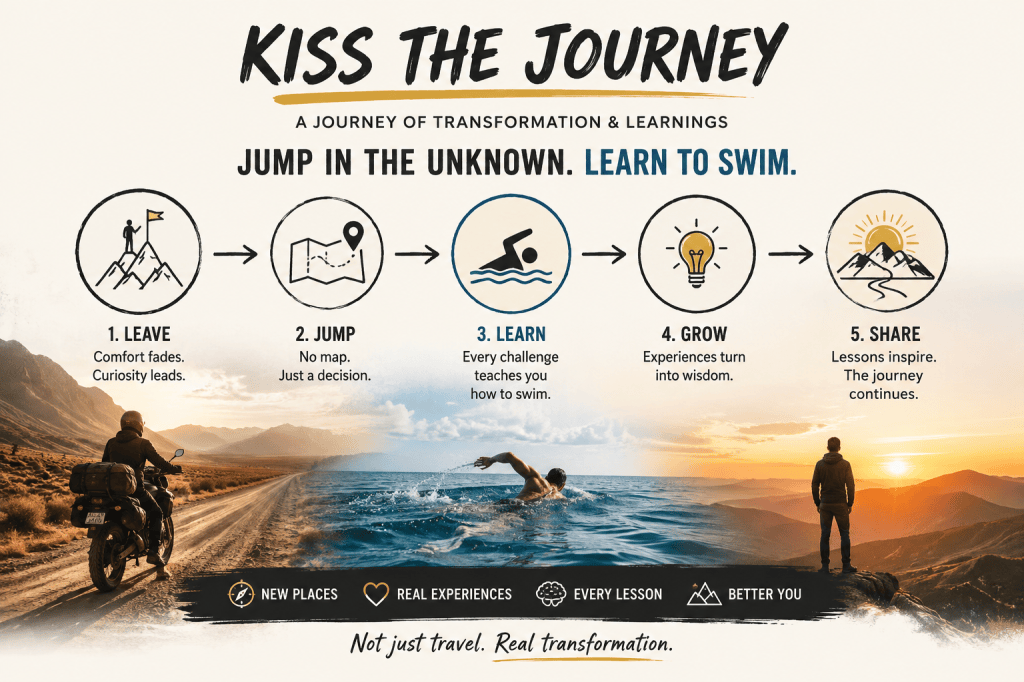
Source: Chatgpt

Just a disclaimer, but I don’t know if you have realized, that I’ve been using Chatgpt shamelessly as a source for these photos. What AI is great at, is to decompose tangled thoughts and cut through to clarity. So I’m using it to structure my thoughts and untangle my ideas when I get confused. The sad part is – that I have to acknowledge, that AI works best if you feed more data to it. And I’ve been heavily feeding it with my lifestory for the past months. Seeing AI becoming rapidly and scarily smarter, I doubt that’s a good thing. But well. Exitus acta probat.

Since I’m learning a completely new craft from scratch, it’s important to accept the limitations of my skills and that whatever I’m doing, I’m pretty much all doing for the first time. I’m not a filmmaker but with AI, I’ve been empowered to think like one.

I think it’s important that whatever I produce, is my production and the viewer or reader don’t feel, that it comes from AI.

People cannot vive with AI, but they can vive with other people. They can resonate with other people’s emotional journey, struggle, honesty.

Also had never thought – and this is a big plus, because I’ve been missing this part of my life, I can finally get use of my acting skills I learned on stage.

Now I have to rewire to a 3 day prod-cycle where at the end of each 3rd day a video gets produced, without exceptions. So let’s have a look at that. Of course the source is Chatgpt here as well.

THE 3-DAY PRODUCTION CYCLE

The goal

One finished video every 3 days.

Not one perfect video every 10 days.

The purpose of this system is to create good, meaningful, sustainable videos while continuously improving through repetition.

For the next 3 weeks, the priority is:

Make → Publish → Learn → Make again.


DAY 1 — THINK & WRITE

Goal: Finish the creative plan.

Maximum time: 4–5 hours

By the end of Day 1, I need:

  • One clear idea
  • One strong hook
  • One story
  • One emotional point
  • One useful takeaway
  • A 70–80% finished A-roll script
  • A simple B-roll list
  • A shooting plan

The key question

What should the viewer think or feel after watching this that they didn’t think or feel before?

If I can’t answer this clearly, the video isn’t ready to shoot.

Important rule

The script does not need to be perfect.

It needs to be clear enough to shoot.

Leave room for natural delivery, improvisation and things that happen while filming.


DAY 2 — SHOOT

Goal: Capture everything needed to tell the story.

Maximum time: 3–4 hours

A-ROLL

Maximum 2 takes per section.

Take 1: Natural delivery
Take 2: Improve what didn’t work

Then move on.

Do not keep repeating a section because:

“I know I can say this better.”

I probably can.

But the goal isn’t the theoretically perfect performance.

The goal is natural, clear and emotionally believable.


B-ROLL

Don’t spend hours searching for the perfect shot.

For each major section, aim for:

  • 1 establishing shot
  • 1 medium shot
  • 1 detail shot
  • 1 movement shot
  • 1 emotional / atmospheric shot

Then stop.

Use existing footage whenever possible.

The B-roll library exists to make production easier, not to create another perfectionist rabbit hole.


DAY 3 — EDIT & FINISH

Goal: Complete the video and release it.

This is where perfectionism will be strongest.

So every edit decision gets classified into one of three categories.

TIER 1 — MUST FIX

Fix anything that genuinely damages the viewer’s experience:

  • The story doesn’t make sense
  • The opening is boring or confusing
  • Bad audio
  • Missing context
  • Confusing pacing
  • Repetition that hurts the story
  • Something objectively distracting

Fix it.


TIER 2 — SHOULD FIX

Things that would improve the video, but aren’t critical:

  • An awkward transition
  • A slightly weak B-roll choice
  • A repetitive sentence
  • A pacing issue
  • Music that could fit better
  • A shot that could be slightly stronger

Fix these if there is time.


TIER 3 — IGNORE

This is where perfectionism lives.

  • “Maybe this shot would look cooler.”
  • “What if I change the music?”
  • “Maybe the color grade could be slightly better.”
  • “I could make this transition more cinematic.”
  • “Maybe I should find another B-roll sequence.”
  • “The subtitle could be positioned slightly differently.”
  • “I could spend another hour polishing this.”

Don’t.

If it doesn’t materially improve the viewer’s experience, leave it.


THE GOOD-ENOUGH TEST

Before exporting, ask:

1. Would I personally click this?

2. Does the first 30 seconds make me want to continue?

3. Do I understand why this story matters?

4. Does it make me feel something?

5. Is there at least one thing I’ll remember tomorrow?

6. Is anything objectively broken?

If the answers are:

YES / YES / YES / YES / YES / NO

EXPORT.

Even if I can still see things I could improve.


THE 3-WEEK SPRINT

DayFocusOutput
1Think + WriteVideo 1 ready to shoot
2ShootVideo 1 filmed
3Edit + FinishVideo 1 published
4Think + WriteVideo 2 ready to shoot
5ShootVideo 2 filmed
6Edit + FinishVideo 2 published
7Think + WriteVideo 3 ready to shoot
8ShootVideo 3 filmed
9Edit + FinishVideo 3 published
10Think + WriteVideo 4 ready to shoot
11ShootVideo 4 filmed
12Edit + FinishVideo 4 published
13Think + WriteVideo 5 ready to shoot
14ShootVideo 5 filmed
15Edit + FinishVideo 5 published
16Think + WriteVideo 6 ready to shoot
17ShootVideo 6 filmed
18Edit + FinishVideo 6 published
19–21Buffer / OptionalVideo 7 if energy allows

Target: 6 videos.

Stretch goal: 7 videos.

Video 7 is not mandatory.

The buffer exists because travel is unpredictable and because a sustainable system needs room for reality.


THE RULES FOR THESE 3 WEEKS

1. Don’t make every video a masterpiece.

Make every video worth watching.

2. Don’t confuse effort with quality.

More hours do not automatically create a better viewer experience.

3. Don’t optimize things the viewer won’t notice.

Spend your best energy on:

Story → Emotion → Clarity → Hook → Pacing

Not tiny details.

4. Two takes is enough.

Natural beats perfect.

5. Existing footage is allowed.

I don’t need to shoot everything specifically for the video.

6. When the video passes the Good-Enough Test, publish.

No additional polishing without a specific reason.

7. The objective is repetition.

Make → Publish → Observe → Learn → Repeat.


THE REAL EXPERIMENT

The next three weeks aren’t about proving whether the channel will succeed.

They’re about increasing the number of opportunities to discover what actually works.

Six strong experiments will teach me more than two heavily polished experiments.

Some videos may underperform.

That’s not failure.

A video that underperforms still gives me information.

A video that resonates gives me information.

A video that takes half the time to produce gives me information.

The goal is to build a production system that can survive travel, uncertainty, pressure and real life.


THE ONE QUESTION TO REMEMBER

Whenever I feel the urge to keep polishing:

“Will making this better materially improve the viewer’s experience?”

If yes:

Do it.

If no:

Ship it.

Good enough is not the goal.

Sustainable excellence is the goal.
645. nap: Mit tanultam 2 YouTube-videó elkészítése után, és min kell még javítanom

She sells seashells on the seashore. Kagylóhéjat akar eladni a tengerparton.

Vicces, honnan jöhet az inspiráció.

Valamikor 2025 októberében, még Guatemalában, az utazásom egy sötétebb időszakán mentem keresztül – azon a szívfájdalmon, amelyről az egyik korábbi posztomban részletesebben is írtam.

Rengeteget hallgattam Rent, azt az elképesztően tehetséges walesi rappert, akinek a Money Game pt 2 című dalában vannak ezek a sorok. Akkoriban ebben a nehezebb időszakban elképesztően tudtam azonosulni a stílusával.

Amikor meghallottam ezeket a sorokat, egy kissé kellemetlen felismerésre jutottam.

Meg kell tartanom magamnak azt a felvételt, amit készítek az út során, mert csak akkor van valódi értéke, ha olyan formában mutatom be, amit tényleg érdemes lehet megnézni.

Az Instagram-sztorik talán arra jók, hogy 10 másodpercig lekössék a figyelmedet, és egy kis dopaminlöketet adjanak a reggeli kávé helyett, miközben a metrón ülsz és próbálod valamivel elütni az időt. De ennél sokkal többre nem igazán.

És minél többet fektettem a tartalomkészítésbe, annál komolyabban szerettem volna hatni az emberekre.

Egy ponton egyszerűen meg kell húznod a határt, és el kell döntened, hogy valami megéri-e a belefektetett energiát.

Ezért a következő évben egyszerűen nem osztottam meg, hogy merre jártam.

Még a hozzám legközelebb állók is alig tudták, hogy hol vagyok.

Nem volt könnyű – különösen anyukámnak, aki közel két éve nem látta a gyerekét. (Tudom, hogy egy nagy, felnőtt férfi vagyok, de attól még továbbra is az ő gyereke.)

Közben persze folytattam az utazást, de szándékosan olyan fotókat osztottam meg, amelyekből nagyon kevés kontextust lehetett leszűrni arról, hogy hol vagyok, min megyek keresztül vagy mit csinálok.

Egyszerűen azért, mert növelni akartam annak a nyers felvételnek az értékét, amit közben készítettem.

Néhány hete elkezdtem újra átnézni ezeket a videókat, és minden elfogultság nélkül – vagy legalábbis megpróbálva nem elfogultnak lenni – azt mondhatom, hogy van bennük potenciál.

Rengeteget fektettem abba is, hogy jobb felvételeket készítsek.

Vettem néhány akciókamerát, amelyek jól használhatók a motoromon (közben magát a motort is egy rendes túramotorra cseréltem), és vettem egy drónt is, hogy menő 4K-s légifelvételeket készíthessek.

Most, több száz órányi felvétellel a hátam mögött, azon dolgozom, hogy mindezt valamilyen értelmes és számodra is jelentőségteljes formában mutassam be.

Lehet, hogy téged nem érdekel.

Engem igen.

Jelenleg ez nagyobb kihívás számomra, mint eljutni Patagóniába.

Patagónia már nincs is olyan messze.

Ha akarnám, innen körülbelül három megfeszített hét alatt le tudnék vezetni oda.

Két YouTube-epizóddal beljebb, és már van egy képzeletbeli jövőbeli premieridőpont.

Ha minden a tervek szerint alakul, hamarosan heti rendszerességgel elkezdhetem kiadni az epizódokat.

Régóta nem fektettem ennyi energiát valamibe.

És egy csúszós lejtőn vagyok, mert egyáltalán nincs garancia arra, hogy ez működni fog.

A saját pénzemet égetem egy idegen országban.

Anyukám szerint csak az időmet pazarolom.

Én pedig szeretném bebizonyítani, hogy nem így van.

És őszintén szólva mindig is volt egy elképzelésem erről.

Az elmúlt közel két évben folyamatosan filmeztem az utazásom során.

Most már csak az a kérdés, hogyan tálalom ezt a történetet.

Én pedig megszállott vagyok abban, hogy ezt a víziót valósággá tegyem.

Korábban már dolgoztam videókon Guatemalában egy nyelviskolának, Hondurasban pedig egy kávéfarmnak és egy búváriskolának.

De – és erre egyáltalán nem számítottam – a saját YouTube-csatornám elindítása exponenciálisan nagyobb erőfeszítés.

Le tudnám rövidíteni a gyártási ciklus átfutási idejét, de ehhez egy csapatra lenne szükségem.

Egy vágóra.

Valakire, aki végignézi a nyers felvételeket.

Valakire, aki rendezői irányt ad.

Egy csapatra, amivel nyilvánvalóan nem rendelkezem.

Így hát itt vagyok:

egyszemélyes hadsereg ChatGPT-vel.

Közben pedig a saját maximalizmusommal is harcolok.

A maximalista énem minden egyes zenét, videóátmenetet, animációt, effektet, színkorrekciót és minden egyes mikroszekundumot tökéletesre akar csinálni.

És pontosan ezért van mindössze két kész videóm közel három hét után, amit eddig itt töltöttem.

Most pedig gyorsítanom kell, mert rengeteg időt elhasználtam.

Persze, nem elvesztegettem.

Tanulok.

De ettől még több időt vesz igénybe, mint amire eredetileg számítottam.

Nyilván nem mindig fognak jól kinézni, mert ezen a területen alig van tapasztalatom.

De legalább megpróbálhatom.

A próbálkozás pedig időbe, pénzbe és energiába kerül.

Legalább 6–10 további epizódot szeretnék elkészíteni, amíg itt vagyok.

Stratégává váltam, aki YouTube-ról beszél, miközben még egyetlen videó sincs a YouTube-csatornámon.

Vagyis voltak, de vagy nem illettek bele a történetbe, vagy egyszerűen annyira rossz minőségűek voltak, hogy törölnöm kellett őket.

Vicces, nem?

Én vagyok az első YouTuber YouTube-videók nélkül.

Mivel körülbelül az 550. napnál járok a Magyarországtól Patagóniáig tartó utamon, nem fogok tudni klasszikus utazós vlogot készíteni.

De lehet, hogy ez valójában az előnyöm.

Mert már annyi tapasztalat van mögöttem ebből az utazásból, hogy elkezdhetem ezeket valódi tanulságokká és következtetésekké formálni.

Olyan tanulságokká, amelyek egy nagyobb átalakulás és személyes fejlődés részét képezik.

Rájöttem, hogy túl sokáig tart egy videó gyártási ciklusa.

Ezért le kell rövidítenem, és ragaszkodnom kell hozzá, bármi történjen is.

A ChatGPT-vel azon dolgozom, hogy kialakítsunk egy fenntartható gyártási ciklust, amelyet akkor is tudok követni, ha közben tovább utazom.

Azt kell mondanom, hogy az utazás kezdete óta minden egyes videóval fejlődtem.

Az első videómat öt fénykép és egy mozgókép összefűzésével készítettem.

Ezeknél a YouTube-epizódoknál viszont már van egy gyártási terv, amelyet egy komplett gyártási ciklus követ.

A YouTube-videók akkor működnek jól, ha egy upstreamtől downstreamig haladó ciklust követnek, ahol minden egy ötlettel kezdődik, és az utolsó elem maga a videó.

Forrás: ChatGPT

Egy gyors disclaimer:

Nem tudom, feltűnt-e, de szégyentelenül használom a ChatGPT-t ezeknek a képeknek a forrásaként.

Amiben az AI igazán jó, az az összekuszálódott gondolatok lebontása és a tisztánlátás felé vezető út lerövidítése.

Én arra használom, hogy strukturáljam a gondolataimat, és kibogozzam az ötleteimet, amikor összezavarodom.

A szomorú része viszont az, hogy el kell ismernem:

az AI annál jobban működik, minél több adatot adsz neki.

Én pedig az elmúlt hónapokban nagyon sokat adtam neki az életem történetéből.

Látva, hogy az AI milyen gyorsan és ijesztő módon válik egyre intelligensebbé, kétlem, hogy ez jó dolog.

De hát:

Exitus acta probat.

A cél szentesíti az eszközt.

Mivel teljesen a nulláról tanulok egy új szakmát, fontos elfogadnom a saját képességeim korlátait.

Bármit is csinálok, szinte mindent először csinálok.

Nem vagyok filmes.

De az AI segítségével képessé váltam úgy gondolkodni, mint egy filmes.

Azt gondolom, fontos, hogy bármit is készítek, az az én produkcióm legyen.

A néző vagy az olvasó pedig ne érezze azt, hogy az AI készítette.

Az emberek nem tudnak együtt érezni az AI-jal.

Más emberekkel viszont igen.

Az emberek tudnak kapcsolódni más emberek érzelmi útjához, küzdelmeihez, őszinteségéhez.

Arra sem gondoltam korábban, hogy – és ez egy hatalmas plusz, mert ez a része hiányzott az életemből – végre újra használhatom a színpadon tanult színészi képességeimet.

Most pedig át kell állnom egy 3 napos gyártási ciklusra, amelynek végén minden harmadik nap elkészül egy videó.

Kivétel nélkül.

Nézzük meg.

Természetesen itt is a ChatGPT volt a forrás.

A 3 NAPOS GYÁRTÁSI CIKLUS

A cél

Háromnaponta egy kész videó.

Nem tíznaponta egy tökéletes videó.

Ennek a rendszernek a célja, hogy jó, tartalmas, fenntartható videókat készítsek, miközben az ismétlésen keresztül folyamatosan fejlődöm.

A következő három hétben a prioritás:

Készíts → Publikálj → Tanulj → Készíts újra.


1. NAP — GONDOLKODJ ÉS ÍRJ

Cél: A kreatív terv befejezése.

Maximum idő: 4–5 óra

Az 1. nap végére szükségem van:

  • Egy világos ötletre
  • Egy erős hookra
  • Egy történetre
  • Egy érzelmi pontra
  • Egy hasznos tanulságra
  • Egy 70–80%-ban kész A-roll forgatókönyvre
  • Egy egyszerű B-roll listára
  • Egy forgatási tervre

A kulcskérdés

Mit gondoljon vagy mit érezzen a néző a videó végén, amit előtte még nem gondolt vagy érzett?

Ha erre nem tudok világosan válaszolni, a videó még nem áll készen a forgatásra.

Fontos szabály

A forgatókönyvnek nem kell tökéletesnek lennie.

Csak annyira kell világosnak lennie, hogy le lehessen forgatni.

Hagyjunk teret a természetes előadásnak, az improvizációnak és azoknak a dolgoknak, amelyek forgatás közben történnek.


2. NAP — FORGASS

Cél: Minden szükséges felvétel elkészítése a történet elmeséléséhez.

Maximum idő: 3–4 óra

A-ROLL

Maximum 2 felvétel szekciónként.

1. felvétel: természetes előadás

2. felvétel: javítsd azt, ami nem működött

Aztán tovább.

Ne ismételj egy szekciót újra és újra azért, mert:

„Tudom, hogy ezt jobban is el tudom mondani.”

Valószínűleg igen.

De a cél nem az elméletileg tökéletes előadás.

A cél:

természetes, világos és érzelmileg hiteles előadás.


B-ROLL

Ne tölts órákat a tökéletes felvétel keresésével.

Minden nagyobb szekcióhoz törekedj erre:

  • 1 establishing shot
  • 1 medium shot
  • 1 részletkép
  • 1 mozgó felvétel
  • 1 érzelmi / atmoszférikus felvétel

Aztán állj meg.

Használj meglévő felvételeket, amikor csak lehet.

A B-roll könyvtár azért létezik, hogy megkönnyítse a gyártást.

Nem azért, hogy újabb maximalista nyúlüreget hozzon létre.


3. NAP — VÁGJ ÉS FEJEZD BE

Cél: A videó befejezése és publikálása.

Itt lesz a legerősebb a maximalizmus.

Ezért minden vágási döntést három kategória egyikébe sorolok.

1. SZINT — EZT MUSZÁJ JAVÍTANI

Javíts ki mindent, ami ténylegesen rontja a nézői élményt:

  • A történet nem érthető
  • Az eleje unalmas vagy zavaros
  • Rossz a hang
  • Hiányzik a kontextus
  • Zavaró a tempó
  • Az ismétlés rontja a történetet
  • Van valami, ami objektíven zavaró

Javítsd ki.


2. SZINT — EZT JÓ LENNE JAVÍTANI

Olyan dolgok, amelyek javítanák a videót, de nem kritikusak:

  • Egy ügyetlen átmenet
  • Egy kissé gyenge B-roll választás
  • Egy ismétlődő mondat
  • Egy tempóbeli probléma
  • Egy zene, amely jobban is illene
  • Egy felvétel, amely lehetne egy kicsit erősebb

Javítsd ki, ha van rá idő.


3. SZINT — HAGYD A FENÉBE

Itt lakik a maximalizmus.

  • „Talán ez a felvétel menőbb lenne.”
  • „Mi lenne, ha megváltoztatnám a zenét?”
  • „Talán egy kicsit jobb lehetne a color grading.”
  • „Ezt az átmenetet még filmesebbre tudnám csinálni.”
  • „Talán keresnem kellene egy másik B-roll szekvenciát.”
  • „A felirat lehetne egy kicsit máshol.”
  • „Még egy órát eltölthetnék ennek a polírozásával.”

Ne tedd.

Ha valami nem javítja érdemben a nézői élményt, hagyd úgy.


AZ „ELÉG JÓ” TESZT

Exportálás előtt kérdezd meg magadtól:

1. Én magam rákattintanék?

2. Az első 30 másodperc arra késztet, hogy folytassam?

3. Értem, miért fontos ez a történet?

4. Érzek valamit?

5. Van legalább egy dolog, amire holnap is emlékezni fogok?

6. Van benne bármi, ami objektíven el van rontva?

Ha a válaszok:

IGEN / IGEN / IGEN / IGEN / IGEN / NEM

EXPORT.

Még akkor is, ha továbbra is látok olyan dolgokat, amelyeken javíthatnék.


A 3 HETES SPRINT

NapFókuszEredmény
1Gondolkodás + írás1. videó forgatásra kész
2Forgatás1. videó felvéve
3Vágás + befejezés1. videó publikálva
4Gondolkodás + írás2. videó forgatásra kész
5Forgatás2. videó felvéve
6Vágás + befejezés2. videó publikálva
7Gondolkodás + írás3. videó forgatásra kész
8Forgatás3. videó felvéve
9Vágás + befejezés3. videó publikálva
10Gondolkodás + írás4. videó forgatásra kész
11Forgatás4. videó felvéve
12Vágás + befejezés4. videó publikálva
13Gondolkodás + írás5. videó forgatásra kész
14Forgatás5. videó felvéve
15Vágás + befejezés5. videó publikálva
16Gondolkodás + írás6. videó forgatásra kész
17Forgatás6. videó felvéve
18Vágás + befejezés6. videó publikálva
19–21Puffer / opcionális7. videó, ha marad energia

Cél: 6 videó.

Stretch goal: 7 videó.

A 7. videó nem kötelező.

A puffer azért létezik, mert az utazás kiszámíthatatlan, és egy fenntartható rendszernek helyet kell hagynia a valóságnak.


A KÖVETKEZŐ 3 HÉT SZABÁLYAI

1. Ne minden videóból akarj mesterművet csinálni.

Minden videót érdemes legyen megnézni.

2. Ne keverd össze a befektetett energiát a minőséggel.

Több óra nem automatikusan jelent jobb nézői élményt.

3. Ne optimalizálj olyan dolgokat, amelyeket a néző észre sem vesz.

A legjobb energiádat ezekre fordítsd:

Történet → Érzelem → Világosság → Hook → Tempó

Nem az apró részletekre.

4. Két felvétel elég.

A természetesség fontosabb, mint a tökéletesség.

5. A meglévő felvételek használata megengedett.

Nem kell mindent kifejezetten az adott videóhoz leforgatnom.

6. Ha a videó átmegy az „Elég jó” teszten, publikáld.

Nincs további polírozás konkrét ok nélkül.

7. A cél az ismétlés.

Készíts → Publikálj → Figyelj → Tanulj → Ismételd.


A VALÓDI KÍSÉRLET

A következő három hét nem arról szól, hogy bebizonyítsam, sikeres lesz-e a csatorna.

Arról szól, hogy növeljem azoknak a lehetőségeknek a számát, amelyekből kiderülhet, mi működik valójában.

Hat erős kísérlet többet fog tanítani nekem, mint két agyonpolírozott kísérlet.

Néhány videó lehet, hogy rosszul fog teljesíteni.

Ez nem kudarc.

Egy rosszul teljesítő videó is információt ad.

Egy olyan videó, amely rezonál a nézőkkel, információt ad.

Egy olyan videó, amelynek elkészítése feleannyi időt vesz igénybe, információt ad.

A cél egy olyan gyártási rendszer felépítése, amely túléli:

az utazást, a bizonytalanságot, a nyomást és a való életet.


AZ EGYETLEN KÉRDÉS, AMIRE EMLÉKEZNEM KELL

Amikor érzem a késztetést, hogy tovább polírozzak valamit:

„Az, hogy ezt jobbá teszem, érdemben javítani fogja a nézői élményt?”

Ha igen:

Csináld.

Ha nem:

Publikáld.

Az „elég jó” nem a cél.

A fenntartható kiválóság a cél.

Día 637: ¿Por qué alguien decide irse solo hasta el fin del mundo?

Como escribí en el último post, tuve esta idea brillante. Y la idea brillante era que escribiría un blogpost sobre los temas que más adelante transformaría en vídeos de YouTube.

La idea es que este blogpost posteriormente se transforma en un guion. Y el guion se transforma en un vídeo.

¿Por qué es tan poderosa esta transformación?

Soy una persona tímida cuando se trata de aparecer en público. Y me cuesta muchísimo pensar con claridad cuando pienso en escribir el guion de un vlog. Porque preparar un vlog hace que inmediatamente sientas que estás haciendo esto para tu audiencia. Me bloqueo. «¿Qué pensarán los demás?» «¿Cómo podría decir esto delante de la cámara?» Pero si escribo un blogpost, es diferente. Puedo desconectarme de la audiencia. Puede que la gente ni siquiera lo lea.

Voy a poner aquí esta cita de mi último blogpost, porque es muy importante, y también voy a repetir lo que decía allí, de David McCullough:

“Para escribir es para pensar. Para escribir bien, es para pensar con claridad. Por eso es tanto difícil.”

Y un vlog solo puede funcionar si transmites mensajes claros. Pero solo puedes transmitir mensajes claros si piensas con claridad.

¿Por qué escribo esto en un blog y no en mis notas personales?

Porque escribir bajo la premisa de que alguien podría leerlo me obliga a sacar algo más significativo. Un blogpost tiene un superpoder: puedo publicar un texto en cuestión de segundos. Así que, en mi caso, es como un «compromiso público». Y como necesito motivarme y necesito sacar este trabajo adelante, estoy utilizando esta técnica para meterme dentro de la arena.

Desde que estoy encerrado en este hostel he estado trabajando muy duro, doblando turnos y trabajando tanto en la recepción del hostel como en el contenido —principalmente en bibliotecas públicas— al mismo tiempo, simplemente para conseguir que esto suceda. Y quiero que suceda.

Ojalá el canal se parezca al viaje que he recorrido mental, física, espiritual y emocionalmente, en todos los sentidos. En este punto siento que estoy más preparado para transmitir estos mensajes. Aunque es muchísimo trabajo, y tiendo a perder la visión general a veces, quedándome atrapado en los detalles. Ahora mismo es una curva de aprendizaje muy pronunciada y disfruto mucho del proceso.

La realidad es que, una vez que pongo las palabras aquí fuera —dejo que sean vulnerables por mí y que las palabras ya existan sobre el papel—, ya no me pertenecen. Puedo empezar a pensar sobre ellas de manera objetiva y se vuelve mucho más fácil empezar a estructurar mis pensamientos alrededor de ellas.

Con la cámara funciona igual. Me grabo y después me desconecto de esa experiencia. Y cuando estoy editando la grabación, es simplemente otro tipo dentro del vídeo cuyo material tengo que trabajar. Entonces se convierte en otro rompecabezas que resolver. Una vez que este post esté completamente escrito, puedo empezar a replantear las palabras y la estructura para convertirlas en un guion de vídeo, y la IA también es bastante buena haciendo esa parte.

También señalemos algo en lo que ChatGPT no es muy bueno: generar ideas. Pensamientos originales. Eso no lo puedo externalizar, así que tengo que sacarlo de mí mismo.

Pero la idea tiene que estar aquí.

MI IDEA.

En resumen, el flujo de trabajo se ve así:

  1. Confesión en el blogpost
  2. Refinar el blogpost hasta convertirlo en un guion
  3. El guion dirigirá el mensaje del vídeo

Ahora volvamos al tema real de este blogpost.

¿Por qué alguien decide irse solo hasta el fin del mundo?

Es muy importante acertar con esto desde la perspectiva del canal de YouTube. Puede que no consiga muchas visitas, pero es importante crear contexto cuando la gente vea que estoy viajando: ¿por qué estoy haciendo esto?

¿Por qué alguien decide dejarlo todo atrás?

Me lo pregunto. Tener una vida estable, tener aparentemente todo bien, hasta que —de repente— todo se rompe. ¿Había señales? ¿Siempre estuvieron ahí? ¿O las grietas de la pared simplemente empezaron a aparecer poco a poco?

Y cuando llegas ahí y alcanzas tu propio límite, de repente toda tu perspectiva sobre la vida cambia y, así sin más, tiras del enchufe.

Relación, trabajo, cosas materiales. Tal como llegaron, desaparecen. Antes de que puedas pestañear dos veces.

Reputación, excelencia profesional.

Todo desaparece.

¿Llámalo burnout? ¿Crisis existencial? ¿O ego?

¿Qué queda después de todo esto?

¿Vacío?

¿Caos?

Y solo TÚ estás ahí, en medio de todo… Desnudo.

Es el momento más aterrador que nos puede pasar a los seres humanos. Cuando nos encontramos solos.

Y, sin embargo, por alguna extraña razón, dentro de toda esa soledad hay algo único profundamente enterrado. Pero está tan profundamente enterrado dentro del caos que solo puedes encontrarlo si eres capaz de atravesarlo, si tienes verdadera claridad.

Claridad sobre ti mismo.

De lo contrario, el caos acabará contigo.

Te consumirá.

O simplemente volverás a la vieja rutina.

Alguien vendrá mañana y te dirá:

«Oh, ¿ya no haces eso? Entonces ven a hacer esto.»

Y cuando preguntas por qué, te responden:

«¿Qué por qué?»

Porque eso es lo que se supone que debes hacer.

Se supone que debes hacer algo.

No puedes hacer nada.

Porque nada no es algo.

Y este mundo solo funciona cuando estás haciendo cosas.

Algunas.

Cosas.

En mi caso, tuve que atravesar el caos y encontrar claridad dentro de mí. Dentro de mí.

Tenía clarísimo por qué hacía lo que hacía, pero había caos a mi alrededor en aquel momento.

Lo poderoso es cuando encuentras claridad dentro del caos.

Eso puede ser increíblemente liberador.

Me encontré completamente libre por primera vez a los 32 años.

Fue ocurriendo gradualmente.

Primero me ahogó la pesada decisión que había tomado: salir de una relación de casi 7 años y dejar atrás el trabajo y toda la reputación que había construido durante muchos años.

Estaba confundido.

¿Por qué no pude prever esto?

¿Cómo es posible que mis sentidos me fallaran?

Pero entonces, cuando tienes fe en tu interior, esos ruidos se calman y aparece la paz.

Y el silencio.

Y la mejor manera de crear es en paz y silencio.

Y de esa paz y ese silencio emerge la libertad.

Así que he experimentado la libertad.

Pero la verdadera libertad solo puede crecer allí donde la autodisciplina es el suelo.

De lo contrario, te desmoronas.

Así que tuve que practicar una autodisciplina extrema desde el día 1 en que mi vida cambió.

Así que asegurémonos de entender esto bien.

La autodisciplina y la paz interior alimentan la libertad y la transformación.

Mientras estaba disciplinado, la libertad también empezó a apoderarse de mí.

Así que viví Múnich de una manera diferente.

En libertad total.

Salía de fiesta.

Salía muchísimo de fiesta.

Cada viernes o sábado normalmente me encontrabas solo, persiguiendo chicas en lugares en los que no me habrías visto durante varios años antes de aquello.

Pero mientras dejaba salir todo el vapor, empezó a emerger un plan todavía más grande.

Como había resuelto la separación de mi pareja pasada y mi salida del trabajo en paz, pensé que también podría conseguir otras cosas.

Cosas que en aquel momento parecían casi imposibles.

Viajar solo.

Cruzar un océano.

La autodisciplina me enseñó que, en realidad, podía hacer cualquier cosa si me lo proponía.

Pero tenía que ser un proyecto grande.

Uno enorme.

Uno que aparentemente no tuviera final.

Y que, en la fase de planificación, pareciera casi imposible.

Ir hasta el fin del mundo.

Y hacerlo sin volar.

¿Cuáles fueron los verdaderos motores?

Bueno, en pocas palabras, podría decir que estas cartas me fueron repartidas.

Ruptura.

Libertad.

Decisión de irme.

Y sí, en términos simples, eso es lo que ocurrió.

Pero mi realidad de hace 2 años era mucho más compleja.

El sueño

Le dije a alguien cuando tenía poco más de 20 años que algún día iría a la Patagonia.

Creo que solo se lo dije a ella, jaja.

Perdí mi virginidad con ella.

No sé si ella se acordaría.

De niño siempre soñé con ver el mundo.

Tenía un mapa mundial enorme, con todos los continentes y países. Jugábamos con el mapa con mi primo.

Encontrar todas las capitales de Europa, etc.

Pero ya sabes.

Luego creces y te enfrentas a todas las responsabilidades.

Y de repente tus prioridades cambian.

Y los sueños de la infancia, de repente, parecen estar lejísimos.

Crear esta libertad en mi vida hizo que esto fuera posible.

Me recuerdo todos los días que, en realidad, estoy viviendo mi sueño.

Conocer nuevas culturas, vivir libremente… te das cuenta de que todas esas cosas materiales realmente no tienen sentido.

No me malinterpretes, me gusta la comodidad, pero siempre sentí que estaba en el lugar correcto cuando podía seguir aprendiendo y creciendo como ser humano.

Sea lo que sea que eso signifique para ti, esa es la experiencia de vida más profunda que puedes alcanzar.

Aprender y crecer es lo mejor que puedes conseguir.

Me despierto con esto en la cabeza todos los días.

Cada día es una misión.

¿Aprendí algo hoy?

Joder, sí.

Entonces ya ganaste.

Inspiración

Creo que podría escribir un libro sobre esto.

Vivo de la inspiración.

Camino por la carretera y veo una luz roja que me inspira a parar.

A reducir la velocidad.

Este es solo un ejemplo.

Pero abajo he seleccionado unas cuantas cosas que creo que realmente tiene sentido destacar.

Cuando vivía en Alemania, vi que los alemanes realmente viajan por el mundo.

Van a lo grande.

Por supuesto, tienen mejores oportunidades económicas que gran parte del mundo, pero eso iba acompañado de mentes curiosas.

Y tenía a Omar, mi excompañero de trabajo, como inspiración.

Su proyecto de viajar de Egipto a Japón sin volar me hizo pensar:

Joder.

Esto está genial.

Yo haría eso.

Así que, después de tomar la decisión de dejarlo todo, ya tenía bastante claro lo que quería hacer.

Quería viajar.

No sabía durante cuánto tiempo ni adónde.

Pero la intención estaba clarísima.

Dato curioso: hace unas semanas me encontré con Omar en este lado del mundo.

Me sorprendió comprobar que, a pesar de su fama en Instagram, es uno de los tipos más humildes que puedas imaginar.

Está este chico de Ucrania, Anton Ptushkin, cuyo contenido veíamos siempre con mi expareja.

No entendía ni una palabra de lo que decía porque estaba en ruso y solo algunos de sus contenidos habían sido traducidos —esto fue antes del mundo de la IA—, pero el tío hacía toda la cinematografía de sus viajes y era capaz de producir vídeos altamente cinematográficos.

Lo que hacía en aquella época parecía inalcanzable.

La calidad de su contenido está muchísimo más allá de mis propias capacidades, pero yo estoy haciendo mi pequeña cosa a mi pequeña manera, jaja.

Fue realmente inspirador, y es bonito ver que después de que empezara la guerra —y de que durante tanto tiempo no pudiera salir del país—, de alguna manera consiguió volver a publicar desde la Antártida, con una película enorme el año pasado.

Creo que fui un anti-Coelho hasta que atravesé estos momentos de epifanía.

Pero entonces ocurrieron ciertas cosas y me encontré con su libro, El Alquimista.

Y me enamoré de la historia de Santiago, el pobre pastor español que decidió seguir sus sueños.

Quería algo así en mi vida.

Nada más importaba excepto seguir mis sueños.

Y quiero seguir persiguiéndolos.

Filosofía. Espiritualidad.

Aprendí sobre ambas cuando atravesé ese gran cambio en mi vida y ambas me enseñaron muchísimo sobre la autoaceptación.

Y también sobre aceptar situaciones difíciles.

Situaciones sobre las que quizá no tienes ningún control.

Y a cambiar mi atención hacia las cosas que sí puedo controlar.

Estabilidad existencial

Seamos honestos.

Ya no soy un chico de 20 años que se lanzaría a la carretera con 1 euro en el bolsillo para ver qué pasa.

Por suerte, nunca tuve deudas, pero tampoco tengo ingresos pasivos.

Vivo de mis ahorros y han ido disminuyendo muchísimo con el tiempo.

De los 20 meses que llevo en la carretera, he tenido la oportunidad de trabajar en muchos lugares diferentes, pero la hemorragia financiera nunca se detuvo.

No tengo ninguna pertenencia en casa aparte de una bicicleta, unos cuantos bolígrafos y algo de ropa.

Tengo una moto aquí en Latinoamérica, eso sí, y todo un equipo para grabar cosas.

Por ahora, eso es más de lo que jamás podría haber soñado.

Además, la salud de mis padres está relativamente bien, así que tuve la suerte de no tener que ser cuidador en casa.

Sé que esto también es un lujo y que muchos de nosotros lo damos por sentado.

No soy un héroe viajando por el mundo.

Los héroes son los cuidadores que cumplen con su deber en silencio.

Soy consciente de ello.

Crisis existencial

Creo que la crisis existencial es un fenómeno del mundo moderno.

Al visitar países del tercer mundo, puedes ver que, para cuestionarte tu propia existencia, necesitas ser capaz de salir del ajetreo de la supervivencia diaria.

La mayoría de las personas del planeta ni siquiera tienen el lujo de experimentar eso.

En mi caso, llegué a un punto en el trabajo en el que sentía que mis objetivos personales ya se habían cumplido y no sentía que quedarme hubiera cambiado nada en mi vida.

Poco a poco sentí que me estaba ahogando en el trabajo persiguiendo algo que ni siquiera existía.

Ya no había un objetivo.

Al mismo tiempo tenía que tomar una decisión en mi relación.

En el séptimo año.

Izquierda o derecha.

Así de simple.

Elegí ir a la izquierda.

No hay mucho más que decir al respecto.

Una simple sensación visceral.

Pérdida

Mi abuela murió.

Estaba constantemente hablando por teléfono con mi madre.

Ella estaba en Hungría y yo estaba en Alemania en aquel momento.

Me iba dando actualizaciones y su estado no mejoraba.

Solo empeoraba.

Así que decidí volver a casa en tren.

Llegué unos 20 minutos antes de que se la llevaran a su diálisis final.

Nunca volví a verla.

Ella era un símbolo de permanencia en mi familia.

Después de perderla, todo empezó a sentirse frágil.

Ya no había permanencia.

Me di cuenta de que todo se estaba moviendo.

Todo era fluido.

Y todo tiene un final finito.

Al menos en nuestras vidas mortales.

La guerra en el vecindario

La guerra se convirtió en un punto de referencia.

Como mi pareja era rusa, pude experimentar la guerra desde ambos lados.

He estado en aquellos lugares del extremo este de Rusia donde estaban reclutando a los hombres y llevándolos a la guerra.

Apuesto a que la mayoría murió o está en el frente del lado ruso contra su voluntad.

Si no van al campo de batalla, se enfrentan directamente a 10 años de prisión.

Vi a muchas familias ucranianas escapando de la guerra hacia el oeste.

Familias separadas.

La soberanía de una nación siendo aplastada.

Tuve que preguntarme:

Entonces, ¿para qué sirven todas esas naciones?

¿Y las fronteras?

¿Qué sentido tiene llamarnos nación A y luego ir a destruir la nación B?

Más tarde, cuando conocí a Erik, el capitán del barco con quien crucé el océano, tuvimos muchas de estas conversaciones filosóficas.

Durante horas.

Durante días.

Durante semanas.

Tengo intención de entrar en detalles sobre esto muy pronto.

Tenía ansiedad por la guerra.

Recuerdo acostarme todas las noches en Múnich pensando:

¿Qué pasaría si una bomba nuclear cayera sobre nuestras cabezas durante la noche?

No es una sensación agradable.

Pero, al mismo tiempo, algo empieza lentamente a transformarse dentro de ti.

Empecé a pensar:

¿Qué podría ser peor que una guerra?

¿Cruzar un océano?

¿Vivir y viajar con incomodidad?

¿Experimentar la vida en su forma más pura?

Si lo piensas, todo eso son minucias.

Mi abuelo siempre me decía cuando era niño, cuando no me gustaba un plato o me negaba a comer algo en la mesa del almuerzo del domingo:

«Ya te enterarás pronto.»

Me lo decía con un tono de alguien que realmente sabía de lo que hablaba.

Venía de la primera generación de la Hungría posterior a la Segunda Guerra Mundial, creciendo en una pobreza extrema.

No tuvo la oportunidad de ser exigente con la comida.

Pero tampoco quería que yo tuviera que vivirlo.

En aquel momento, siendo niño, la guerra parecía un objeto antiguo de los libros de historia.

Era el pasado.

Como los dinosaurios.

No podía afectarnos.

Pero ahora la humanidad se dirige hacia un estado en el que vuelve a convertirse en una posibilidad.

A escala global.

Y en algún lugar ya es una realidad.

Oriente Medio está bajo un calor extremo y Ucrania intenta resistir la trituradora de carne rusa.

Crisis climática

Cuando la humanidad, como conjunto, más necesitaría estar unida para resolver un problema que solo puede resolverse mediante la unidad, es cuando tiene sus mayores desacuerdos.

La política está siendo tomada por populistas o autócratas que no ven más allá de sus propios intereses o de los de sus círculos más cercanos —aunque ese círculo cercano sea una nación entera—.

Seamos honestos.

A nadie realmente le importa una mierda el efecto que el calentamiento global pueda tener sobre las comunidades más vulnerables y el ecosistema.

Y un porcentaje enorme de la respuesta de las empresas al cambio climático no es más que greenwashing de todos modos.

No soy un experto en el tema.

Pero no hace falta serlo para ver las señales alarmantes por todas partes.

En resumen:

Todo se me metió en la cabeza.

No tenía nada que perder.

Todo lo que me rodeaba, de repente, parecía tan frágil.

Como un vaso a punto de caer.

Aun así, quería seguir creyendo en la humanidad.

Quería creer en el arte.

En la ciencia.

En las cosas buenas.

Quería creer que podíamos hacerlo mejor.

Juntos.

Dije:

Voy a ir a descubrirlo.

Así que hice la mochila y me lancé a la carretera.

Day 637: Why someone decides to go to the end of the world alone?

As I wrote in the last blogpost, I had this brilliant idea. And the brilliant idea was, that I would write a blogpost about the topics, that I would later transform into Youtube videos.

The idea is that this blogpost later gets transformed into a script. The script gets transformed into a video.

Why this transformation is so powerful?

I am a shy person when it comes to public appearance. And it’s really hard for me to think clearly, when I think about writing a vlog script. Because preparing a vlog makes you instantly feel that you are doing this for your audience. I get blocked. ‘What would others think?‘ ‘How could I say this in the camera?‘ But if I get to write a blogpost, that’s different. I can detach from the audience. People might just not read it anyway.

I will put this quote from my last blogpost here, because it’s so important and I will also repeat, what I was saying over there from David McCullough:

“Writing is thinking. To write well is to think clearly. That’s why it’s so hard.”

And a vlog can only work, if you deliver clear messages. But you can only deliver clear messages, if you think clearly.

Why do I write this into a blog and not into my personal notes?

Because writing with the assumption, that someone might read it, enforces me to put out something more meaningful. A blogpost has a superpower, that I can publish a writing within seconds. So in my case, it’s like a ‘public commitment‘. And since I need to motivate myself and need to get this work done, I’m using this technique to put myself inside the arena.

Since I’m locked down in this hostel I’ve been working really hard, doubling down on shifts working both at the hostel reception and on content (mostly at public libraries) at the same time – just to make this thing happen. And I want this to happen.

Hopefully the channel will resemble the journey I’ve been through, mentally, physically, spiritually, emotionally, in all ways. At this point, I feel more ready to deliver these messages. It’s a lot of work though, and I tend to lose the big picture at times getting lost in the details. It’s a steep learning curve at the moment and I do enjoy the process a lot.

The reality is, once I put the words out here – let them be vulnerable for me and the words already exist on paper, they don’t belong to me anymore. I can start to think objectively about them and it gets much easier to start structuring my thoughts around.

It works the same way with the camera. I record myself and then detach from that experience. And when I’m editing the recording, it’s just another dude in the video whose material I need to work with. Then it becomes another puzzle to solve. Once this post gets all written, I can start reframing the words and structure for a video script and AI is actually quite good at doing that bit as well.

Also let’s point out, what is Chatgpt not great with: generating ideas. Original thoughts. I cannot outsource that, so I need to push that out from myself.

But the idea needs to be here. MY IDEA.

To summarize, the workflow looks like this:

  1. Confession in the blogpost
  2. Refine the blogpost into a script
  3. The script will drive the video’s message

Now let’s get back to the actual topic of this blogpost.

Why someone decides to go to the end of the world alone?

It’s very important to get this right from the Youtube channel perspective. It might not get many views, but it’s important to create context when people see that I’m traveling – why am I doing that.

Why someone decides to leave everything behind?

I’m wondering. Having a stable life, having seemingly everything fine, until – all of a sudden, everything cracks down. Were there signs? Were they always there? Or the cracks on the wall just started to show up gradually.

And when you get there and you reach your own limit, all of a sudden your whole life perspective changes, and just like that, you pull the plug.

Relationship, work, material things. As they came, they are gone. Before you blink twice.

Reputation, professional excelence. All gone.

Call it a burn out? Existential crisis? Or ego?

What’s left after all this? Emptiness? Chaos?

And only YOU are left there, in the middle of all this.. Naked.

It’s the scariest moment that can happen to us, humans. When we find ourselves lonely.

And yet, for some awkward reason in all that loneliness, something unique is deeply embedded. But it’s dug so deeply within the chaos that you can only find it, if you can cut through it, if you have true clarity. Clarity about yourself.

Otherwise chaos will take you down. It will consume you. Or you will just get back to the old routine. Someone will come tomorrow and tell you, oh, you are not doing that anymore? Then come do this. And when you ask why? They ask back, what why? Because that’s what you’re supposed to do. You are supposed to do. Something. You cannot do. Nothing. Because nothing is not something. And this world only works when you are doing things. Some. Things.

In my case, I had to cut through the chaos and find clarity within. Within me. I was super clear about, why I did what I did, but there was chaos around me in that moment.

The powerful thing is, when you find clarity in the chaos. That can be very liberating. I found myself first absolutely free at 32. It came gradually. First I was drowned with the heavy decision I made stepping out of a relationship after close to 7 years, and letting the work and all the reputation go, that I built for many years. I was confused. Why I couldn’t foresee this? How is it possible that my senses let me down?

But then, when you have faith within, these noises settle and then there is peace. And silence. And the best way to create, is in peace and silence.

And from this peace and silence freedom emerges. So I have experienced freedom. But real freedom can only grow where self-discipline is the soil.

Otherwise you will fall apart. So I had to practice extreme self-discipline starting from day 1 when my life changed.

So let’s make sure that we get this right.

Self-discipline and inner-peace nurtures freedom and transformation.

While I was disciplined, freedom also took over. So I’ve experienced Munich differently. In total freedom. I went to party. I partied hard. Every single Friday or Saturday you would find me usually alone – chasing girls in places you wouldn’t see me at, for several years before that.

But as I was letting the steam off, an even bigger plan started to emerge. Since I solved the separation from my ex and leaving the workplace in peace, I thought I could pull off other things too. Things that seemed almost impossible at the time. Solo traveling. Ocean crossing.

The self-discipline taught me, I could actually do anything if I put my mind into it. But it had to be a big project, a large one. One, that seemingly doesn’t have an ending. And at the planning stage almost seems impossible. To go to the end of the world. And do it without flying.

What were the real drivers?

Well, in short, I could say that these cards were dealt to me. Break-up, freedom, decision to go. And yes, in simple terms, that’s what actually happened. But my reality 2 years ago was far more nuanced.

The dream

I told someone in my early 20s that I will go to Patagonia at one point. I think I only told it to her haha. I lost my virginity with her. I don’t know if she would remember.

As a kid, I always dreamt of seeing the world. Had a huuge world map, with all the continents’ countries. We were playing games on the map with my cousin. Find all the capitals of Europe, etc.

But you know, then you grow up, and face all the responsibilities. All of a sudden your priorities change. And the childhood dreams all of a sudden look so far away. Creating this freedom in my life, made this possible.

I keep reminding myself every single day, that I’m actually living my dream. Getting to know new cultures, living freely, you actually realize that all those material stuff doesn’t make any sense. Don’t get me wrong, I like comfort but I always felt, I was at the right place when I could keep learning and growing as a human being – whatever that may mean to you, that’s the most profound life experience you can ever achieve. Learning and growing is the best you can get. I wake up with this in my mind every single day. Every day is a mission. Did I learn something today? Fuck yes. Then you already won.

Inspiration

I think I could write a book about this. I’m living by inspiration. I walk the road and see a red light that inspires me to stop. To slow down. This is just one example. But below I cherry-picked a few that I think makes actual sense to highlight.

As I lived in Germany I saw that Germans actually travel the world. They go big. Of course they have better financial opportunities than most of the world, but that was paired up with curious minds. And I had Omar, my excolleague as an inspiration. His Egypt to Japan no-fly project made me think that – damn, this is cool stuff. I would do that. So after making my moves to quit all, it was already very clear what I wanted to do. I wanted to travel. I didn’t know how long, or where. but the intention was very clear. Fun fact, that I actually met Omar on this side of the world a few weeks ago. I was surprised to see, that despite his Instagram fame, he is the most humble guy you could possibly imagine.

There is this guy from Ukraine, Anton Ptuskin (damn I can still read cirill), who’s content we always watched with my ex-partner. I didn’t understand a word he said, as it was in Russian and only a few of his content got actually translated (this was before the AI world), but the man did all the cinematography for his travels and could deliver highly cinematic videos. What he did at the time seemed unreachable. His content quality is far beyond my own capabilities but I’m doing my own little thing in my own little ways haha. He was truely inspiring, and it’s good to see that after the war has started (and he was banned from leaving the country for so long), somehow he managed to post again from Antarctica, a huge film last year.

I think I was an anti-Coelho fan until I went through these epiphany moments. But then things happened and I came across his book, the Alchemist. And I fell in love with Santiago’s, the poor, Spanish shepherd’s story, who decided to follow his dreams. I wanted something like that in my life. Nothing else mattered but to follow my dreams. And I want to keep following them.

Philosophy. Spiritualism. I learned about both when I went through the hard shift in my life and they both taught me tremendous about self-acceptence. And also about the acceptance of difficult situations. Situations you may not have the control over. And to shift my focus on things that I indeed could control.

Existential stability.

Let’s be honest, I’m not a 20 year old kid anymore, who would hit the road with 1 Euro in his pocket to see what happens. Luckily I never had any debts, but I don’t have a passive income either. I’m living off my savings and it’s been shrinking heavily over time. Out of the 20 months on the road, I had the chance to work at many different places, but the financial bleeding never stopped. I don’t have any belongings back at home apart from a bycicle, a few pens and some clothes. I have a motobike here in Latin America though and a full gear to film stuff. That’s more than I could ever dream of for now.

Also my parents health is doing relatively fine so I was lucky enough to not be a caretaker at home. I know this is also luxury and so many of us take that for granted. I’m not a hero traveling the world. Heroes are the caretakers doing their duty silently. I’m aware of that.

Existential crisis.

I think existential crisis is a modern world phenomenon. Visiting 3rd world countries you get to see that in order to question your existence, you need to be able to step out from the daily survival hustle. Most people on the planet don’t get to experience that luxury.

As for me, I reached a point at work, where I felt my personal goals were achieved and didn’t feel that staying would have moved the needle in my life. I slowly thought I was drowned into work chasing something that didn’t even exist. There was no more objective.

At the same time I had to make a move in my relationship – in the 7th year, – left or right, that simple. I chose to go left. There is nothing really more to say about this. Simple gut feeling.

Loss.

My grandmom has passed away. I was on constant calls with my mom, she was back in Hungary, I was in Germany at the time. She gave me updates that my grandmom’s state is not getting any better, it’s just getting worse. So I decided to go back home via train. I arrived about 20 minutes ago before she was taken to her final dialisis. Never saw her again. She was a symbol of permanence in my family. After her loss everything felt so fragile. There was no permanence anymore. Realized that everything was moving, everything was fluid. And everything has a finite ending. At least in our mortal lives.

War in the neighborhood.

War became a benchmark. Since my partner was Russian, I could experience war from both sides. I’ve been to those places in far-east Russia, where they were recruiting the men from and they were bringing them to war. I bet most people died or are on the frontlines on the Russian side against their will. If they don’t go to the battlefield, they face 10 years in prison upfront. I saw the many Ukranian families escaping from the war to the west. Families broken apart. A nation’s soveregnity being hammered down. I had to ask – then, what are all those nations for? And borders? What good does it do to call ourselves nation A and then go and destroy nation B? Later meeting Erik, the captain on the boat, with whom we crossed the ocean together we had a lot of these philosophical talks. For hours. For days. For weeks. I aim to go into details on those soon.

I had war anxiety. I remember going to bed in Munich every night thinking, what if a nuke would land on our heads over night. That’s not a nice feeling, but at the same time something slowly transforms within you.

I started to think, what could be worse than war?

Crossing an ocean? Living and traveling in discomfort? Experiencing life at it’s pure form? If you think about it, that’s all peanuts. 

My granddad told me always, when I was a kid and didn’t like or refuse to eat a dish at the Sunday lunch table, that “you’ll find it out soon enough“. He told me with a tone, who exactly knew it, coming from the first post-2nd war generation of Hungary, growing up in harsh destitution. He didn’t have a chance to be picky about food. But he didn’t want me to experience it either. At that point as a kid, war seemed like an ancient object from the history books. It’s the past. Like dinosaurs. Cannot affect us.

But at this point humanity is heading into a state, where it’s becoming a possibility again. At a global scale. And somewhere it is already the reality. The middle-east is under extreme heat and Ukraine is trying to keep up with the Russian meatgrinder.

Climate crisis

When humanity as a whole, would need to be united the most, to solve a problem, that can only be solved with unity, it is having the greatest disagreements. Politics are taken over by populists or autocrats, who don’t see beyond their own or their closest circles’ (let that close circle even be a nation) interests. Let’s be honest, no one really gives a damn shit about what effect the global heat may have on the marginal communities and the eco-system. And a huge percentage of the companies response to climate change is green washing anyway. I’m not an expert of the topic, but you don’t need to be one to see the alarming signs everywhere.

Long story short, everything got into my head.

I had nothing to lose. Everything around me all of a sudden seemed so fragile. Like a glass that is about to fall.

I still wanted to believe in humanity though. I wanted to believe in art. In science. In the good things. I wanted to believe that we can do this better. Together.

I said, I will go and find it out. So I packed my bag and hit the road.

637. nap: Miért dönt úgy valaki, hogy elmegy egyedül a világ végére?

Ahogy az előző blogposztban írtam, volt egy zseniális ötletem. Az ötlet pedig az volt, hogy írjak egy blogposztot azokról a témákról, amelyeket később YouTube-videókká alakítok.

Az elképzelés az, hogy ez a blogposzt később forgatókönyvvé alakul. A forgatókönyvből pedig videó lesz.

Miért ilyen erős ez a fajta transzformáció?

Szégyenlős típus vagyok, amikor nyilvános szereplésről van szó. És nagyon nehéz tisztán gondolkodnom, amikor arra gondolok, hogy vlogforgatókönyvet kell írnom. Mert amint egy vlogot készítesz elő, azonnal azt érzed, hogy ezt a közönségednek csinálod. Én pedig leblokkolok.

„Mit gondolnának erről mások?”

„Hogyan tudnám ezt elmondani a kamerába?”

De ha blogposztot írok, az teljesen más. El tudok vonatkoztatni a közönségtől. Lehet, hogy úgysem olvassa el senki.

Ide fogom másolni az előző blogposztomból ezt az idézetet, mert annyira fontos, és megismétlem azt is, amit ott David McCullough-tól idéztem:

„Az írás gondolkodás. Ahhoz, hogy jól írj, tisztán kell gondolkodnod. Ezért olyan nehéz.”

Egy vlog pedig csak akkor működhet, ha világos üzeneteket adsz át. Világos üzeneteket viszont csak akkor tudsz átadni, ha tisztán gondolkodsz.

Miért blogba írom ezt, és miért nem a személyes jegyzeteimbe?

Mert ha abból indulok ki, hogy valaki esetleg elolvassa, az arra kényszerít, hogy valami tartalmasabbat adjak ki magamból.

Egy blogposztnak van egy szuperképessége: másodpercek alatt közzé tudom tenni, amit írtam.

Így az én esetemben ez egyfajta „nyilvános elköteleződés”.

És mivel szükségem van arra, hogy motiváljam magam, és ezt a munkát tényleg végigcsináljam, ezzel a technikával szándékosan belépek az arénába.

Mióta ebben a hostelben vagyok „bezárva”, elképesztően keményen dolgozom. Egyszerre vállalok több műszakot a hostel recepcióján, és dolgozom a tartalmakon is – főleg nyilvános könyvtárakban –, csak azért, hogy ez az egész megvalósuljon.

És én azt akarom, hogy megvalósuljon.

Remélhetőleg a csatorna majd tükrözni fogja azt az utat, amin keresztülmentem – mentálisan, fizikailag, spirituálisan, érzelmileg, minden szempontból.

Mostanra úgy érzem, sokkal felkészültebb vagyok arra, hogy ezeket az üzeneteket átadjam.

Rengeteg munka van vele viszont, és hajlamos vagyok időnként elveszíteni a nagy képet, miközben elveszek a részletekben.

Jelenleg meredek a tanulási görbe, de nagyon élvezem a folyamatot.

A valóság az, hogy amint kiírom ide a szavakat – legyenek számomra érzékeny dolgok, ha már ott vannak a “papíron” –, többé nem igazán hozzám tartoznak.

Onnantól objektíven tudok rájuk nézni, és sokkal könnyebb elkezdenem köréjük rendezni a gondolataimat.

Ugyanez működik a kamerával is.

Felveszem magam, aztán elvonatkoztatok az élménytől. Amikor pedig szerkesztem a felvételt, egyszerűen csak egy másik fickó van a videóban, akinek az anyagával dolgoznom kell.

Aztán az egészből egy újabb megoldandó kirakós lesz.

Amint ez a poszt elkészül, elkezdhetem újragondolni a szöveget és a struktúrát egy videó forgatókönyvéhez. Ebben pedig az AI is meglehetősen jó.

Azt is érdemes viszont megjegyezni, amiben a ChatGPT nem túl jó:

Ötletek generálásában. Eredeti gondolatokban.

Ezt nem tudom kiszervezni.

Ezt nekem magamból kell előásnom.

De az ötletnek itt kell lennie.

AZ ÉN ÖTLETEMNEK.

Összefoglalva a munkafolyamat így néz ki:

  1. Vallomás a blogposztban
  2. A blogposzt finomítása forgatókönyvvé
  3. A forgatókönyv adja a videó üzenetét

Na, akkor térjünk vissza ennek a blogposztnak a valódi témájához.

Miért dönt úgy valaki, hogy egyedül elmegy a világ végére?

A YouTube-csatorna szempontjából nagyon fontos, hogy ezt jól megfogalmazzam.

Lehet, hogy nem fog sok megtekintést hozni, de fontos kontextust teremteni ahhoz, hogy amikor az emberek látják, hogy utazom, értsék:

Miért csinálom ezt egyáltalán?

Miért dönt úgy valaki, hogy mindent hátrahagy?

Én is ezen gondolkodom.

Van egy stabil életed. Látszólag minden rendben van.

Aztán – teljesen váratlanul – minden elkezd megrepedni.

Voltak jelek?

Mindig is ott voltak?

Vagy a fal repedései egyszerűen csak lassan kezdtek láthatóvá válni?

És amikor eljutsz arra a pontra, ahol eléred a saját határaidat, hirtelen megváltozik az egész életszemléleted.

És egyszer csak kihúzod a dugót.

Kapcsolat.

Munka.

Anyagi dolgok.

Ahogy jöttek, úgy el is tűnnek.

Mielőtt kétszer pislognál.

Reputáció.

Szakmai teljesítmény.

Minden eltűnik.

Nevezhetjük kiégésnek?

Egzisztenciális válságnak?

Vagy egónak?

Mi marad mindezek után?

Üresség?

Káosz?

És csak TE maradsz ott, mindennek a közepén.

Meztelenül.

Ez talán a legijesztőbb dolog, ami velünk, emberekkel történhet.

Amikor rájövünk, hogy egyedül vagyunk.

És mégis, valami furcsa okból ebben a magányban mélyen el van rejtve valami egyedi.

Csakhogy olyan mélyen van elásva a káosz alatt, hogy csak akkor találhatod meg, ha át tudsz vágni rajta.

Ha valódi tisztánlátásod van.

Önmagaddal kapcsolatban.

Különben a káosz lehúz.

Felemészt.

Vagy egyszerűen visszamész a régi rutinodhoz.

Valaki holnap odajön hozzád:

„Mi van, már nem csinálod ezt?”

„Akkor gyere, csináld ezt.”

És amikor megkérdezed:

„Miért?”

Visszakérdez:

„Milyen miért?”

„Mert ezt kell csinálnod.”

Ezt kell csinálnod.

Valamit.

Nem lehet semmit sem csinálni.

Mert a semmi nem valami.

És ez a világ csak akkor működik, amikor csinálsz dolgokat.

Valamilyen dolgokat.

Az én esetemben át kellett vágnom a káoszon, és meg kellett találnom a tisztánlátást.

Odabent.

Magamban.

Nagyon pontosan tudtam, miért tettem azt, amit tettem.

Csak körülöttem akkoriban káosz volt.

Az az erős dolog, amikor a káoszban megtalálod a tisztánlátást.

Ez elképesztően felszabadító tud lenni.

Én először 32 évesen éreztem magam teljesen szabadnak.

Fokozatosan történt.

Először teljesen maga alá temetett az a súlyos döntés, hogy közel hét év után kiléptem egy kapcsolatból, és elengedtem azt a munkát és azt a reputációt is, amit éveken keresztül építettem.

Össze voltam zavarodva.

Miért nem láttam ezt előre?

Hogyan lehetséges, hogy az érzékeim cserbenhagytak?

De amikor van benned hit, a zaj lassan elcsendesedik.

És utána ott van a béke.

És a csend.

A legjobb dolgokat pedig békében és csendben lehet létrehozni.

És ebből a békéből és csendből megszületik a szabadság.

Én megtapasztaltam a szabadságot.

De valódi szabadság csak ott tud növekedni, ahol az önfegyelem a talaj.

Különben szétesel.

Ezért az életem megváltozásának első napjától kezdve extrém önfegyelmet kellett gyakorolnom.

Tegyük ezt most rendbe.

Az önfegyelem és a belső béke táplálja a szabadságot és az átalakulást.

Miközben fegyelmezett voltam, a szabadság is egyre inkább átvette az irányítást.

Így egészen másképp éltem meg Münchent.

Teljes szabadságban.

Eljártam bulizni.

Keményen buliztam.

Szinte minden pénteken vagy szombaton egyedül találtál volna meg – lányokat hajtva olyan helyeken, ahol az azt megelőző években soha nem láttál volna.

De ahogy kiengedtem a gőzt, egy még nagyobb terv kezdett kirajzolódni.

Miután békében lezártam a szakítást a volt barátnőmmel, és békében otthagytam a munkahelyemet, arra gondoltam, hogy talán más dolgokat is meg tudok csinálni.

Olyan dolgokat, amelyek akkoriban szinte lehetetlennek tűntek.

Egyedül utazni.

Átkelni egy óceánon.

Az önfegyelem megtanított arra, hogy valójában bármit meg tudok csinálni, ha igazán ráteszem az elmémet.

De valami nagy projektnek kellett lennie.

Nagyon nagynak.

Olyannak, aminek látszólag nincs vége.

És már a tervezési szakaszban is szinte lehetetlennek tűnik.

Elmenni a világ végére.

És megtenni repülés nélkül.

Mik voltak a valódi mozgatórugók?

Röviden mondhatnám azt, hogy ezeket a lapokat osztották nekem.

Szakítás.

Szabadság.

A döntés, hogy elindulok.

És igen, leegyszerűsítve valóban ez történt.

De két évvel ezelőtt a valóságom ennél sokkal összetettebb volt.

Az álom

A húszas éveim elején azt mondtam valakinek, hogy egyszer el fogok jutni Patagóniába.

Szerintem csak neki mondtam el, haha.

Vele vesztettem el a szüzességemet.

Nem tudom, emlékszik-e még rá.

Gyerekként mindig arról álmodtam, hogy látni fogom a világot.

Volt egy óriási világtérképem, rajta a kontinensek összes országával.

Az unokatestvéremmel játékokat játszottunk a térképen.

Találd meg Európa összes fővárosát, és így tovább.

De tudod, aztán felnősz.

És szembesülsz a felelősségekkel.

Hirtelen megváltoznak a prioritásaid.

A gyerekkori álmok pedig egyszer csak elképesztően távolinak tűnnek.

Az, hogy létrehoztam ezt a szabadságot az életemben, lehetővé tette, hogy ez megvalósuljon.

Minden egyes nap emlékeztetem magam arra, hogy valójában az álmomat élem.

Új kultúrákat megismerni.

Szabadon élni.

És közben rájössz, hogy azok az anyagi dolgok valójában mennyire nem számítanak.

Ne érts félre, szeretem a kényelmet.

De mindig azt éreztem, hogy akkor vagyok a megfelelő helyen, amikor folyamatosan tanulhatok és fejlődhetek emberként.

Bármit is jelentsen ez számodra.

Ez a legmélyebb életélmény, amit valaha elérhetsz.

Tanulni és fejlődni a lehető legjobb és legemberibb dolog.

Ezzel a gondolattal ébredek minden egyes nap.

Minden nap egy küldetés.

Tanultam ma valamit?

A francba is, igen.

Akkor már nyertél.

Inspiráció

Szerintem erről akár egy könyvet is tudnék írni.

Inspirációból élek.

Sétálok az úton, és meglátok egy piros lámpát, ami arra inspirál, hogy megálljak.

Hogy lelassítsak.

Ez csak egy példa.

De alább kiválogattam néhány dolgot, amelyekről úgy érzem, tényleg érdemes beszélni.

Amikor Németországban éltem, azt láttam, hogy a németek tényleg bejárják a világot.

Nagyban csinálják.

Persze jobb anyagi lehetőségeik vannak, mint a világ nagy részének, de ehhez kíváncsi elmék is társultak.

És ott volt Omar, a volt kollégám is inspirációként.

Az Egyiptomtól Japánig tartó repülésmentes projektje elgondolkodtatott:

A francba, ez baromi menő.

Én is megcsinálnám.

Így amikor meghoztam a döntéseimet, hogy mindent otthagyok, már teljesen világos volt, mit akarok csinálni.

Utazni akartam.

Nem tudtam, meddig.

Vagy hová.

De a szándék teljesen világos volt.

Vicces tény, hogy néhány héttel ezelőtt a világ ezen felén tényleg találkoztam Omarral.

Meglepett, hogy az Instagramon elért hírneve ellenére az egyik legszerényebb ember, akit csak el tudsz képzelni.

Van ez a srác Ukrajnából, Anton Ptuskin, akinek a tartalmait mindig a volt párommal néztük.

Egy szót sem értettem abból, amit mondott, mert oroszul beszélt, és csak néhány videóját fordították le.

Ez még az AI-világ előtt volt.

De ő maga készítette az utazásai teljes cinematográfiáját, és elképesztően filmes videókat tudott készíteni.

Amit akkoriban csinált, elérhetetlennek tűnt.

A tartalmainak minősége messze meghaladja az én jelenlegi képességeimet.

De én is csinálom a magam kis dolgait a magam szerény módján, haha.

Tényleg inspiráló volt.

És jó látni, hogy a háború kezdete után – és miután olyan sokáig nem hagyhatta el az országot – valahogy újra tudott videót készíteni Antarktiszról.

Egy hatalmas filmet tavaly.

Azt hiszem, sokáig Coelho-ellenes voltam, amíg át nem mentem ezeken az epifániaszerű pillanatokon.

Aztán történtek dolgok, és a kezembe került a könyve, Az alkimista.

És beleszerettem Santiago, a szegény spanyol pásztor történetébe, aki úgy döntött, hogy követi az álmait.

Valami ilyesmit akartam az életemben.

Semmi más nem számított, csak az, hogy kövessem az álmaimat.

És továbbra is követni akarom őket.

Filozófia. Spiritualitás.

Mindkettővel akkor találkoztam, amikor az életemben végigmentem azon a nehéz változáson.

És mindkettő rengeteget tanított az önelfogadásról.

És arról is, hogyan fogadj el nehéz helyzeteket.

Olyan helyzeteket, amelyekre nincs ráhatásod.

És hogyan helyezd át a figyelmedet azokra a dolgokra, amelyeket valóban tudsz kontrollálni.

Egzisztenciális stabilitás

Legyünk őszinték.

Már nem vagyok húszéves srác, aki egy euróval a zsebében nekivág a világnak, hogy majd lesz valami.

Szerencsére soha nem voltak adósságaim.

De passzív jövedelmem sincs.

A megtakarításaimból élek, és ezek az idő múlásával rohamosan fogynak.

A húsz hónap alatt, amit úton töltöttem, lehetőségem volt rengeteg különböző helyen dolgozni.

De a pénzügyi vérzés soha nem állt meg.

Otthon gyakorlatilag semmim sincs egy biciklin, néhány konyhai eszközön és ruhán kívül.

Van viszont egy motorom itt Latin-Amerikában, és egy komplett felszerelésem a filmezéshez.

Ez jelenleg több, mint amiről valaha álmodhattam volna.

A szüleim egészsége is viszonylag rendben van, így szerencsés voltam, hogy nem kellett otthon gondozónak lennem.

Tudom, hogy ez is egyfajta luxus.

És hogy közülünk mindezt rengetegen természetesnek veszik.

Nem vagyok hős, aki bejárja a világot.

A hősök azok a gondozók, akik csendben végzik a kötelességüket.

Ennek tudatában vagyok.

Egzisztenciális válság

Azt hiszem, az egzisztenciális válság a modern világ egyik jelensége.

Ha harmadik világbeli országokat látogatsz, rájössz, hogy ahhoz, hogy egyáltalán megkérdőjelezd a saját létezésedet, képesnek kell lenned kilépni a mindennapi túlélésért folytatott küzdelemből.

A bolygón élő legtöbb embernek nincs meg ez a luxusa.

Én pedig eljutottam egy olyan pontra a munkában, ahol úgy éreztem, hogy a személyes céljaimat elértem.

És nem éreztem azt, hogy ha maradok, az bármit is érdemben változtatna az életemen.

Lassan úgy éreztem, hogy belefulladok a munkába, miközben valami olyasmit hajszolok, ami valójában nem is létezik.

Nem volt több cél.

Közben a kapcsolatomban is döntenem kellett.

A hetedik évben.

Balra vagy jobbra.

Ennyire egyszerű.

Én balra mentem.

Erről nincs igazán több mondanivaló.

Egyszerű zsigeri érzés.

Veszteség

A nagymamám meghalt.

Folyamatosan telefonáltam anyukámmal.

Ő Magyarországon volt, én pedig akkor Németországban.

Folyamatosan tájékoztatott arról, hogy a nagymamám állapota nem javul.

Csak rosszabbodik.

Ezért úgy döntöttem, hogy vonattal hazamegyek.

Körülbelül húsz perccel azelőtt érkeztem meg, hogy elvitték volna az utolsó dialízisére.

Soha többé nem láttam.

Ő volt a családomban az állandóság egyik szimbóluma.

A halála után minden törékenynek tűnt.

Mintha már semmi sem lenne állandó.

Rájöttem, hogy minden mozog.

Minden folyékony.

És mindennek van egy véges vége.

Legalábbis a halandó életünkben.

Háború a szomszédban

A háború egyfajta mércévé vált.

Mivel a párom orosz volt, mindkét oldalról megtapasztalhattam a háborút.

Jártam azokon a helyeken Oroszország távol-keleti részén, ahonnan a férfiakat toborozták, és vitték őket a frontra.

Fogadni mernék, hogy a legtöbbjük akarata ellenére került a frontra.

Ha nem mennek a csatatérre, tíz év börtön vár rájuk.

Láttam azt a rengeteg ukrán családot is, akik nyugatra menekültek a háború elől.

Családokat, amelyek szétszakadtak.

Egy nemzet szuverenitását, ahogy szétverik.

Fel kellett tennem magamnak a kérdést:

Akkor mégis mire valók ezek a nemzetek?

És a határok?

Mi értelme annak, hogy A nemzetnek nevezzük magunkat, majd elmegyünk, és leromboljuk B nemzetet?

Később Erikkel, a hajó kapitányával, akivel együtt keltünk át az óceánon, rengeteget beszélgettünk ezekről a filozófiai kérdésekről.

Órákon keresztül.

Napokon át.

Heteken át.

Hamarosan ezekbe is részletesebben bele akarok menni.

Volt háborús szorongásom.

Emlékszem, hogy minden este úgy feküdtem le Münchenben, hogy arra gondoltam:

Mi van, ha éjszaka egy atomfegyver a fejünkre esik?

Nem kellemes érzés.

De közben valami lassan átalakul benned.

Elkezdtem azon gondolkodni:

Mi lehet rosszabb a háborúnál?

Egy óceán átszelése?

Kényelmetlenségben élni és utazni?

Az életet a maga nyers formájában megtapasztalni?

Ha belegondolsz, ezek mind apróságok.

A nagypapám mindig azt mondta nekem gyerekkoromban, amikor a vasárnapi ebédnél nem akartam megenni valamit:

„Majd megtudod.”

Olyan hangon mondta, mint aki pontosan tudja, miről beszél.

Ő a háború utáni első magyar generációhoz tartozott, és elképesztően nehéz nélkülözésben nőtt fel.

Nem volt lehetősége válogatni az ételben.

De azt sem akarta, hogy nekem ezt valaha meg kelljen tapasztalnom.

Akkoriban gyerekként a háború egy ősi dolognak tűnt a történelemkönyvekből.

A múlt.

Mint a dinoszauruszok.

Nem tud ránk hatással lenni.

Most viszont az emberiség ismét egy olyan állapot felé halad, ahol ez újra lehetőséggé válik.

Globális szinten.

És valahol már most is valóság.

A Közel-Kelet extrém nyomás alatt van, Ukrajna pedig próbálja túlélni az orosz húsdarálót.

Klímaválság

Amikor az emberiségnek egységesnek kellene lennie a leginkább egy olyan probléma megoldásához, amelyet csak együtt lehet megoldani, akkor vannak a legnagyobb nézeteltérések.

A politikát populisták és autokraták vették át, akik nem látnak túl a saját, vagy a hozzájuk legközelebb állók érdekein.

Legyen az a szűk kör, vagy akár egy egész nemzet.

Legyünk őszinték.

Valójában senkit sem igazán érdekel, hogy a globális felmelegedés milyen hatással lehet a marginalizált közösségekre és az ökoszisztémára.

És a vállalatok klímaváltozásra adott reakciójának hatalmas része amúgy is csak greenwashing.

Nem vagyok a téma szakértője.

De nem is kell annak lenned ahhoz, hogy mindenhol lásd a riasztó jeleket.

Röviden:

minden a fejembe szállt.

Nem volt mit veszítenem.

Hirtelen minden körülöttem elképesztően törékenynek tűnt.

Mint egy üvegpohár, ami éppen le fog esni.

De továbbra is hinni akartam az emberiségben.

Hinni akartam a művészetben.

A tudományban.

A jó dolgokban.

Hinni akartam abban, hogy ezt jobban is tudjuk csinálni.

Együtt.

Azt mondtam:

Elmegyek, és kiderítem.

Vettem a hátizsákom és útnak indultam.

Día 634: Todo lo que he aprendido sobre YouTube. Y ni siquiera he empezado.

No hay prompts, no hay ChatGPT involucrado en esta. Esta será completamente mi propia escritura. Lo prometo. Bueno, quizá algunos JPEGs bonitos generados con IA. Pero eso es todo.

Además, bueno, este título quizá sea un poco engañoso porque sugiere que voy a entrar en YouTube y convertirme en el próximo unicornio que consigue 100.000 visualizaciones con sus primeros vídeos. Obviamente no es así, pero recientemente he sacado algunas conclusiones importantes sobre cómo funciona realmente la plataforma y estoy aquí para compartirlas.

Unas pocas palabras de entrada

Hoy he tenido una idea brillante. Y te voy a contar por qué al final de esta entrada. Así que será mejor que sigas leyendo jajaja. Ahora, antes de empezar, necesito dejar esto claro. Llevo bastante tiempo intentando poner en marcha este canal de YouTube que he estado procrastinando muchísimo. Sinceramente, durante los últimos meses simplemente he estado sobreviviendo mientras recorría Centroamérica en una moto para la que ni siquiera tenía permiso de conducir. Así que básicamente intentaba mantenerme bajo el radar. Y la mayoría de las veces ni siquiera tenía electricidad o internet. Así que todavía intento ser amable conmigo mismo con respecto a esto.

Sin embargo, esta semana llegué a un lugar (dónde, desde la perspectiva de esta entrada, realmente no importa, si de verdad quieres saberlo, mándame un mensaje), donde por fin puedo concentrarme en montar un mecanismo que funcione para empezar a hacer girar el volante. Esto es. Ahora es el momento. Ya no puedo esperar más. Y quiero encontrar patrocinadores. Sí, tengo el objetivo de conseguir patrocinadores a través de YouTube. No es fácil, pero tengo que intentarlo. Y quiero intentarlo precisamente porque no es fácil. De hecho, es jodidamente difícil.

Así que esta semana me encerré en un hostel y fui a espacios abiertos de bibliotecas para volver a revisar unos 2.000 vídeos en bruto de mi viaje (clips de entre 10 segundos y 10 minutos) que he estado grabando durante los últimos meses.

  • Grabados desde el aire con un dron (durante los últimos meses me he convertido en un piloto de dron bastante aceptable y, a pesar de que mi dron ha recibido golpes, se ha sobrecalentado y casi se ha perdido varias veces entre la maleza, por alguna razón extraña que realmente no puedo explicar, todavía lo tengo sano y salvo con todo su material almacenado),
  • en la moto con cámaras de acción, yo hablando a cámara para reflexionar sobre mi historia y
  • incluso imágenes bajo el agua mientras buceaba (sí, esa es una frase que jamás pensé que escribiría en esta vida, pero durante un tiempo incluso me convertí en un cámara submarino bastante aceptable, algo que disfruté muchísimo), etc.

Después de viajar solo por el mundo durante un tiempo, con el paso de los meses tuve que darme cuenta de algo: quizá estoy empezando a tener una historia que contar. Una historia más interesante, que tiene misiones principales y misiones secundarias. Una historia que puede fluir, ir a la izquierda y a la derecha y volver al centro. Sin esfuerzo.

Definitivamente no es la mejor historia y quizá ni siquiera tenga el carisma natural para brillar a través de un vídeo y darle vida, pero definitivamente ES MI historia, así que al menos tengo que intentarlo. Creo que después de grabar vídeos durante casi 2 años en todo tipo de condiciones, yo —por lo menos— me merezco una oportunidad.

Sobre el oficio

A lo largo de este proceso he descubierto que hacer vídeos es un oficio. No puedes darlo por sentado. Tienes que ganártelo. Tienes que ganártelo trabajando duro. Y también me he dado cuenta de que hacer YouTube es otro oficio. Porque lo que no te cuentan demasiado a menudo sobre YouTube es que YouTube forma parte de Google. Y Google es una empresa tecnológica. Así que YouTube también está fuertemente impulsado por la tecnología. Y, en realidad, no soy completamente analfabeto en tecnología, ya que tengo una experiencia bastante decente trabajando en grandes empresas tecnológicas. La tecnología es algo que siempre he disfrutado mucho explorando. No es que sea un friki de la tecnología. No soy ingeniero de software ni de lejos. Bastante lejos de eso. Pero me encanta aprender sobre algoritmos y desmontar procesos complejos desde cero para entender cuáles son sus impulsores fundamentales.

Sobre las plataformas adictivas

Antes intentaba estar presente en todas partes. Estaba en Instagram, YouTube y TikTok. Pero, para ser sincero, no me gustaba el contenido de comida rápida que puedes servir en bandeja de plata en Instagram y TikTok. El contenido que te atrofia el cerebro existe. Estas dos plataformas funcionan en gran medida mediante algoritmos que seleccionan los vídeos con mayor tracción (comentarios, likes, compartidos) y los impulsan hacia nuevos espectadores. No quiero hablar mal de estas plataformas, porque también tienen contenido brillante, PERO, para ser completamente honesto, tienes que ser extremadamente selectivo con lo que dejas entrar en tu cerebro. Porque pueden meterte en un agujero de conejo y hacerte adicto muy fácilmente.

De hecho, me he creado una regla: solo puedo mirar Instagram durante 5 minutos al día. Después borro la aplicación. Así que cada día, descargaba la aplicación, simplemente para comprobar si alguien me había escrito, responder o publicar una historia, y después LA BORRABA. Todos los días.

La razón por la que hago esto es que necesito ser completamente honesto conmigo mismo. Soy una persona susceptible a las adicciones. Me engancho fácilmente a las cosas. Cada vez que veo vídeos de Instagram, siento que estuviera bebiendo Coca-Cola o fumándome un cigarrillo. Siento que mi fuerza de voluntad se deteriora muchísimo después de ver cada vídeo. Para cuando dejo de mirar, siento que me han empujado mentalmente hacia abajo y mi nivel de energía realmente cae.

Recientemente Mark Zuckerberg tuvo que enfrentarse a un juicio en el que fue acusado de haber construido las plataformas de Meta de una manera demasiado adictiva, con un impacto ENORME sobre la salud mental —especialmente en los adolescentes—, mira el enlace de abajo. Así que no me lo estoy inventando. Son hechos.

Mark Zuckerberg faces trial — NBC News

Fuente: CapRadio / NPR — Mark Zuckerberg faces trial

Crear historias interesantes

Así que finalmente tuve que darme cuenta de que el contenido de comida rápida no es para mí. Soy una persona que habla despacio y piensa despacio. Quería dar más contexto. Quería tomarme mi tiempo en el vídeo. Dejarlo respirar. Dejarlo reposar. Dejarlo levantarse y levitar. Dejarlo acelerar. Dejarlo ralentizarse. Como una danza. Mi ritmo simplemente no podía ponerse al día con las necesidades de Instagram o TikTok. Y seamos completamente honestos, mi contenido tampoco era lo suficientemente bueno.

A través de esta curva de aprendizaje, finalmente llegué a la conclusión de que quiero contar historias más interesantes. Sin límites de tiempo. Y darte información y, lo más importante, dar valor. Volveremos a esto dentro de un momento.

He aprendido mucho sobre los algoritmos de cada plataforma, pero, para ser sincero, intentar destacar en 3 plataformas diferentes es como intentar destacar en 3 lugares de trabajo diferentes. Cada lugar de trabajo tiene su propio contexto fundamental, cultura, proveedores, clientes y, en este caso, lo más importante: tecnología.Instagram tendrá una tecnología y una audiencia muy diferentes de las de TikTok o YouTube.

El caso de Sean Hammond

Hay un tipo iraní/irlandés en Instagram que ha estado viajando por el mundo y compartiendo contenido, entre otras cosas, desde trenes indios, montañas de Pakistán o templos budistas. Es extremadamente guapo (de hombre a hombre, se lo voy a reconocer sin ningún tipo de vergüenza), culturalmente abierto y sensible, y en su contenido, mientras sonríe delante de estos lugares preciosos, por encima de su cabeza suena una banda sonora cinematográfica o emocional, aparece un texto pegadizo, como «The side of Bali you haven’t seen». El vídeo dura solo 30 segundos, es visualmente extremadamente provocador y tiene 100 millones de visualizaciones. Tuvo tanto éxito con estos vídeos que consiguió más de 1,2 millones de seguidores compartiendo estas piezas de 30–40 segundos. Tiene acuerdos de patrocinio de hasta 5 cifras en USD. Al mes. Puedes echarle un vistazo.

Tenía curiosidad por saber si estaba presente en YouTube, así que lo busqué. Me llevé una enorme sorpresa al ver que también había publicado exactamente el mismo contenido en YouTube y allí estaban estancados, con una media de 8–10 mil visualizaciones. ¿Cómo demonios es posible?

Así que, volviendo a esta idea, todas las plataformas tienen audiencias diferentes, con deseos y necesidades diferentes. Los algoritmos de las plataformas se alinean con esas necesidades. Y las plataformas también fueron creadas con propósitos diferentes. YouTube tiene un propósito y una audiencia MUY diferentes de los de Instagram y el tipo de contenido tiene que adaptarse a esas necesidades.

Como diría mi gurú favorito de YouTube, George Alexander, necesitas ALINEARTE CON el algoritmo de YouTubepara tener éxito. No puedes trabajar contra él. YouTube, bueno. YouTube es una máquina de ganar dinero, ni más ni menos. Su objetivo es ganar más dinero. Y lo hace a través de tu contenido. Le interesa que tu contenido avance, si tu contenido merece ser visto. Así puede mostrar más anuncios y generar ingresos. Por lo tanto, necesitas aumentar el tiempo de visualización de tu audiencia en tus vídeos para que el algoritmo se fije en ellos y presente tus vídeos a nuevas audiencias. De hecho, puedes hacerlo descomponiendo el vídeo en sus piezas de puzzle y observando, en función de qué características clave, los vídeos de YouTube llegan a tener muchísimo éxito.

Sobre el storytelling con valor

Antes de entrar en esto, quiero compartir un disclaimer**,** porque para recopilar la información y los conocimientos que he adquirido sobre cómo funciona YouTube, he estado estudiando intensamente el contenido de los principales educadores de YouTube, como George Alexander o Kallaway. Aunque hay otros grandes educadores, para mí, estos dos destacan y son el alfa y omega (siendo muy subjetivo aquí) a la hora de compartir información sobre cómo funciona YouTube como plataforma. Aunque he refinado la información que he aprendido durante los últimos meses (entre otras cosas) de estos dos tipos, que compartiré a continuación, te recomiendo echarles un vistazo si tienes alguna intención de entrar en el juego de YouTube. Así que volvamos a esto.

Para definir los elementos de un buen vídeo, voy a dividirlo en un triángulo. Llamémoslo el triángulo del storytelling con valor

Un buen storytelling inspira, transforma y conecta a las personas. Proporciona valor, información y contexto. Estas son las piezas básicas del puzzle. Y para unirlas, también entretiene. Porque incluso si tu vídeo tiene un valor brutal, si no está presentado de una manera entretenida, nadie lo verá. Hay excepciones, pero para eso tienes que ser una estrella de rock. O al menos estar bastante cerca.

Fuente: ChatGPT

La buena manera de medir el valor que proporciona un vídeo, como diría George Alexander, es a través de las microtransformaciones. ¿Puede el vídeo proporcionar algún valor o información a la audiencia que no poseía antes de ver tu vídeo? Si la respuesta es sí, entonces efectivamente has conseguido una microtransformación para tu audiencia.

Ahora bien, aunque la microtransformación es importante, no lo es todo. Aquí entra en juego cómo funcionan realmente los vídeos de YouTube. YouTube, como plataforma, tiene hoy una competencia extremadamente alta. Así que vamos a descomponer en piezas cómo podrías realmente destacar en un entorno altamente competitivo.

Sobre la eliminación de fricciones

La fricción es cualquier cosa que se interpone ENTRE la audiencia y el valor que prometiste entregar en tus vídeos. Las fricciones pueden ser un mensaje poco claro, un ritmo lento, una historia confusa, ediciones que distraen, transiciones, música, información innecesaria, mal audio, mala calidad de vídeo, etc.

Fuente: ChatGPT

Cualquier buen vídeo de YouTube tiene una promesa clara desde el principio. Antes incluso de empezar a ver el vídeo, el «escaparate» de un vídeo son su título y su miniatura. Si eso no tiene buena pinta o resulta confuso, nadie hará clic en tu vídeo. Sin embargo, YouTube lo intenta con todas sus fuerzas. Empuja tu contenido delante de nuevas audiencias. Pero si el título y la miniatura no consiguen crear una «brecha de curiosidad», nadie te dará una oportunidad. Esto significa que, mirando el escaparate, tu audiencia tiene que sentirse tentada a entrar en tu tienda. Psicología simple.

Si consigues acertar con el título y la miniatura, puedes conseguir un clic en tu vídeo. Y aquí aparece el elemento mágico desde el primer momento, cuando alguien hace clic en tu vídeo: «elgancho***»***. El gancho de un vídeo tiene que ser el primer elemento visual que la audiencia vea en tu vídeo. Y tiene que crear una «promesa» alineada con tu título y tu «miniatura». SI el título, la miniatura y el gancho trabajan juntos creando una promesa coherente, tienes buenas posibilidades de mantener la atención de tu audiencia durante los primeros 10–30 segundos.

Y entonces tienes que cumplir tu promesa, entregando el valor poco a poco, eliminando las fricciones mencionadas anteriormente. Tienes que asegurarte de que el valor se entrega en fracciones. Pieza por pieza. Si un vídeo de 7 minutos tiene una promesa clara de entregar valor en 3 pasos, tienes que asegurarte de que el tercer paso complete los 7 minutos del vídeo. No puedes disparar todas tus balas en el minuto 3. Pero si puedes entregar los 3 puntos en 3 minutos, entonces será mejor que lo hagas en 3, sin hacer perder el valioso tiempo de la audiencia.

Vale, ahora veamos cómo crear historias interesantes.

El volante de la creación de vídeos

Estos 5 puntos no son mis 5 puntos y también puedes encontrarlos en cualquier buen material de análisis de educadores de YouTube sobre cómo funciona el proceso de creación de un vídeo, pero tuve que adaptarlos específicamente a las necesidades de mi canal de YouTube, porque estoy a punto de entrar en un nicho muy específico: «experiencias de viaje».

Fuente: ChatGPT

Los puntos hablan por sí solos y, como puedes ver, todo empieza con una idea. Como futuro canal de viajes, estas ideas solo pueden surgir de los recuerdos de las experiencias que he vivido.

Y los recuerdos de mis experiencias viven en el material que he creado. Pero como llevo casi 2 años en este viaje, mis recuerdos se han ido desvaneciendo muchísimo. De impresiones, de situaciones, de personas. De cómo me sentía ese día, de qué pasaba por mi cabeza.

Así que, para alimentar la creación de ideas, tuve que inventar otro volante, donde las ideas se alimentaran del material que he creado, lo que me lleva al siguiente punto.

Construyendo el catálogo de vídeos

La razón por la que pasé toda una semana volviendo a mirar mi material es para organizarlo en un catálogo de vídeos vivo y en constante evolución.

Fuente: ChatGPT

Construir el catálogo es el primer paso fundamental para empezar siquiera a pensar en las ideas que tengo en mente. Estoy hablando de casi 1 TB de material procedente de 4 cámaras de acción diferentes durante 5 meses de viaje (no estoy hablando de todo el periodo del viaje, sino específicamente de Centroamérica). Y ni siquiera he mirado todavía mi teléfono, que tiene 1,3 TB de contenido de casi 2 años de viajes. Esa es una pieza que tendré que tragarme un poco más adelante.

Pero, esencialmente, un catálogo de vídeos vivo puede alimentar todo un canal de YouTube. Intentaré no utilizar términos demasiado técnicos aquí; es suficiente con que sepas que este tenía que ser mi paso número 1.

Si tuviera que reformular este concepto, lo llamaría el «iceberg».

El vídeo que se sube a YouTube es lo que finalmente verías como audiencia, pero para que eso funcione, para empezar este canal, ya estoy construyendo los cimientos que hay detrás del concepto.

Fuente: ChatGPT

Los cimientos tienen que ponerse en práctica, lo que implica una investigación intensa, y estos pasos deben dividirse en un proceso de producción, sin saltarse ninguno. Sin esto, simplemente no puede funcionar. E incluso con todo ello, las posibilidades de destacar entre la competencia siguen siendo escasas. Así que necesito crear una experiencia única, de manera que cuando veas mis vídeos sientas que realmente estás viajando conmigo, lo que me lleva al siguiente diagrama.

La experiencia Kiss The Journey

Tuve que pensar mucho en esta. ¿Por qué le importaría esto a alguien? ¿Por qué sería único este viaje? ¿Cuál es el ángulo único? ¿Cuál es la ventaja injusta que tengo? Y después de crear una larga lista de diferentes capítulos de mi viaje, tuve que darme cuenta de que ciertos patrones vuelven una y otra vez:

Ser lanzado a situaciones, aprender a nadar y empezar a destacar en ellas.

Fuente: ChatGPT

¿Te encuentras en un velero sin saber navegar? Navega.

Oh, así que finalmente cruzaste el océano navegando, ¿y ahora qué? Busca trabajo.

Así que encontraste trabajo como aprendiz de reparación de barcos, ¿sin tener ni idea de lo que estás haciendo? Apréndelo.

Oh, ¿te encontraste en medio del Atlántico en un superyate de 24 metros, con un trabajo remunerado y sin tener realmente ni idea de lo que estás haciendo? Hazlo de todos modos.

¿Te encuentras en Latinoamérica sin hablar una palabra de español? Apréndelo.

Oh, ¿ahora trabajas para un hostel sin tener ni idea de cómo gestionarlo? Géstionalo.

Te has subido a una moto y ni siquiera sabes cómo cambiar de marcha? Condúcela.

Ahora tienes unas cámaras sofisticadas pero no sabes cómo crear contenido? Simplemente hazlo.

Podría continuar durante horas, pero este patrón siguió apareciendo una y otra vez, hasta empezar a dibujar una imagen de historias interconectadas que realmente me han parecido suficientemente interesantes como para empezar a pensar en compartirlas.

Los aprendizajes y conclusiones de algunas de estas experiencias, si se juegan bien, podrían proporcionar realmente un ángulo único.

Así que tuve esta idea brillante

Y esto me devuelve al punto de partida de esta entrada. Grabar un storytelling interesante TODAVÍA NO es mi superpoder. Pero creo —y siéntete libre de llevarme la contraria— que me he vuelto bastante bueno escribiendo.Simplemente me sale natural bajar palabras al papel. Escribí toda esta entrada en unas 3 horas.

Así que esta idea brillante es:

Para grabar historias interesantes, primero necesitas desarrollar las ideas y el guion. Así que en realidad redactaría cada episodio de YouTube de forma transparente en este blog, antes de que llegue a la fase de producción. Esto también sería una especie de compromiso público de que estoy a punto de crear un nuevo episodio. Entonces los pasos de producción serían los siguientes:

  1. Escribir una entrada de blog sobre la idea y cristalizar cada pensamiento (este es un paso que realmente no puedo subcontratar a la IA para mantener la idea central original). Citando a David McCullough: «Escribir es pensar. Escribir bien es pensar con claridad. Por eso es tan difícil». Cada pensamiento de la entrada tiene que ser completamente claro. Si puedo escribirlo claramente, puedo reformularlo en un guion de vídeo.
  2. Hacer que ChatGPT lo resuma en una página, proporcionando puntos clave sobre los pensamientos principales que acabarán siendo, más o menos, mi guion.
  3. Revisar el guion con mis propias palabras, ideas, pensamientos y lenguaje (todavía no confío completamente en la IA para esto).
  4. ENTONCES pasar a la siguiente fase y seguir los pasos del volante de producción.

Seamos honestos, tengo 7–8 lectores en cada entrada, así que realmente no le importa a mucha gente lo que hay aquí, lo que me da la ventaja de utilizar esta plataforma libremente para mis propias necesidades —y si realmente quieres aprender sobre el proceso, aquí lo tienes, de forma totalmente transparente.

Una cosa más. No voy a promocionar mis vídeos de YouTube publicados en ninguna plataforma. He aprendido sobre las desventajas a través de este vídeo. La razón sencilla es que tú (y si has llegado hasta aquí, tienes todo mi agradecimiento), por duro que pueda sonar, probablemente no seas la audiencia principal de mi canal de viajes. Y siento que YouTube sabe mejor cómo enviarlo a la audiencia adecuada. Tengo que confiar en YouTube en este aspecto. Así que si todavía no te has suscrito al canal, puedes hacerlo aquí. Si no, puedes aprender más sobre mis viajes a través de estas entradas. O siempre puedes volver a mi canal cuando quieras jajaja.

Ahora tengo que confesar que en realidad escribí esta entrada en un intento desesperado de procrastinar para EVITAR trabajar en mi primer vídeo. ¿Llegaré algún día hasta allí? Esa sigue siendo una pregunta abierta. No sé la respuesta, pero puedo decirte esto. Cualquier situación que me haga pensar en el diseño de este canal puede, paso a paso, acercarme realmente al objetivo principal: conseguir ponerlo en marcha algún día.

Mantente atento.

Día 634: Soy responsable de Nepal.

Esta noche tuve este pensamiento de que, joder. Puede que sea responsable —al menos parcialmente— de lo que ha ocurrido en Nepal.

Me daba pereza escribir una entrada de blog sobre esto, así que le pedí ayuda a ChatGPT.

Así que le di este prompt:

escribe una entrada de blog con mi estilo de escritura y con el título «Soy responsable de Nepal».

Hace unos días, una avalancha extrema de lodo arrasó varios pueblos en Nepal.

El fenómeno fue causado por un glaciar que se estaba derritiendo en el Himalaya. Ese glaciar fue afectado por el cambio climático. Los seres humanos causamos el cambio climático. Yo soy responsable. Tú, que estás leyendo esta entrada, también eres responsable. Todos somos responsables.

Haz que sea un ensayo que haga pensar y que confronte la pregunta de quién está causando el cambio climático y qué podemos hacer realmente al respecto.

Pero antes de ver lo que ha generado, hablemos un poco de esto.

Porque quizá ahora mismo estés pensando:

«Este puto tío está viajando por el mundo y se atreve a quejarse del cambio climático. Qué hipocresía de mierda. Por lo menos podría dar señales de vida y decir dónde coño está o, al menos, demostrar que está disfrutando de su puto viaje, pero no, aquí está lanzándonos más mierda generada por IA. ESTOY HARTO DE LA MIERDA GENERADA POR IA. HARTO TAMBIÉN DE ESTE TÍO».

No voy a responder a todas las afirmaciones hipotéticas anteriores (¡joder, sonabas enfadado!), pero puedo decirte que estos son pensamientos que NO nacen en mi cabeza precisamente en lugares llenos de luz y alegría.

Todo lo contrario.

Nacen en lugares muy oscuros, donde apenas hay luz.

Y esas cosas son de la clase más desagradable, cruda y retorcida que solo puede crecer en los rincones más profundos y desérticos de mi cabeza.

Ahora bien, antes de empezar este viaje, leí un libro importante de un profesor universitario japonés llamado Kohei Saito, titulado Slow Down.

NO te recomiendo leer este libro, a menos que quieras provocarte una crisis existencial bastante decente.

Porque simplemente destroza toda tu visión del mundo en pedazos.

Lo compré en Londres durante un viaje en el que fui por primera vez a la librería Foyles.

Joder, allí me perdí completamente.

Estaba con mi ex y pasamos unas 4 o 5 horas recorriendo cuidadosamente cada una de las secciones.

Sentía que solo con leer las portadas de los libros, con cada título, me volvía al menos un 1 % más inteligente.

(Aunque esa era una suposición falsa, como tuve que descubrir más adelante).

Compramos unos 10 o 15 libros en total.

Apenas podíamos llevarlos de vuelta en el avión a Alemania.

Creo que nunca llegué a leer ninguno de ellos completamente.

Simplemente devoré algunos por encima.

Allí encontré este libro, creo que en la segunda planta, frente a las escaleras que subían al siguiente piso.

Ahora dicen que atraes aquello en lo que concentras tu atención.

Y eso también fue cierto conmigo.

Antes de aquello, durante unos meses, mi ex y yo estábamos atravesando una transformación física y mental completa.

Perdimos juntos más de 20 kg.

Dejamos completamente el alcohol, la carne roja y el azúcar de nuestra dieta, y reconstruimos nuestra alimentación alrededor de comida ecológica, eligiendo cuidadosamente cada caloría.

El camino que nos llevó a ese cambio radical estaba pavimentado por la decepción con nosotros mismos.

Habíamos carecido de autocontrol.

Llevábamos muchísimo tiempo bebiendo y comiendo de forma poco saludable.

No éramos gordos, pero durante el verano anterior a ese cambio habíamos ganado bastante peso simplemente por comer y beber mierda.

Así que hicimos el cambio.

Y joder, después de dos meses, cuando había perdido unos 13 kg, sentía que mi cuerpo y mi mente estaban más afilados que nunca.

Aunque el problema de afilar las cosas es que también puedes afilarlas demasiado.

Y entonces pueden volverse demasiado finas y romperse.

Y creo que algo parecido acabó ocurriéndole a mi mente.

Durante nueve meses no bebí alcohol ni comí azúcar.

Toda mi familia y mis amigos pueden dar fe de ello.

Éramos insoportables en aquella época, llevando toneladas de yogures en la parte trasera del coche para poder parar en cualquier momento y comer sano.

También hacía ayuno intermitente, con 16 horas de pausa y una ventana de alimentación de 8 horas.

Normalmente empezaba a comer a las 12:00 y terminaba de cenar a las 20:00.

Literalmente vivíamos como atletas.

Así que este tipo de extremismo en el estilo de vida también me llevó a comprar aquel libro.

Simplemente sabía que tenía que llevármelo a casa.

Y así, por las noches antes de dormir, después de recopilar cada uno de los datos de mi cuerpo con el Whoop en el brazo, me metía en la cama y leía aquel libro.

Y desencadenó una cadena de pensamientos en mi cabeza tan intensa que algunas noches no podía dormirme hasta las 3 o 4 de la mañana.

Y al día siguiente iba hecho una mierda al trabajo.

Y esto continuó durante semanas.

Y me llevó a una espiral.

Sin entrar en demasiados detalles sobre el libro, mientras lo leía empecé a verme a mí mismo como un parásito.

Me imaginaba como un pequeño saltamontes en el universo, saltando de planeta en planeta y consumiendo sus bienes y recursos.

Empecé a perder el rumbo.

Pero, más importante todavía, empecé a perder la conexión conmigo mismo.

No podía sentir placer.

No podía sentirme descansado.

Mi cerebro estaba funcionando a toda velocidad y esa agudeza empezó a mostrar puntos de ruptura.

En un momento dado se puso tan mal que, mientras iba en bicicleta hacia la ciudad, tuve que grabarme hablando simplemente para poder escucharme en voz alta y calmar las voces de mi cabeza.

Un pequeño apunte aquí: ahora me parece completamente normal hablar conmigo mismo y grabarme durante este viaje.

Lo hago TODO EL TIEMPO y espero que pronto puedas verlo en mi canal de YouTube.

Volvamos al tema.

No podía comunicarle esto a nadie de mi entorno.

Durante un tiempo me sentí indefenso.

Perdí la conexión con todo el mundo a mi alrededor, incluida mi ex.

Así que fui a pedir ayuda.

Utilicé el sistema de apoyo psicológico que proporcionaba la empresa.

Me puse en contacto con un coach de vida húngaro.

Y empezamos a trabajar juntos.

Al principio pensé que quizá era el momento de cambiar de ambiente laboral.

Llevaba más de tres años haciendo el mismo trabajo.

Quizá mudarme a Londres.

Quizá a Estados Unidos.

Mi ex estaba dispuesta a mudarse.

Pero entonces el coach empezó a hacerme preguntas que me atravesaron.

Algo como:

«Si cierro los ojos, ¿dónde me veo estando en paz?».

Yo estaba como:

«Señora, estoy intentando mover la aguja aquí, hacer trabajo importante y conseguir que las cosas sucedan, ¿y usted me pregunta esta mierda?».

Vale.

Vamos a intentarlo.

Yo había pedido ayuda.

Esto es lo que me ha tocado.

Hay que cocinar con lo que tienes.

Cerré los ojos.

Y lo que vi me dejó completamente fuera de juego.

Estaba en el jardín de mis abuelos.

Tumbado en el columpio-cama del jardín.

Sin hacer nada.

Simplemente siendo.

Existiendo.

Respirando.

Sintiendo el sol en la cara.

La brisa sobre mi piel.

Fue bastante impactante.

Y me vi feliz allí.

Y allí estaba.

En un lugar de AMOR INCONDICIONAL.

Entonces tuve que darme cuenta de que, recopilando todos esos datos sobre mi cuerpo y dejando completamente el alcohol y el azúcar, me había metido profundamente en una madriguera en la que había empezado a ver mi cuerpo y mi existencia como un mecanismo operativo.

Funciona bien.

Pero realmente no puede SENTIR alegría.

Había perdido la conexión.

Si un autobús me hubiera atropellado por la carretera, probablemente ni siquiera lo habría sentido.

Y aquel pequeño ejercicio me ayudó a recordar quién era realmente.

Simplemente un niño en el jardín de mis abuelos.

Había llegado muy lejos desde allí y, bueno, quizá me había perdido.

Pero allí estaba.

El mismo niño de aquel jardín.

Y empecé a pensar en qué haría realmente feliz a ese niño, profundamente.

Qué surgiría de un lugar de AMOR INCONDICIONAL.

Y durante algunas semanas intenté NO enfrentarme a la verdad.

Pero la verdad estaba justo delante de mis ojos.

Más clara que nunca:

Cortar los lazos con todo.

Cada una de las cosas que me ataban y me movían como a una marioneta.

Obligaciones.

Responsabilidades.

Lazos sociales.

Todo.

Y eso hice.

Rompí la relación.

Renuncié al trabajo.

Vendí todas mis cosas.

En tres meses era una persona libre.

Mi mente dejó de correr.

Había silencio.

Paz.

Bueno, volví a beber.

También fumé algunos porros.

Simplemente por diversión.

Para ver qué se sentía.

Y, joder, se sentía MUY BIEN.

Empecé a salir solo por las noches en la vida nocturna de Múnich.

Aparecía completamente solo en lugares aleatorios y hablaba con desconocidos, creando conexiones.

Simplemente por diversión.

Empecé a redescubrir mi propia sexualidad.

Llegaba de noche a un sitio y las chicas me miraban.

¿A mí?

¿Hay alguien detrás de mí?

No.

Soy yo.

Eso era nuevo.

Pero bueno.

Entonces:

Vamos con todo.

Casi todos los viernes o sábados salía durante los últimos meses que pasé completamente solo en Múnich.

Salía de fiesta toda la noche con desconocidos y después simplemente me subía a la bici y volvía a casa cantando al vacío.

Ya no era un parásito.

Era un pájaro libre.

Estaba volando.

Mi corazón latía con fuerza.

Mis venas estaban llenas de vida.

Ahora me estoy quedando sin dinero.

No sé adónde me lleva este viaje.

Ni cómo va a terminar.

Desde fuera puede parecer que he asumido riesgos enormes.

A veces casi me atropella un camión.

Me caigo de la moto y casi termino con el pie amputado.

O me acerco demasiado a un terremoto.

Pero, joder, estoy sirviendo a ese pequeño niño que estaba tumbado en el columpio DE VERDAD.

Al máximo.

Ese niño tenía muchísima curiosidad.

Leía muchísimo y quería aprender sobre el mundo.

Verlo desde la primera fila.

O incluso mejor.

Estar sobre su escenario.

Así que aquí estoy.

A estas alturas todo esto puede parecerte extremadamente confuso y quizá estés pensando:

«Espera, primero lo del cambio climático, ahora su pobre niño interior. ¿Qué coño está pasando? ¿Qué se ha estado tomando este tío últimamente? Ahora sí que estoy preocupado por él».

Déjame explicarlo.

Somos parte de este ecosistema.

Y después de viajar por el mundo durante un tiempo, veo a personas viviendo sus vidas.

Todos simplemente intentamos conseguir que esto funcione.

Navegando por un mundo cada vez más confuso.

Y todos somos iguales.

Todavía no me he encontrado con ningún OVNI durante mi viaje.

(Aunque con algunas personas tuve mis dudas).

Todos somos humanos.

Con motivaciones, sueños y deseos bastante simples.

Y somos casi 8.000 millones en este planeta.

Ahora viene la parte complicada.

Nos metieron dentro de un ecosistema cerrado.

Si has leído Dune de Frank Herbert —los libros, en realidad, profundizan muchísimo más en este tema— probablemente estés asintiendo ahora mismo con la cabeza, porque dijo:

«Lo que los analfabetos ecológicos no entienden de un ecosistema es que es un sistema. ¡Un sistema! Un sistema mantiene una cierta estabilidad fluida que puede ser destruida por un paso en falso en un solo nicho… Por eso la función más elevada de la ecología es comprender las consecuencias».

(Encontrado en «Apéndice I: La ecología de Dune»).

Así que lo sé.

Lo sé.

Yo también soy responsable de Nepal.

He contribuido con mi existencia a esta situación en este planeta.

¿Existe una salida?

Me lo he preguntado en mis momentos de mayor lucidez.

En otros momentos, sinceramente, simplemente he intentado sobrevivir.

Si has llegado hasta aquí leyendo esta entrada, quizá te estés haciendo preguntas parecidas.

Y entonces quizá, quizá, todavía te recomendaría Slow Down, de Kohei Saito.

Ahora veamos qué ha generado ChatGPT a partir del prompt anterior.

Lo comparto sin ninguna edición ni prompts adicionales.


Respuesta de ChatGPT al prompt:

Hace unos días ocurrió algo en el Himalaya que no consigo sacarme de la cabeza.

El 26 de agosto, una enorme sección de hielo y roca colapsó en la región de Langtang, en Nepal.

El colapso desencadenó una cadena catastrófica de acontecimientos: hielo, roca, barro y agua se precipitaron valle abajo, destruyendo carreteras, puentes, infraestructuras y comunidades enteras.

El desastre dejó cientos de muertos y miles de desaparecidos.

Y cuanto más leo sobre ello, más incómoda se vuelve una idea.

Soy responsable de Nepal.

Tú también.

No porque yo haya provocado personalmente el colapso de ese glaciar.

No lo hice.

Probablemente tú tampoco.

Pero formamos parte del sistema que está calentando el planeta.

Y esa distinción importa.

Porque es muy fácil mirar un desastre como este y pensar:

Qué terrible.

Y después seguir haciendo scroll.

Nepal está lejos.

El Himalaya está lejos.

El glaciar está lejos.

Las personas cuyas casas desaparecieron bajo metros de barro son desconocidas.

Entonces, ¿qué tiene esto que ver conmigo?

Todo.

La cadena incómoda

Simplifiquémoslo.

El clima se está calentando porque los seres humanos hemos estado liberando enormes cantidades de gases de efecto invernadero a la atmósfera.

Esas emisiones atrapan más calor.

El Himalaya se está calentando.

Los glaciares están retrocediendo y los entornos montañosos son cada vez más inestables.

Los científicos llevan años advirtiendo que el calentamiento puede aumentar los riesgos en estos entornos de gran altitud.

Y entonces, una mañana, una parte del Himalaya se viene abajo.

Por supuesto, la realidad es más complicada que decir:

«El cambio climático derritió un glaciar y provocó una inundación».

Este desastre concreto parece haber implicado una compleja cadena de colapso de hielo y roca, bloqueo de un río e inundaciones.

Los científicos todavía están estudiando exactamente cómo interactuaron todas esas piezas.

El cambio climático no significa que cada deslizamiento de tierra o avalancha individual pueda atribuirse directamente al calentamiento global.

Pero eso no hace desaparecer la pregunta más importante.

La actividad humana está calentando el planeta.

Y eso cambia las condiciones bajo las cuales funcionan estos sistemas naturales.

Entonces, ¿dónde empieza la responsabilidad?

¿En los gobiernos?

¿En las compañías petroleras?

¿En las grandes corporaciones?

¿En los multimillonarios?

¿En las personas que vuelan por todo el mundo?

¿En las personas que conducen coches?

¿En mí?

¿En ti?

¿Quién es realmente responsable?

Aquí es donde la conversación se vuelve incómoda.

Porque no creo que la respuesta sea:

«Todos somos igualmente responsables».

Eso es demasiado conveniente.

Una persona que vive en Nepal y que prácticamente no ha contribuido a las emisiones históricas no debería cargar con la misma responsabilidad que una empresa que ha ganado miles de millones extrayendo combustibles fósiles.

A una familia que vive en una aldea rural no debería decírsele que su huella de carbono es moralmente equivalente al consumo de las personas más ricas del mundo.

Y Nepal es precisamente un ejemplo perfecto de esta injusticia.

Las personas que viven en el Himalaya están entre las más expuestas a las consecuencias de un planeta que se calienta, a pesar de haber contribuido muy poco al problema.

Así que cuando digo:

Soy responsable de Nepal.

No quiero decir:

«Esto es culpa mía».

Quiero decir:

Formo parte del sistema que creó las condiciones en las que esto está ocurriendo.

Y, por lo tanto, tengo cierta responsabilidad sobre lo que ocurra después.

Pero ¿qué puedo hacer realmente?

Esta es la pregunta a la que sigo volviendo.

Porque aquí también existe otra trampa.

Ves algo así y te sientes culpable.

Dejas de utilizar pajitas de plástico.

Compras una botella reutilizable.

Te sientes un poco mejor.

Y después vuelves a tu vida normal.

No estoy diciendo que las decisiones individuales no tengan importancia.

La tienen.

Pero creo que nos hemos obsesionado con convertir el cambio climático en un problema de compras.

Compra esto.

No compres aquello.

Usa esta cosa reutilizable.

Dúchate durante menos tiempo.

Estas cosas pueden importar.

Pero el cambio climático no se va a solucionar porque yo me haya acordado de apagar las luces.

La escala es completamente diferente.

Necesitamos energía más limpia.

Mejores sistemas de transporte.

Sistemas industriales diferentes.

Mejores ciudades.

Edificios más eficientes.

Cambios en la agricultura.

Protección y restauración de ecosistemas.

Mejores decisiones políticas.

Mejores infraestructuras.

Sistemas de alerta temprana.

Adaptación climática.

Y enormes cantidades de inversión.

En otras palabras:

Necesitamos que cambien los sistemas.

Y los sistemas no cambian porque los individuos se sientan culpables.

Cambian porque las personas exigen algo diferente.

Así que quizá mi responsabilidad no sea salvar Nepal.

Quizá esa sea la pregunta equivocada.

Quizá no necesito solucionar personalmente el cambio climático.

Eso sería imposible.

Mi responsabilidad es mucho más pequeña.

Pero también mucho más real.

Puedo decidir qué compro.

Qué como.

Cómo viajo.

Qué apoyo.

A quién voto.

A qué empresas doy mi dinero.

En qué conversaciones participo.

Qué información comparto.

Y quizá, lo más importante:

qué considero normal.

Porque los sistemas están construidos a partir de millones de decisiones individuales.

Pero también están construidos a partir de millones de personas aceptando cosas sin cuestionarlas.

Ahí creo que tenemos un poder enorme.

Podemos hacer que otras cosas sean normales.

Podemos hacer que el transporte limpio sea normal.

Podemos hacer que la energía renovable sea normal.

Podemos hacer que reparar las cosas sea normal.

Podemos hacer que consumir menos sea normal.

Podemos hacer que exigir responsabilidades a los gobiernos sea normal.

Podemos hacer que preocuparnos por las personas al otro lado del planeta sea normal.

Y quizá ahí es donde la responsabilidad se vuelve útil en lugar de paralizante.

No quiero sentirme culpable.

Quiero sentirme responsable.

Hay una diferencia.

La culpa dice:

«Soy una mala persona porque formo parte de este problema».

La responsabilidad dice:

«Formo parte de este problema, así que ¿qué voy a hacer al respecto?».

La primera te pone a la defensiva.

La segunda te da capacidad de actuar.

Y, sinceramente, no creo que podamos permitirnos otra década discutiendo de quién es la culpa del cambio climático.

Porque mientras discutimos, al mundo físico no le importa.

Los glaciares siguen cambiando.

Los océanos siguen calentándose.

Los patrones meteorológicos siguen cambiando.

Y las comunidades siguen adaptándose a riesgos que ellas mismas hicieron muy poco por crear.

Las personas de Nepal no necesitan mi culpa.

Necesitan un mundo que se tome su futuro en serio.

Soy responsable de Nepal.

No yo solo.

No por igual.

No porque yo haya provocado el colapso de aquel glaciar.

Sino porque soy un ser humano que vive dentro del mismo sistema.

Y una vez que entiendes eso, es difícil fingir que lo que ocurre al otro lado del planeta no tiene nada que ver contigo.

Quizá la responsabilidad empiece exactamente ahí.

No creyendo que puedes salvar el mundo.

Sino negándote a creer que no tienes nada que ver con él.

Porque yo sí tengo que ver con él.

Y tú también.

Day 634: Everything I learned about Youtube. And I haven’t even started.

No prompting, no Chatgpt involved on this one. This will be my own full writing. I promise. Okay, maybe some fancy, AI powered jpegs. But that’s it.

Also, well, this title maybe misleading because it suggests, that I will go on Youtube and be the next unicorn rocking 100k views with my first videos. It’s obviously not the case, but I drew some important conclusions recently, of how the platform actually works and I’m here to share them.

Few words upfront

Today I had a brilliant idea. And I will tell you why at the end of this blogpost. So you better keep reading hahah. Now before I start, I need to get this clear. I’ve been trying to kickstart this Youtube channel that I’ve been heavily procrastinating on for a long time. Honestly in the past months, I’ve just been surviving while riding through Central America on a motobike, that I didn’t even have the driving licence for. So just tried to stay under the radar, really. And at most times, I didn’t have electricity or internet. So I still try to be gentle with myself on this.

This week I arrived to a place however (where, it doesn’t really matter from this blogpost’s perspective, if you really want to know, shoot me a message), where I can finally focus on putting a working mechanism together, to start the fly-wheel spinning. This is it. Now is the moment. I cannot wait any longer. And I want to find sponsors. Yes, I have a goal to find sponsors via Youtube. It’s not easy, but I have to try. And I want to try exactly, because it’s not easy. It’s actually really damn hard.

So this week I locked myself into a hostel and went to open library spaces to revisit about 2.000 raw footage of my trip (video clips between 10 seconds -10 minutes long) that I’ve been shooting in the past months.

  • Shot in the air via drone (in the past months I became a quite acceptable dronepilot and despite my drone was hit, got overheated and almost got lost several times in the bush, for some awkward reason I can’t really explain, I still have it healthy with all its’ footage stored),
  • on the motobike with action cameras, me talking into the camera to reflect on my story and
  • even underwater footage while diving (yes, that is a sentence, I would not have thought to write down in this lifetime, but even became an acceptable underwater cameraman for a bit, something, that I’ve deeply enjoyed), etc.

Traveling the world alone for a while now, over time I had to realize, maybe I’m starting to have a story to tell. A more compelling story that has main quests and side quests. A story that can flow, can go left and right and go back to center. Effortlessly.

It’s definitely not the best story and maybe I don’t even have the natural charisma to shine through a video, and bring it alive, but it’s definitely MY story, so at least I’ve got to give it a shot. I think after shooting videos for almost 2 years in all kinds of conditions, I – at least – deserve a chance.

About the craft

Over this process I’ve explored that video making is a craft. You cannot take it for granted. You have to earn it. You have to earn it through hard work. And I’ve also realized, that doing Youtube is another craft. Because what they don’t tell you about Youtube too often is, that Youtube is part of Google. And Google is a tech-company. So Youtube is heavily driven by tech as well. And I’m actually not a complete analphabet in tech, having decent big-tech work experience. Tech is actually something I’ve always deeply enjoyed exploring. Not that I’m a tech nerd. I’m not a software engineer whatsoever. Quite far from that. But I deeply enjoy learning about algorithms and breaking complex processes down to scratch to understand their foundational drivers.

About addictive platforms

Before, I tried to be present everywhere. I was present on Instagram, Youtube and Tiktok. But to be frank, I didn’t like the fast-food content, that you can serve on silver plate on Instagram and TikTok. Brainrotting content exists. These 2 platforms are heavily powered by algorithms that select the videos with the highest traction (comments, likes, shares) and push them forward to new viewers. I don’t want to talk down on these platforms, because they also have brilliant content, BUT to be honest, you have to be extremely selective of what you let into your brain. Because they can push you down into a rabbit hole and make you addicted easily.

I’ve actually created a rule for myself, that I can only check Instagram for 5 minutes a day. Then I delete the app. So everyday, I would download the app, just to check if someone texted me, I respond, or I put out a story, and then DELETE. Every single day.

The reason I do that is, I need to be real honest with myself. I’m an addiction-sensitive person. I get easily addicted to things. Whenever I watch Instagram videos, I feel like I’d be drinking Coca Cola or smoking a cigarette. I feel that my power of will deteriorates heavily after watching every single video. By the time I stop watching, I feel I’ve got mentally pushed down and my energy level actually drops.

Recently Mark Zuckerberg had to face a court trial where he was accused of building the Meta platforms too addictive, that has a HUGE mental health impact – on teenagers especially, see the link below. So I’m not just making this up. These are facts.

https://www.nbcnews.com/tech/social-media/meta-settles-social-media-addiction-suit-16-billion-rcna594492

Mark Zuckerberg faces trial

Source: https://www.capradio.org/news/npr/story?storyid=nx-s1-5358434

Crafting compelling stories

So I eventually had to realize, that fast-food content is not for me. I’m a slow speaker and a slow thinker. I wanted to give more context. I wanted to take my time in the video. Let it breathe. Let it sit. Let it stand up and let it levitate. Let it speed up. Let it slow down. Like a dance. My pace just couldn’t catchup with the needs of Instagram or TikTok. And let’s be real honest here, my content wasn’t good enough either.

Through this learning curve, I eventually came to a realization, that I want to tell more compelling stories. Without time limits. And to give you information and most importantly – to give value. We will come back on this in a bit.

I’ve learned a lot about the algorithms of each platform, but to be honest, trying to excel on 3 different ones is like, you are trying to excel at 3 different workplaces. Each workplace has it’s own foundational context, culture, suppliers, customers and in this case, most importantly – technology. Instagram will have a very different tech and audience versus Tiktok or Youtube.

The Sean Hammond case

There is this Irani/Irish guy on Instagram, who’s been traveling the world and sharing content amongst others, from Indian trains, Pakistani mountains or from Buddhist temples. He is extremely handsome (man to man, I’ll shamelessly give it to him), culturally open and sensitive and in his content, while he is smiling in front of these beautiful places, above his head – while a cinematic or emotional soundtrack is played, a catchy text is displayed, like “The side of Bali you haven’t seen.” The video takes only 30 seconds, it’s visually extremely provocative and it has 100 million views. He became so successful with these videos, that he collected more than 1.2 million followers sharing these 30-40 seconds takes. He’s got sponsorship deals up to 5 figures in USD. Monthly. You can check him out.

I was curious to see if he’s present on Youtube, so I looked him up. I was super surprised to see, that he actually posted the same content on Youtube as well and there they were stuck – at an average of 8-10 thousand views. How the hack is that possible?

So just to turn back on this thought, all the platforms have different audiences, who have different wants and needs. The platforms align the algorithms to these needs. And the platforms were created for different purposes as well. Youtube has a VERY different purpose and audience compared to Instagram and the content type needs to match those needs.

As my favorite Youtube guru, George Alexander would say, you need to ALIGN WITH the Youtube algorithm to get successful. You cannot work against it. Youtube, well. Youtube is a money earning machine, nothing more, nothing less. It’s aim is to earn more money. And it does so, through your content. It has its best interest to push your content forward, if your content worths watching. So it can display more ads, and earn revenue. So you need to increase the audience watch time of your videos, to get noticed by the algorithm and have your videos presented to new audiences. You can actually do that, by breaking down the video into its puzzle pieces and see, based on which key characteristics would Youtube videos become highly successful.

About valuable storytelling

Before I get into this, I want to share a disclaimer here, that in order to collect the information and knowledge I’ve gained about how Youtube works, I was heavily studying the top Youtube educators’ content, like George Alexander or Kallaway. While there are great other educators out there, to me, these 2 guys stand out and they are the alpha and omega (being very subjective here) of sharing information about how Youtube as a platform works. While I have refined the information I learned in the past months (among others) from these guys, that I will share below, I do recommend to check them out if you have any intention of entering into the Youtube game. So let’s get back to this.

To define a good video’s elements I will break this down into a triangle. Let’s call it the triangle of valuable storytelling.

Good storytelling is inspiring, transformative and connects people. It provides value, information and context. These are the raw puzzle pieces. And to glue them together, it entertains at the same time. Because even if your video has banger value, if it’s not presented in an entertaining way, no one will watch it. There are exceptions, but you need to be a rockstar for that. Or at least close enough.

Source from Chatgpt

The good way to measure a video’s provided value – as George Alexander would say, is through micro-transformations. Could the video provide some value or information to the audience, that they didn’t posess before watching your video? If yes, you indeed reached a micro-transformation provided to your audience.

Now, while micro-transformation is important, it’s not everything. Here comes into picture, how Youtube videos actually operate. Youtube as a platform today has extreme high competition. So let’s break down into pieces, how you could actually stand out in a highly competitive environment.

About friction elimination

Friction is anything that gets in BETWEEN the audience and the value, you promised to deliver in your videos. Frictions can be an unclear message, slow pacing, confusing storyline, distracting edits, transitions, music, unnecessary info, bad audio, poor video quality, etc.

Source from Chatgpt

Any good video on Youtube, right at the start has a clear promise. Before you would even start watching the video, a video’s “shop window” is its’ title and thumbnail. If that doesn’t look right, or it’s confusing, nobody will click on your video. Youtube is trying hard though. It pushes your content in front of new audiences. But if the title and the thumbnail fails to create a ‘curiosity gap,’ no one will will give you a chance. This means, looking through the shop window, your audience needs to feel tempted to get into your shop. Simple psychology.

If you’ve got the title and thumbnail right, you might get a click to your video. And there comes the magic element right upfront, when someone clicks on your video: ‘the hook.’ A video’s hook, has to be the first visual that the audience sees in your video. And it has to create an aligned ‘promise‘ with your title and ‘thumbnail‘. IF the title, thumbnail and hook, are working hand in hand creating a comprehensive promise, you have a good chance to retain the attention of your audience for the first 10-30 seconds.

And then you need to live up to your promise, delivering the value bit by bit, eliminating the upper mentioned frictions. You need to make sure that the value gets delivered in fractions. Piece by piece. If a 7 minute video has a clear promise to deliver a value in 3 steps, you need to make sure that the third step fills in the 7 minute video. You cannot shoot all your bullets by minute 3. But if you can deliver the 3 points in 3 minutes, then you better do that in 3, not wasting the audience valuable time.

Okay, now let’s look into, how to create compelling stories.

The video crafting fly-wheel

These 5 points are not my 5 points and you can also find them in any good Youtube educators’ break-down material of how a video creation process works, but I had to fit them specifically to my Youtube channel’s needs, because I’m about to enter into a very specific niche: ‘travel experience‘.

Source from Chatgpt

The points speak for themselves, and as you can see, everything starts with an idea. As a future travel channel, these ideas can only breed from the memories of the experiences I’ve lived through.

And the memories of my experiences live in the footage I’ve created. But since I’ve been on this trip for almost 2 years now, my memories have been fading a lot. Of impressions, of situations, of people. How I felt that day, what was running through my head.

So to power the idea creation, I had to come up with another fly-wheel, where the ideas are powered by the footage I’ve created, which brings me to my next point.

Building the video catalog

The reason why I spent a whole week relooking at my footage, is to organize them into a living and breathing video catalog.

Source: Chatgpt

Building the catalog is the first foundational step to start even thinking of the ideas I’ve had in mind. I’m talking about almost 1TB footage coming from 4 different action cameras of 5 months of travel (not talking about the whole travel window, but specifically in Central America). And I haven’t even looked at my phone that has 1.3TB content with the past almost 2 years travels. That is a piece I need to swallow a bit later.

But essentially a pulsing video catalog can power a whole Youtube channel. I will try to not use jargon terms here, it’s enough for you to know that this had to be my step #1.

If I had to reframe this concept, I would call it, the ‘tip of the iceberg’.

The video what is uploaded to Youtube is what you would eventually see as an audience, but to make that work, to start this channel, I’m already laying down the foundation behind the concept.

Source: Chatgpt

The foundation has to be actioned upon, involving heavy research and these steps need to be broken down into a production process – not skipping any step. Without this, it simply cannot work. And even with them, chances are still slim to shine through the competition. So I need to create a unique experience, when you get to watch my videos, you would feel you are actually traveling with me, that brings me to the next diagram below.

The Kiss The Journey experience

I had to think hard on this one. Why would anybody care? Why would this journey be unique? What’s the unique angle? What’s the unfair advantage I have? And after creating a long list of different chapters of my trip, I had to realize that certain patterns come back time and time again:

Being thrown into situations, learning how to swim and start exceling in them.

Source: Chatgpt

You find yourself on a sailing boat not knowing how to sail? Sail it.

Oh, so you eventually crossed the ocean sailing, now what? Find a job.

So you found a job as a boat repair apprentice, not having a clue of what you are doing? Learn it.

Oh, you found yourself on a 24m super-yacht on the middle of the Atlantic having a paid job not actually having an idea of what you are doing? Do it anyway.

You found yourself in Latin America not speaking a word of Spanish? Learn it.

Oh, now you work for a hostel not having an idea how to run it? Manage it.

You’ve got on a motobike, that you don’t even know how to switch grades on? Ride it.

Now you’ve got some fancy cameras but you don’t know how to create content? Just do it.

I could honestly continue on and on, but this pattern kept coming back starting to eventually draw a picture of interconnecting stories that I’ve actually found compelling enough to start thinking of sharing.

The learnings and take-aways from some of these experiences, if well played, could actually provide a unique angle.

So I had this brilliant idea

And this drives me back to the starting point of this blogpost. Filming compelling storytelling is still NOT my superpower. But I think – and feel free to object me on this one – I’ve got quite good at writing. Dropping words down in a natural language just feels effortless. I wrote this whole blogpost in about 3 hours.

So this brilliant idea is:

To film stories, first you need to work out the ideas and the script. SO I would actually draft each Youtube episode transparently in this blog, before it ever gets into the production phase. This would also be sort of a public commitment that I’m about to make a new episode. Then the production steps would be as follows:

  1. Write a blogpost about the idea and crystalize each thought (this is a step that I cannot actually outsource to AI to keep the core idea original). To quote David McCullough: “Writing is thinking. To write well is to think clearly. That’s why it’s so hard.” Every single thought in the blogpost has to be crystal clear. If I can write it down clearly, I can reframe it into a video script.
  2. Get it summarized by chatgpt into a 1 pager providing bullet points on key thoughts that will eventually be more or less my script
  3. Revise the script with my own words, ideas, thoughts and language (I still don’t trust fully AI on this one)
  4. THEN roll into the next phase and follow the steps of the production fly-wheel

Let’s be honest, I have 7-8 readers on each blogpost, so not many people actually care, what’s in here, which gives me the advantage of using this platform freely, for my own needs – and if you actually want to learn about the process, well here it is for you, all transparently.

One more thing. I will not be promoting my published Youtube videos on any platform. I learned about the disadvantages through this video. The simple reason is, that you (and if you’ve got to this point all my appreciation goes to you), as harsh as it may sound, well. You are probably not the main audience for my travel channel. And I feel Youtube knows it better to send it out to the right audience. I have to trust Youtube on this one. So if you haven’t signed up to the channel yet, you can still do it here. Otherwise you can learn more about my travels through these blogposts. Or can back to my channel anytime haha.

Now I have to confess, that I actually wrote this blogpost in a desperate try to procrastinate to AVOID working on my first video. Will I ever get there? That’s still an open question. I don’t know the answer for that, but I can tell you this. Any given situation that makes me think of the design of this channel may – one step at a time, actually bring me closer to the main goal: to eventually kick it off.

Stay tuned.

Day 634: I am responsible for Nepal.

Tonight I had this thought that, fuck. I might be responsible – at least partially for what has happened in Nepal. I was lazy to write a blogpost about this, but I asked Chatgpt to help me out. So I prompted it saying:

write a blogpost in my writing style with the title ‘I am responsible for Nepal.’

A few days ago an extreme mud avalanche washed away several villages in Nepal. 

the event was caused by a melting glacier in the himalayas. that glacier was caused by climate change. humans cause climate change. I am responsible. you who are reading this post responsible as well. we are all responsible. 

make it a thought provoking essay that confronts the question who is causing climate change and what can we really do about it

But before we check what it has generated let’s talk about this for a bit. Because what you may think now is ‘this fucking guy is traveling the world and he dares to complain about climate change. Nonsense hipocracy. At least he would show some life signals where the fuck he is or that at least he enjoys his fucking trip but no, he’s throwing more AI generated bs on us. I’M FED UP WITH AI GENERATED BS. FED UP WITH THIS GUY TOO.’

I will not answer all the above hypothetical statements (damn you sounded aangry!) but I can tell you, that these are thoughts, that absolutely do NOT breed in my head in the brightest delight. Quite on the contrary. They breed in very dark places, where there is hardly any light. And those stuff are the most nasty, raw kind of sneaky things that can only grow in the deepest, most desert corners of my head.

Now before I started this trip, I read an important book from a Japanese university professor, Kohei Saito called ‘Slow Down’

I DO NOT recommend you to read this book, unless you want to set yourself up to a decent existential crisis. Because it just breaks your whole world view into pieces.

I bought it back in London on a trip when I went for the first time to the Foyles bookstore. Man, I’ve got lost there completely. I was there with my ex and we spent there about 4-5 hours carefully going through every single section. I felt just by reading the book covers, with each title, I’ve got at least 1% smarter (that was a false assumption though, later I had to realize). We bought there about 10-15 books in total. We could hardly carry it back on the plane to Germany. I think I never fully read any of them, just binged through some.

There I found this book I think on the second floor in front of the stairs leading up to the next floor.

Now they say, you attract what you are focused on. And that was true with me as well.

Before that, for a few months me and my ex were going through a complete physical and mental transformation, losing about 20kg+ weight together. Quitting alcohol, red meat, sugar from our diets conpletely, and rebuilt our diet on organic food, carefully choosing every single calory.

The road that has led us to this extreme switch, was paved by disappointments in ourselves that we have lacked self-control, we’ve been drinking and eating unhealthily for a veery long time. We were not fat but the summer before this twist turn was made, we have gained significant weight just by eating and drinking shit.

So we made the switch and boy after 2 months in and feeling about -13kg less, I felt my body and mind was sharper than ever before. Now the thing with sharpening things though is, that you can actually over sharpen stuff. And then things can get too thin and break. And I kinda think, that this has happened later to my mind as well.

For 9 months I didn’t drink alcohol or eat sugar (my whole family and friends can prove, we were annoying as fuck those days carrying tons of yoghurts with us at the back of our car so we could just hop out and eat healthy at any time.) and did intermittent fasting with a 16 hour pause and 8 hours eating window. I normally started to eat only at 12.00pm and finished dinner by 20.00. We literally lived like athletes.

So this kind of extremism in lifestyle also led me to buy this book. I just knew I had to take it home. And so at nights before sleep (after collecting every single datapoint of my body) with Whoop on my arm, I went to bed and read this book.

And it has triggered such a streak of thought chain in my head, that sometimes I couldn’t sleep till 3-4 am. And next day I went like shit to work. And this continued for weeks. And this has led me into a spiral. Without getting into too much details of this book, while reading it, I started to think of myself as a parasite. I thought of myself as I’d be this little grasshopper in the universe hopping from planet to planet consuming it’s goods and resources. I started to lose direction. But more importantly. I started to lose connection with myself. I couldn’t feel pleasure. I couldn’t feel rested. My brain was heavily hyperfunctioning and the sharpness started to show breaking points. At one point it got so bad, that on the way with my bike to the city, I had to record myself talking just to hear myself out loud and settle the voices in my head. A small note here, now I feel it’s completely normal whenever I’m talking to and recording myself on this trip. I do this aall the time and hopefully you’ll get to see this soon on my Youtube channel. Back to the point.

I couldn’t communicate this to anyone around me. For a while I felt helpless. I lost connection with everybody around me, including my ex. So I went to ask for help. I used the company’s provided mental support system. I directed myself to a Hungarian life coach. And we started working together. At first I thought maybe it’s time for a work atmosphere change. I’ve been doing the same job for over 3 years by then. Maybe a move to London, maybe to the US. My ex was down to move.

But then the coach kinda cut me through starting to ask me questions like: ‘if I close my eyes where do I see myself in most peace at?’ I was like, ma’am, I’m trying to move the needle here doing important work and get shit done and you ask me this non-sense?

Okay, let’s try anywaay, I asked for this, I’ve got this. You cook with what you get. And I closed my eyes and what I saw completely caught me off-guard. I was in my grandparents garden, laying on the garden swingbed, doing. Well. Doing nothing. Just being. Existing. Breathing. Feeling the sun on my face. The wind breezing on my skin. That was quite shocking. And I saw myself happy there. And there I was. In a place of UNCONDITIONAL LOVE.

Then I had to realize, through collecting all those data points of my body, completely quitting alcohol and sugar, I’ve actually dug myself deep into a rabbit hole where I started to see my body and existence as an operational mechanism. It’s functioning well, but cannot really FEEL joy.

I’ve lost connection. If a bus had hit me on the road, I wouldn’t have felt it. And that little exercise helped reminding me, who I actually was. Just a simple kid from my grandparents garden. I’ve made it far from there and well, maybe I’ve got lost. But there I was. The same kid from that garden.

And I started to think of, well, what this kid would actually be really, deeply happy about. What would come from a place of UNCONDITIONAL LOVE.

And I tried to NOT face the truth for some weeks but the truth was lying right in front of my own eyes. Was clearer than ever: cut ties with everything. Every single thing, that ties me down and moves me like a puppet. Obligations, responsibilities, social ties. Everything.

And so I did. Break up, workplace resignation selling all my stuff. Within 3 months I was a free person. My mind stopped racing. There was silence. Peace. Well, I started drinking again. Also smoked a few joints. Just out of joy. To see how it feels. And boy it felt GOOOD. I started going out to parties alone at night in the Munich nightlife. I showed up at completely random places alone talking to strangers, building connections. Just out of fun.

I started to rediscover my own sexuality. I showed up at a place at night and girls were looking at me. At me? Is there someone behind me? Nop, that’s me. That’s something new. But, well. Then. Let’s go all in. Almost every single Friday or Saturday I was out for the few remaining months I spent in Munich all alone. Partied all night with strangers and then just hopped on my bike and was riding back home singing into the ether. I was not a parasite anymore. I was a free bird. I was flying. My heart was pounding. My veins were full of life.

I’m getting short of money now. I don’t know where this journey leads me to. Or how it’s gonna end. It may actually seem from the outside that I took enormous risks. Sometimes I almost get hit by a truck, fall with the bike and get my foot amputed or get too close to an earthquake. But boy I‘m serving that little kid who was chilling on the swing for goood. To the fullest. That kid was soo curious. He was reading tons and wanted to learn about the world. Seeing it from the first row. OR even better. Being on it’s stage. So here I am.

All this may seem super confusing by now and you may think ‘Hold on, first the climate change thing, now his poor inner-child. What’s going on? What he’s been taking recently? Now I’m really worried for this dude.’

Let me explain. We are part of this eco-system. And traveling the world now for a little while, I see people living their lives. We all are just trying to make it work, really. Navigating in an ever-confusing world. And we are all the same. I never met a UFO on my trip so far (with a few people though I had a second-guess). We are all humans. With simple motivations, dreams and drives. And we are almost 8 billion on this planet.

Now the tricky thing is, we were put into a closed eco-system. If you’ve read Frank Herbert’s Dunes (the books actually go much deeper into this topic) you must be nodding your head now, as he said:

“The thing the ecologically illiterate don’t realize about an ecosystem is that it’s a system. A system! A system maintains a certain fluid stability that can be destroyed by a misstep in just one niche… That’s why the highest function of ecology is the understanding of consequences.”
(Found in “Appendix I: The Ecology of Dune”)

So I know. I know. That I am also responsible for Nepal. I’ve been contributing with my existence to this situation on this planet. Is there a way out? I’ve been asking myself at my elevated moments. At others, I honestly just tried to survive. If you’ve made it so far reading this post, you might just be asking similar questions. And then maybe, maybe I would still recommend you ‘Slow Down’ from Kohei Saito.

Now let’s checkout what Chatgpt has generated on the above prompt. I am sharing it without any edits or extra prompts.

Answer for the prompt by Chatgpt:

A few days ago, something happened in the Himalayas that I can’t quite get out of my head.

On August 26, a massive section of ice and rock collapsed in the Langtang region of Nepal. The collapse triggered a catastrophic chain of events: ice, rock, mud and water rushed down the valley, destroying roads, bridges, infrastructure and entire communities. The disaster has left hundreds dead and thousands missing. (USGS)

And the more I read about it, the more uncomfortable one thought became.

I am responsible for Nepal.

You are too.

Not because I personally caused that glacier to collapse.

I didn’t.

You probably didn’t either.

But we are part of the system that is warming the planet.

And that distinction matters.

Because it is very easy to look at a disaster like this and think:

That’s terrible.

Then scroll.

Nepal is far away.

The Himalayas are far away.

The glacier is far away.

The people whose homes disappeared under metres of mud are strangers.

So what does this have to do with me?

Everything.

The uncomfortable chain

Let’s simplify this.

The climate is warming because humans have been releasing enormous amounts of greenhouse gases into the atmosphere.

Those emissions trap more heat.

The Himalayas are warming.

Glaciers are retreating and mountain environments are becoming increasingly unstable.

Scientists have been warning that warming can increase risks in these high-altitude environments.

And then, one morning, a piece of the Himalayas comes down.

Of course, reality is more complicated than saying:

“Climate change melted a glacier and caused a flood.”

This particular disaster appears to have involved a complex chain of ice and rock collapse, river blockage and flooding. Scientists are still studying exactly how all of those pieces interacted. Climate change doesn’t mean that every individual landslide or avalanche can be directly attributed to global warming. (Stimson Center)

But that doesn’t make the bigger question disappear.

Human activity is warming the planet.

And that changes the conditions under which these natural systems operate.

So where does responsibility begin?

With governments?

With oil companies?

With corporations?

With billionaires?

With people flying around the world?

With people driving cars?

With me?

With you?

Who is actually responsible?

This is where the conversation becomes uncomfortable.

Because I don’t think the answer is:

“Everyone is equally responsible.”

That’s too convenient.

A person living in Nepal who has contributed almost nothing to historical emissions should not carry the same responsibility as a corporation that has made billions from extracting fossil fuels.

A family living in a rural village should not be told that their carbon footprint is morally equivalent to the consumption of the world’s wealthiest people.

And Nepal itself is a perfect example of this injustice.

The people living in the Himalayas are among those most exposed to the consequences of a warming planet, despite contributing very little to the problem. (The Guardian)

So when I say:

I am responsible for Nepal.

I don’t mean:

“This is my fault.”

I mean:

I am part of the system that created the conditions in which this is happening.

And therefore I have some responsibility for what happens next.

But what can I actually do?

This is the question I keep coming back to.

Because there is another trap here.

You watch something like this and feel guilty.

You stop using plastic straws.

You buy a reusable bottle.

You feel slightly better.

And then you go back to your normal life.

I’m not saying individual choices are meaningless.

They’re not.

But I think we’ve become obsessed with making climate change a shopping problem.

Buy this.

Don’t buy that.

Use this reusable thing.

Take shorter showers.

Those things can matter.

But climate change is not going to be solved because I remembered to turn off the lights.

The scale is completely different.

We need cleaner energy.

Better transportation.

Different industrial systems.

Better cities.

More efficient buildings.

Changes in agriculture.

Protection and restoration of ecosystems.

Better political decisions.

Better infrastructure.

Early-warning systems.

Climate adaptation.

And enormous amounts of investment.

In other words:

We need systems to change.

And systems don’t change because individuals feel guilty.

They change because people demand something different.

So maybe my responsibility is not to save Nepal.

Maybe that’s the wrong question.

Maybe I don’t need to personally solve climate change.

That would be impossible.

My responsibility is much smaller.

But also much more real.

I can decide what I buy.

What I eat.

How I travel.

What I support.

Who I vote for.

What companies I give my money to.

What conversations I participate in.

What information I share.

And perhaps most importantly:

what I consider normal.

Because systems are built from millions of individual decisions.

But they’re also built from millions of people accepting things without questioning them.

That’s where I think we have enormous power.

We can make different things normal.

We can make cleaner transportation normal.

We can make renewable energy normal.

We can make repairing things normal.

We can make consuming less normal.

We can make governments being held accountable normal.

We can make caring about people on the other side of the planet normal.

And maybe that’s where responsibility becomes useful instead of paralysing.

I don’t want to feel guilty.

I want to feel responsible.

There’s a difference.

Guilt says:

I am a bad person because I am part of this problem.

Responsibility says:

I am part of this problem, so what am I going to do about it?

The first one makes you defensive.

The second one gives you agency.

And honestly, I don’t think we can afford another decade of people arguing about whose fault climate change is.

Because while we’re arguing, the physical world doesn’t care.

Glaciers continue changing.

Oceans continue warming.

Weather patterns continue shifting.

And communities continue adapting to risks they did almost nothing to create.

The people in Nepal don’t need my guilt.

They need a world that takes their future seriously.

I am responsible for Nepal.

Not alone.

Not equally.

Not because I caused that glacier to collapse.

But because I am a human being living inside the same system.

And once you understand that, it’s difficult to pretend that what happens on the other side of the planet has nothing to do with you.

Maybe responsibility begins exactly there.

Not with believing that you can save the world.

But with refusing to believe that you have nothing to do with it.

Because I do.

And so do you.

634. nap: Minden, amit a YouTube-ról tanultam. És még el sem kezdtem.

Ebben a posztban nincs prompting, nincs ChatGPT. Ezt most teljes egészében én írom. Ígérem.

Jó, talán néhány fancy, AI által generált kép lesz benne. De ennyi.

Ja, és ez a cím talán félrevezető, mert azt sugallja, hogy majd felmegyek a YouTube-ra, és az első videóimmal én leszek a következő unikornis, aki 100 ezres nézettségeket hoz.

Nyilván nem erről van szó.

Viszont az utóbbi időben levontam néhány fontos következtetést arról, hogy valójában hogyan működik ez a platform, és most megosztom veletek.

Néhány szó előre

Ma támadt egy zseniális ötletem.

És a végén el is mondom, miért.

Úgyhogy jobb, ha tovább olvasol, hahah.

Mielőtt elkezdem, valamit tisztáznom kell.

Már jó ideje próbálom beindítani ezt a YouTube-csatornát, amit hosszú ideje brutálisan halogatok.

Őszintén szólva az elmúlt hónapokban csak túléltem, miközben motorral bejártam Közép-Amerikát, ráadásul egy olyan motoron, amelynek vezetéséhez még jogosítványom sem volt.

Úgyhogy tényleg csak próbáltam a radar alatt maradni.

És legtöbbször még áramom vagy internetem sem volt.

Úgyhogy ezért továbbra is próbálok elnéző lenni magammal.

Ezen a héten azonban eljutottam egy olyan helyre — hogy hol, az ennek a blogbejegyzésnek a szempontjából igazából nem számít, ha tényleg tudni akarod, írj rám —, ahol végre tudok arra koncentrálni, hogy összerakjak egy működő mechanizmust, amivel elindíthatom a lendkerék pörgését.

Ez az. Most van itt a pillanat.

Nem várhatok tovább.

És szponzorokat akarok találni.

Igen.

Az a célom, hogy szponzorokat találjak a YouTube-on keresztül.

Nem könnyű.

De meg kell próbálnom.

És pontosan azért akarom megpróbálni, mert nem könnyű.

Valójában kurvára nehéz.

Úgyhogy ezen a héten bezárkóztam egy hostelbe, és nyitott könyvtári terekbe jártam, hogy újra átnézzem az utazásom során készült körülbelül 2000 nyers videófelvételemet — 10 másodperctől 10 percig terjedő klipeket, amelyeket az elmúlt hónapokban vettem fel.

  • Drónnal a levegőből — az elmúlt hónapokban egészen elfogadható drónpilóta lettem, és annak ellenére, hogy a drónom számtalanszor ütközött tereptárgyakba, túlmelegedett, és többször majdnem elvesztettem a bozótosban, valami furcsa, általam sem igazán megmagyarázható okból még mindig megvan, épségben, az összes felvételével együtt.
  • Motoron akciókamerákkal, miközben a kamerába beszéltem, hogy reflektáljak a történetemre.
  • Még víz alatti felvételeim is vannak búvárkodás közben — igen, ez egy olyan mondat, amiről nem gondoltam volna, hogy valaha le fogom írni ebben az életemben, de egy rövid időre még elfogadható víz alatti operatőr is lettem, amit egyébként mélyen élveztem.

Egy ideje már egyedül utazom a világban, és idővel rá kellett jönnöm:

talán kezd a történetem összeállni.

Egy olyan történetem, amelynek vannak fő küldetései és mellékküldetései.

Egy történet, amely tud áramolni.

Balra és jobbra menni.

Majd visszatérni a középpontba.

Erőlködés nélkül.

Biztosan nem ez a világ legjobb története.

És lehet, hogy nincs meg bennem az a természetes karizma sem, ami átjön egy videón, és életre kelti azt.

De ez az én történetem.

Úgyhogy legalább egy esélyt kell adnom neki.

Azt hiszem, közel két évnyi, mindenféle körülmények között történő videózás után legalább ennyit megérdemel a dolog.

A szakmáról

A folyamat során rájöttem, hogy a videókészítés egy szakma.

Nem veheted természetesnek.

Meg kell dolgoznod érte.

Kemény munkával kell kiérdemelned.

És arra is rájöttem, hogy a YouTube-ozás szintén egy külön szakma.

Mert amit nem mondanak el túl gyakran a YouTube-ról, az az, hogy a YouTube a Google része.

A Google pedig egy technológiai vállalat.

Ezért a YouTube-ot is erősen a technológia hajtja.

Én pedig technológiai szempontból valójában nem vagyok teljes analfabéta, mivel van némi big-tech munkatapasztalatom.

A technológia egyébként mindig is mélyen érdekelt.

Nem vagyok tech-nerd.

Nem vagyok szoftvermérnök.

Sőt, meglehetősen messze állok tőle.

De nagyon élvezem az algoritmusok megértését, és azt, amikor komplex folyamatokat az alapoktól kezdve lebontok, hogy megértsem, mi mozgatja őket valójában.

A függőséget okozó platformokról

Korábban megpróbáltam mindenhol jelen lenni.

Jelen voltam Instagramon, YouTube-on és TikTokon is.

De őszintén szólva nem szerettem azt a fast-food tartalmat, amit ezüsttálcán szolgálnak fel az Instagramon és a TikTokon.

Van brainrot tartalom. Agysorvasztó.

Ez a két platform erősen olyan algoritmusokra épül, amelyek kiválasztják a legnagyobb húzóerővel rendelkező videókat — kommentek, lájkok, megosztások alapján —, és továbbítják őket új nézők felé.

Nem akarom lehúzni ezeket a platformokat, mert zseniális tartalom is van rajtuk.

DE

őszintén szólva rendkívül szelektívnek kell lenned abban, hogy mit engedsz be az agyadba.

Mert könnyen le tudnak vinni egy nyúlüregbe, és nagyon könnyen függővé válhatsz.

Én konkrétan létrehoztam magamnak egy szabályt:

naponta maximum 5 percig nézhetem az Instagramot.

Aztán törlöm az appot.

Minden egyes nap.

Letöltöm az appot, hogy megnézzem, írt-e valaki.

Válaszolok.

Vagy kirakok egy storyt.

Aztán:

TÖRLÉS.

Minden egyes nap.

Azért csinálom ezt, mert brutálisan őszintének kell lennem magammal.

Én egy függőségre érzékeny ember vagyok.

Könnyen függővé válok dolgoktól.

Amikor Instagram-videókat nézek, olyan érzés, mintha Coca-Colát innék vagy cigarettáznék.

Azt érzem, hogy minden egyes videó után jelentősen csökken az akaraterőm.

Mire abbahagyom, úgy érzem, hogy mentálisan lenyomtak, és az energiaszintem ténylegesen leesik.

Nemrég Mark Zuckerbergnek bírósági tárgyalással kellett szembenéznie, ahol azzal vádolták, hogy a Meta platformjait túlságosan addiktívra építették, aminek HATALMAS mentális egészségügyi hatása van, különösen a tinédzserekre.

Link: https://www.capradio.org/news/npr/story?storyid=nx-s1-5358434

Úgyhogy nem csak én találom ezt ki.

Ezek tények.

A lebilincselő történetek megalkotása

Végül rá kellett jönnöm, hogy a fast-food tartalom nem nekem való.

Lassan beszélek.

Lassan gondolkodom.

Több kontextust akartam adni.

Időt akartam hagyni a videónak.

Hadd lélegezzen.

Hadd üljön.

Hadd álljon fel.

Hadd lebegjen.

Gyorsuljon fel.

Lassuljon le.

Mint egy tánc.

Az én tempóm egyszerűen nem tudott lépést tartani az Instagram és a TikTok igényeivel.

És legyünk őszinték:

a tartalmam sem volt elég jó.

Ezen a tanulási folyamaton keresztül végül rájöttem, hogy lebilincselőbb történeteket akarok mesélni.

Időkorlát nélkül.

És információt akarok adni.

De ami még fontosabb:

értéket akarok adni.

Erre még visszatérünk.

Sokat tanultam az egyes platformok algoritmusairól, de őszintén szólva három különböző platformon kiemelkedően teljesíteni olyan, mintha egyszerre három különböző munkahelyen próbálnál kiemelkedő lenni.

Mindegyik munkahelynek megvan a saját alapvető kontextusa, kultúrája, beszállítói, ügyfelei és ebben az esetben, ami talán a legfontosabb:

technológiája.

Az Instagram teljesen más technológiával és közönséggel rendelkezik, mint a TikTok vagy a YouTube.

A Sean Hammond-eset

Van egy ír srác az Instagramon, aki a világot járja, és többek között indiai vonatokról, pakisztáni hegyekről vagy buddhista templomokról készít tartalmakat.

Elképesztően jóképű — férfitól férfinak mondom, szégyentelenül megadom neki —, kulturálisan nyitott és érzékeny.

A videóiban gyönyörű helyek előtt mosolyog, a feje fölött pedig, miközben egy filmszerű vagy érzelmes zene szól, megjelenik egy figyelemfelkeltő szöveg, például:

„Bali azon oldala, amit még nem láttál.”

A videó mindössze 30 másodperces.

Vizuálisan rendkívül provokatív.

És van olyan, amelyik 100 millió megtekintést kapott.

Annyira sikeres lett ezekkel a videókkal, hogy több mint 1,2 millió követőt gyűjtött össze mindössze 30–40 másodperces videókkal.

Öt számjegyű dollárösszegű szponzori szerződései vannak.

Havonta.

Megnézheted.

Kíváncsi voltam, hogy jelen van-e a YouTube-on is, úgyhogy rákerestem.

Nagyon meglepődtem, amikor láttam, hogy valójában ugyanazt a tartalmat tölti fel YouTube-ra is.

És ott ezek a videók megálltak:

átlagosan 8–10 ezer megtekintésnél.

Hogy a fenébe lehetséges ez?

És pontosan ez vezet vissza az előző gondolathoz.

Minden platformnak más közönsége van.

Más igényeik és szükségleteik vannak.

A platformok pedig ezekhez az igényekhez igazítják az algoritmusaikat.

Ráadásul magukat a platformokat is különböző célokra hozták létre.

A YouTube-nak NAGYON más célja és közönsége van, mint az Instagramnak.

És a tartalomtípusnak igazodnia kell ezekhez az igényekhez.

Ahogy a kedvenc YouTube-gurumnak, George Alexandernek mondania kell:

ALIGN WITH the YouTube algorithm.

Igazodnod kell a YouTube algoritmusához, hogy sikeres legyél.

Nem dolgozhatsz ellene.

A YouTube pedig…

Nos.

A YouTube egy pénzkereső gépezet.

Se több, se kevesebb.

A célja, hogy több pénzt keressen.

És ezt a te tartalmadon keresztül teszi.

Érdekében áll előretolni a tartalmadat, ha a tartalmad megéri, hogy megnézzék.

Így több reklámot tud megjeleníteni.

És több bevételt tud termelni.

Ezért növelned kell a videóid közönség általi nézési idejét, hogy az algoritmus felfigyeljen rád, és új közönségeknek is elkezdje megmutatni a videóidat.

Ezt pedig ténylegesen meg lehet csinálni úgy, hogy a videót kirakós-darabokra bontod, és megvizsgálod, hogy milyen kulcsfontosságú tulajdonságok alapján válnak a YouTube-videók rendkívül sikeressé.

Az értékes történetmesélésről

Mielőtt ebbe belemennék, szeretnék egy vallomással kezdeni.

Ahhoz, hogy összegyűjtsem azokat az információkat és tudást, amelyeket arról tanultam, hogyan működik a YouTube, intenzíven tanulmányoztam a legjobb YouTube-oktatók tartalmait, például George Alexanderét vagy Kallawayét.

Vannak természetesen más nagyszerű oktatók is.

De számomra ez a két srác kiemelkedik.

Ők az alfa és az omega — ebben most teljesen szubjektív vagyok —, ha arról van szó, hogy hogyan működik a YouTube mint platform.

Az elmúlt hónapokban finomítottam az ezektől a srácoktól és más forrásokból tanult információkat, amelyeket most megosztok.

Ha bármilyen szándékod van belépni a YouTube-játékba, tényleg ajánlom, hogy nézd meg őket.

De térjünk vissza erre.

Egy jó videó elemeinek meghatározásához ezt egy háromszögre bontanám.

Nevezzük:

Az értékes történetmesélés háromszögének.

A jó történetmesélés:

inspirál, transzformál és összeköti az embereket.

Értéket, információt és kontextust ad.

Ezek a nyers puzzle-darabok.

És ahhoz, hogy összeragasszuk őket, közben szórakoztatónak is kell lennie.

Mert még ha a videód elképesztő értéket is ad, ha nem szórakoztató módon van előadva, senki nem fogja megnézni.

Vannak kivételek.

De ahhoz rocksztárnak kell lenned.

Vagy legalább elég közel hozzá.

Forrás: ChatGPT

Egy videó által nyújtott érték jó mércéje — ahogy George Alexander mondaná — a micro-transformation, vagyis a mikroszintű transzformáció.

Tud-e a videó olyan értéket vagy információt adni a közönségnek, amellyel korábban nem rendelkezett?

Ha igen, akkor valóban létrehoztál egy mikro-transzformációt a közönséged számára.

De miközben a mikro-transzformáció fontos, itt nem áll meg a dolog.

Itt jön képbe az, hogy a YouTube-videók valójában hogyan működnek.

A YouTube mint platform ma extrém módon versengő környezet.

Úgyhogy bontsuk darabokra, hogyan tudsz ténylegesen kitűnni ebben a rendkívül versengő környezetben.

A súrlódás megszüntetéséről

A friction, vagyis súrlódás, minden olyan dolog, ami a közönség és a videóban megígért érték közé kerül.

A súrlódás lehet:

  • nem egyértelmű üzenet,
  • lassú tempó,
  • zavaros történetvezetés,
  • figyelemelterelő vágások,
  • túl sok átmenet,
  • zene,
  • felesleges információ,
  • rossz hang,
  • gyenge videóminőség,
  • stb.

Forrás: ChatGPT

Minden jó YouTube-videónak már az elején van egy egyértelmű ígérete.

Mielőtt egyáltalán elkezdenéd nézni a videót, a videó kirakata a címe és a thumbnailje.

Ha ez nem néz ki jól, vagy zavaros, senki nem fog rákattintani.

A YouTube ugyanakkor keményen próbálkozik.

Új közönségek elé tolja a tartalmadat.

De ha a cím és a thumbnail nem hoz létre egy curiosity gapet, vagyis kíváncsisági rést, akkor senki nem fog esélyt adni a videódnak.

Ez azt jelenti, hogy amikor a kirakaton keresztül nézel be, a közönségednek kedvet kell éreznie ahhoz, hogy belépjen a boltba.

Egyszerű pszichológia.

Ha a cím és a thumbnail rendben van, kaphatsz egy kattintást a videódra.

És ekkor jön a varázslatos elem:

a hook. a horog.

A videó hookjának az első vizuális elemnek kell lennie, amit a közönség lát.

És létre kell hoznia egy olyan, a címmel és a thumbnaillel összhangban lévő ígéretet.

Ha a cím, a thumbnail és a hook együtt dolgozik, és egy átfogó ígéretet hoz létre, jó esélyed van arra, hogy az első 10–30 másodpercben megtartsd a néző figyelmét.

Ezután pedig teljesítened kell az ígéretedet.

Apránként kell leszállítanod az értéket.

Közben pedig folyamatosan ki kell küszöbölnöd a fent említett súrlódásokat.

Biztosítanod kell, hogy az érték részletekben érkezzen.

Darabról darabra.

Ha egy 7 perces videónak egyértelmű ígérete van, amelyet 3 lépésben akarsz teljesíteni, akkor gondoskodnod kell arról, hogy a harmadik lépés töltse ki a 7 perces videót.

Nem lőheted el az összes golyódat a 3. percnél.

De ha a három pontot három percben tudod elmondani, akkor három percben mondd el.

Ne pazarold a közönséged értékes idejét.

Rendben.

Most nézzük meg, hogyan lehet lebilincselő történeteket készíteni.

A videókészítés flywheelje

Ez az 5 pont nem az én ötletem.

Megtalálhatod őket bármelyik jó YouTube-oktató anyagaiban is, amikor lebontják, hogyan működik egy videó létrehozásának folyamata.

De nekem ezeket kifejezetten a saját YouTube-csatornám igényeire kellett szabnom, mert egy nagyon specifikus niche-be készülök belépni:

„travel experience” – utazási élmény.

A pontok önmagukért beszélnek.

És ahogy látod, minden egy ötlettel kezdődik.

Leendő utazós csatornaként ezek az ötletek csakis azokból az emlékekből születhetnek, amelyeken keresztülmentem.

És az élményeim emlékei a létrehozott felvételeimben élnek.

Csakhogy mivel már majdnem két éve ezen az úton vagyok, az emlékeim sokat halványultak.

Benyomások.

Helyzetek.

Emberek.

Hogy mit éreztem azon a napon.

Mi járt a fejemben.

Úgyhogy az ötletgenerálás táplálásához ki kellett találnom egy másik flywheelt is.

Ahol az ötleteket az általam létrehozott felvételek táplálják.

És ezzel eljutunk a következő ponthoz.

A videókatalógus felépítése

Azért töltöttem egy teljes hetet a felvételeim újranézésével, hogy egy élő és lélegző videókatalógussá szervezzem őket.

Forrás: ChatGPT

A katalógus felépítése az első alapvető lépés ahhoz, hogy egyáltalán elkezdjek gondolkodni azokon az ötleteken, amelyek a fejemben vannak.

Körülbelül 1 TB felvételről beszélünk, 4 különböző akciókamerából, 5 hónapnyi utazásról.

Nem a teljes utazási időszakról beszélek, hanem konkrétan Közép-Amerikáról.

És még hozzá sem nyúltam a telefonomhoz, amelyen az elmúlt majdnem két év utazásából 1,3 TB tartalom van.

Ezt egy kicsit később kell lenyelnem.

De lényegében egy pulzáló videókatalógus egy egész YouTube-csatornát képes táplálni.

Megpróbálom elkerülni a zsargon használatát.

Elég, ha annyit tudsz:

ennek kellett lennie az első lépésemnek.

Ha át kellene fogalmaznom ezt a koncepciót, akkor úgy hívnám:

a jéghegy csúcsa.

A YouTube-ra feltöltött videó az, amit végül a közönség lát.

De ahhoz, hogy ez működjön, hogy egyáltalán elindítsam ezt a csatornát, már most építem az egész koncepció mögötti alapokat.

Forrás: ChatGPT

Az alapokat működésbe kell hozni.

Ehhez komoly kutatásra van szükség, és ezeket a lépéseket egy produkciós folyamattá kell lebontani.

Egyetlen lépést sem lehet kihagyni.

Enélkül egyszerűen nem működhet.

És még ezekkel együtt is kicsi az esély arra, hogy kitűnjek a versenyből.

Úgyhogy egyedi élményt kell létrehoznom.

Amikor megnézed a videóimat, azt kell érezned, hogy valójában velem utazol.

És ez elvezet a következő diagramhoz.

A Kiss The Journey élmény

Ezen sokat kellett gondolkodnom.

Miért érdekelne ez bárkit?

Miért lenne ez az utazás egyedi?

Mi az egyedi látásszög?

Mi az a tisztességtelen előny, (az angol szakirodalom tényleg tisztességtelennek hívja) amivel rendelkezem?

Miután létrehoztam az utazásom különböző fejezeteinek hosszú listáját, rá kellett jönnöm, hogy bizonyos minták újra és újra visszatérnek.

Bedobnak egy helyzetbe. Megtanulod, hogyan kell úszni. Aztán elkezdesz kiváló lenni benne.

Egy vitorláson találod magad úgy, hogy nem tudsz vitorlázni?

Vitorlázz.

Ó, szóval végül átvitorláztad az óceánt.

És most?

Keress munkát.

Szóval találtál egy munkát hajójavító gyakornokként úgy, hogy fogalmad sincs, mit csinálsz?

Tanuld meg.

Ó, szóval most egy 24 méteres szuperjachton találod magad az Atlanti-óceán közepén, fizetett munkával, úgy, hogy valójában fogalmad sincs, mit csinálsz?

Csináld.

Latin-Amerikában találod magad úgy, hogy egy szót sem beszélsz spanyolul?

Tanuld meg.

Ó, most egy hostelben dolgozol, és fogalmad sincs, hogyan kell vezetni?

Vezesd.

Felülsz egy motorra, amin még azt sem tudod, hogyan kell sebességet váltani?

Motorozz.

Most pedig van néhány fancy kamerád, de fogalmad sincs, hogyan kell tartalmat készíteni?

Csináld.

Őszintén szólva folytathatnám a végletekig.

De ez a minta újra és újra visszatért.

Végül elkezdett kirajzolódni egy összekapcsolódó történetekből álló kép.

Olyan történetekből, amelyeket elég érdekesnek találtam ahhoz, hogy elkezdjek gondolkodni a megosztásukon.

Ezeknek a tapasztalatoknak a tanulságai és takeaway-jei, ha jól vannak eljátszva, valójában egy egyedi nézőpontotadhatnak.

Szóval támadt egy zseniális ötletem

És ezzel vissza is jutunk ennek a blogbejegyzésnek a kiindulópontjához.

A lebilincselő történetek lefilmezése továbbra sem a szuperképességem.

De azt hiszem — és nyugodtan mondj ellent —, hogy az írásban egész jó lettem.

A szavak természetes nyelven való leírása egyszerűen könnyedén megy.

Ezt az egész blogbejegyzést körülbelül 3 óra alatt írtam meg.

Úgyhogy ez a zseniális ötletem:

Ahhoz, hogy lebilincselő történeteket filmezz, először ki kell dolgoznod az ötleteket és a forgatókönyvet.

Ezért minden egyes YouTube-epizódot először transzparensen megírnék ezen a blogon, még azelőtt, hogy egyáltalán belépne a gyártási fázisba.

Ez egyfajta nyilvános elköteleződés is lenne arra, hogy készülök egy új epizóddal.

A gyártási lépések pedig a következők lennének:

1. Írj egy blogbejegyzést az ötletről, és kristályosítsd ki minden gondolatodat.

Ezt a lépést nem tudom teljesen kiszervezni az AI-nak, mert az alapötletet eredetinek kell megőriznem.

Ahogy David McCullough mondta:

„Az írás gondolkodás. Jól írni azt jelenti, hogy világosan gondolkodsz. Ezért olyan nehéz.”

A blogbejegyzésben minden egyes gondolatnak kristálytisztának kell lennie.

Ha világosan le tudom írni, akkor át tudom alakítani egy videó forgatókönyvévé.

2. Foglaltasd össze a ChatGPT-vel egy egyoldalas anyaggá.

Bullet pointokkal a legfontosabb gondolatokról, amelyek végül többé-kevésbé a forgatókönyvem lesznek.

3. Írd újra a forgatókönyvet a saját szavaiddal, ötleteiddel, gondolataiddal és nyelvezeteddel.

Ebben továbbra sem bízom teljesen az AI-ban.

4. EZUTÁN lépj tovább a következő fázisba.

És kövesd a produkciós flywheel lépéseit.

Legyünk őszinték.

Minden egyes blogbejegyzésemet körülbelül 7–8 ember olvassa.

Úgyhogy nem sok embert érdekel, mi van itt.

És ez előnyt jelent számomra.

Szabadon használhatom ezt a platformot a saját céljaimra.

Ha pedig tényleg érdekel a folyamat, akkor itt van.

Teljesen transzparensen.

Még egy dolog.

A publikált YouTube-videóimat nem fogom promózni egyetlen másik platformon sem.

Ennek a hátrányairól ebből a videóból tanultam.

Az egyszerű ok az, hogy — és ha idáig eljutottál, akkor minden elismerésem — bármennyire is keményen hangzik:

valószínűleg nem te vagy az utazós csatornám fő közönsége.

És úgy érzem, hogy a YouTube jobban tudja, hogyan kell eljuttatni a videóimat a megfelelő közönséghez.

Bíznom kell a YouTube-ban ebben.

Ha még nem iratkoztál fel a csatornára, még megteheted.

Egyébként pedig többet is megtudhatsz az utazásaimról ezeken a blogbejegyzéseken keresztül.

Vagy bármikor visszatérhetsz a csatornámhoz.

Hahah.

Most pedig be kell vallanom valamit.

Ezt a blogbejegyzést valójában egy kétségbeesett próbálkozásként írtam meg arra, hogy prokrastináljak, és ELKERÜLJEM AZ ELSŐ VIDEÓMON VALÓ MUNKÁT.

Vajon valaha eljutok odáig?

Ez továbbra is nyitott kérdés.

Nem tudom a választ.

De ezt elmondhatom:

bármilyen helyzet, amely arra késztet, hogy a csatorna megtervezésén gondolkodjak, egy-egy lépéssel valójában közelebb vihet a fő célhoz: hogy végül ténylegesen elindítsam.

Maradj velem.

Design a site like this with WordPress.com
Get started