Day 193: Reflections, aka over half year on the road from Hungary to Patagonia… Are you still sure about that?

It’s time to stop for a bit and look back how this travel looks so far in numbers. Btw, I think I screwed up counting the days. Anywho.

I started to draft down the number of countries (10+1 territory), islands (4), continents (3) I’ve touched during this trip so far. Also did some calculations of how much distance I’ve made roughly on land (4k kms or 2.5k miles), on sea (8k kms, 5k miles or 4.4k nautical miles) and via flight (5k kms or 3.1k miles).  But then I was like, what’s the point? Have I extensively studied each countries’ histories and cultures to put a badge on my chest and proudly say, I was there? The obvious answer is no. I traveled through some of these countries, in others I spent a lot of time, but I found there is no real point of collecting countries like stamps.

Different vibes, different styles

I’ve met the most traveled Sri Lankan in St Martin, a guy called Leo, who lived in Australia and who’s been progressing in visiting towards 200 countries+territories in his collection, out of the 240+ recognized by the UN. He was an intelligent guy, a retired accountant. He was spending the evenings on the hostel dock getting drunk alone, checking his investment portfolio every now and then. He was a great talking buddy though and seemed happy with his life, but I had to realize, it’s not my style to collect countries like stamps in a collection book. I don’t want to feel the urge to visit a country just to tick it off the list. If I get to visit it, I don’t want to find myself rushing to the border just to put another few on the list, since they are already in the surrounding.

It’s not to judge the guys who are doing this, I guess I’m just a different kind. I’m also trying to minimize my carbon footprint these days, sometimes with more, sometimes with less success, so I guess, when he told me, he flew like a 100 times to progress with his collections, my anxiety level jumped for a second, and then I was like, cool, have fun with that. Leo was a great guy though, very open minded for a 60+, I have enjoyed the time talking to and learning from him. Now I hear Erik’s (my ex-captain, with whom we crossed the Atlantic) voice in my head “Aron, carbon is life! Without carbon there is no life on this planet! The climate change is bullshit! This is on the global government’s agenda to divert people’s attention from what really matters! The governments are rigged! Power to the people!” 

On another note, numbers are not great storytellers, they do not give a great insight of what has actually happened on the road. When traveling for longer time, you realize, like in life, you need to create your own pace and style, how you are moving forward, that feels most authentic to you. Which people are you surrounding yourself with, how much money are you willing to spend, in which conditions are you willing to live in, how strong are you drawing your boundaries and how open are you for various kinds of experiences. If you are a traveler, it’s assumable that you are already more open-minded than the average, but in that range, there are also highly-varying spectrums. Like, will you live in a tent or a hammock on the Caribbeans, or are you willing to afford a cheaper hostel? Or do you have all the money in the world to spend time in true luxury and you travel by taxi everywhere? I guess, based on what I have learnt about myself and the fellow-travelers so far, I’m falling in the low-mid range on the scale. That means, I can afford the mid-range, but I prefer to keep it on the low. It’s the frugal, accountant mind in the working, that I cannot help myself with, other than accepting. On the other hand, the most guys I’ve met were in their early-mid 20s, whose budgets’ are obviously at a lower-end compared to someone approaching his mid 30s. Damn, writing this down is a painful acknowledgment.

Approaching Omar

When I was at the planning phase of my trip, to tackle my imposter syndrome and to get closer to the traveling world, I’ve hit up an ex-colleague of mine, Omar, with whom we’ve had a longer conversation. He became a traveler after spending time in corporate and his IG profile has skyrocketed, after starting to journal about his no-flight project from Egypt to Japan. I’ve prepared a whole survey and bombarded him with endless questions of all kind. I was deadly serious about it, and he was patient enough to address all my concerns. At the time we spoke, he was already at the ‘IG Stardom’ phase winning the best travel content of 2024 (not sure which society decides on that), so I appreciated him carving out time for me. You can hit up his account on Instagram, it’s ‘@Omar.nok’. He consistently progressed towards his goal from Egypt to Japan traveling through Asia, which is a big deal going through countries with concerning political backgrounds, like Afghanistan or Iran. He completed his whole project in like 250 days.

At the time I’ve started my own travels, I thought, I’ll be like Omar. I’ll be unstoppable heading towards my goal, crossing the Atlantic via sailing, and then finding other boats to hit the mainland. I’ll be an influencer in no time, people will love me and I’ll be in the focus of attention, everywhere I go. No kidding. 

At this point in time, I honestly thought I would be cutting through the bush somewhere, in mainland Columbia with a machete, fighting with mosquitos against getting Malaria. Instead, I’m sitting in a cafe, in Providence, Rhode Island in the US drafting this post, hoping there is at least one person out there in the universe worth writing it for, who is actually reading it and it might move the needle inspiring at least one person’s life. What the heck?!

I will tell you what happened. 2 things, let’s start with the first one.

When I started to plan the trip there were 2 main items on the agenda: 

  1. Learn sailing and find a sailing boat to cross the ocean
  2. Continue the trip on mainland towards Patagonia from Central to South America

To tackle the sailing part, I’ve started to read all sorts of materials about sailing, including memoirs from Sir Francis Chichester. I’ve never sailed before and only had an idea about ocean sailing through the book of Nandor Fa, who is the biggest icon of sailing back in Hungary. He mentioned in a podcast, that he was inspired by Chichester, so I thought it will be nice to start with those memoirs. Chichester became my best friend, at nights reading through his books and the crazy stuff he did flying over Europe, Africa and Asia with a classic Gipsy Moth type of airplane and then after crashing his hydroplane in Japan and almost dying, tapped into sailing in the UK. He won the first solo Atlantic crossing competition from East to West and then circumnavigated the planet with his Gipsy Moth IV, 53 ft ketch. I was so lost in his stories that I kinda forgot about the Patagonia part of my trip.

Then I started to travel and went in with the approach of, let’s see what happens. Completed the first sailing course in Gibraltar, and was heavily invested in making sure that the sailing part of the trip goes well. Then I met Erik, we crossed the ocean together and during the trip he convinced me (not that I needed too much convincing) that I should look more into sailing. So I did. After arriving to St Maarten / St Martin, instead of looking for the next boat to bring me to mainland, I started to look for a job, to work on boats. And I found one. I was assisting in repairing, maintaining and cleaning boats of all kinds, starting from smaller monohulls, catamarans, motoboats and larger sailing ships. It was just about a month of practicing the craft, but I knew I wanted to learn more about boats. So I signed up for the STCW, to be commercially endorsed working on all kinds of boats as crew. Then, through Sam (my fellow crew-member and chosen brother, with whom we crossed the ocean with Erik), we could spend 2 weeks on a 50ft catamaran just looking after the boat. We learned tons about outboard engines. Then just before my course would have started, I’ve met Santiago, the captain of Ikigai, who first offered me a day-work on his boat, and then a crew job to deliver the boat to the US. When I stepped on the boat, I already had a good feeling about it, and when he came up with the offer, I just couldn’t say no. Fast forward a few weeks, after getting the US Visa in Trinidad, I found myself first in Bermuda, and then delivering the 84ft yacht to Newport, transforming the boat from chartering to ocean racing conditions. It wasn’t easy at all, I can tell you that. There was serious money at stake from all parties involved, with high stress-levels onboard, but somehow we pulled it through. And I learned some bits and pieces about ocean sailing and the yachting business again. 

The second one.

I didn’t become an influencer, shame on me. When I first started to draft videos I have hit multiple obstacles:

  1. When I started my IG account, I shortly had to realize, that I cannot edit videos. I had no clue how to. Never had an Instagram account before and I was distant from social media in the past 7 years. I was protesting against it. I felt most of IG content is fake and superficial. That it only triggers jealousy in human kind for no reason, and fuels the society to consume more and more, just because ‘if the others can do it, why I couldn’t’. I kinda liked Omar’s content though. I felt, he could still preserve a level of authenticity I could click with, he didn’t have a mask or fake smile on, which was the single most important thing to me.  So I decided to start learning from scratch, how to put videos together. Following the Mr. Beast advice, I started to work towards the first 100 videos. I’m around 20 now. I’m like, if the 101. video is still crap, I’ll stop. Until that point it’s all about learning the craft. But it’s still hard, because you have already set the wrong standards and expectations, by taking Omar as an example. Why the algorithm doesn’t pick up the content? What’s wrong? When you put the work in and think, it might get pulled through and it doesn’t, it can hurt. But it’s always a good feedback at the same time. On the other hand, there is the ‘Artemi-factor’. Artemi, a fellow-traveler of mine, clearly pulled it through having millions of views on his account, with a constant growth-rate, which shows, that it’s not impossible at all. You can hit up his account on IG, ‘@artemigrimm’. He does it in German, I think he does cool, sometimes edgy stuff. I always tell him, don’t kill yourself, it doesn’t worth it after all. To put the past 6 months into perspective though, I think I improved my video content. My first video had about 5 pictures and 5 videos done in 30 minutes, put on one another with an audio, my New York visit video probably had about 1.000 edits that I worked on for about 15-20 hours. That signals some progress in the end.
  2. I don’t find the right formula to stay authentic and interesting at the same time. The videos I’m making right now, are clearly not hitting through the IG algorithm. Which on one hand, is not meeting the expectations, on the other hand, it gives me a whole lot of surface for experimenting and gives space for breathing. If there is only a bunch of followers, I can try out all sorts of things and I can progress towards my goals without too much pressure of learning the craft of sailing and seamanship. 
  3. I don’t know if I want more followers. This is the biggest piece. When you are not 100% invested in what you are doing and working towards making it happen, results will not come. There is no consistency in my content and reel posts, the content is boring or just somewhat interesting, it looks more like a travel-diary you want to show your family at the end of your trip during Christmas-gatherings, not something you can grab the attention of the outside public with. This problem child is driven by the fact, of me being puzzled by, if I want to be a traveler or if I want to work more on boats. If you ask me, I’m sort of a hybrid in between the two. You can only grab serious attention though by making bold commitments, and working towards those consistently and so far I have been losing momentum on that front. While the Patagonia project is a cool idea, I have been seriously losing consistency on progressing towards the goal, which means, losing attention. And that’s okay in the end, I’m still learning tons on the way about seamanship and traveling, but the sword as always – is double-edged, on the other side I’m sacrificing making my travels look more presentable.
  4. When you are making your way in the boating industry, you are not screwing around making content. Others are investing time and energy into you and they have high expectations of you delivering. So you are not spending time with ‘how should I make the camera stand, to get this piece right.’ To give you an example, after about a month working together, Tiago from the last delivery and boat transformation job had enough trust in me to say ‘Okay, feel free to make any kinds of videos you’d like.’ But then we had new crew members joining, high-profile pros, whom I’ve had to build trust with from scratch again. You won’t stand in front of Dee Caffari and say ‘I will work on this boat, but I will record content at the same time’. You just bow, STFU and work hard to not find your way off the boat from one day to another. Dee is a very cool person by the way, it’s not to signal her personality, but more about, how are you setting the right expectations working with and respecting these kind of pros.

Boooring. Lot of words. Tell me, what’s next.

At this point there are again multiple options to pick from. First, the default setting comes into picture: 

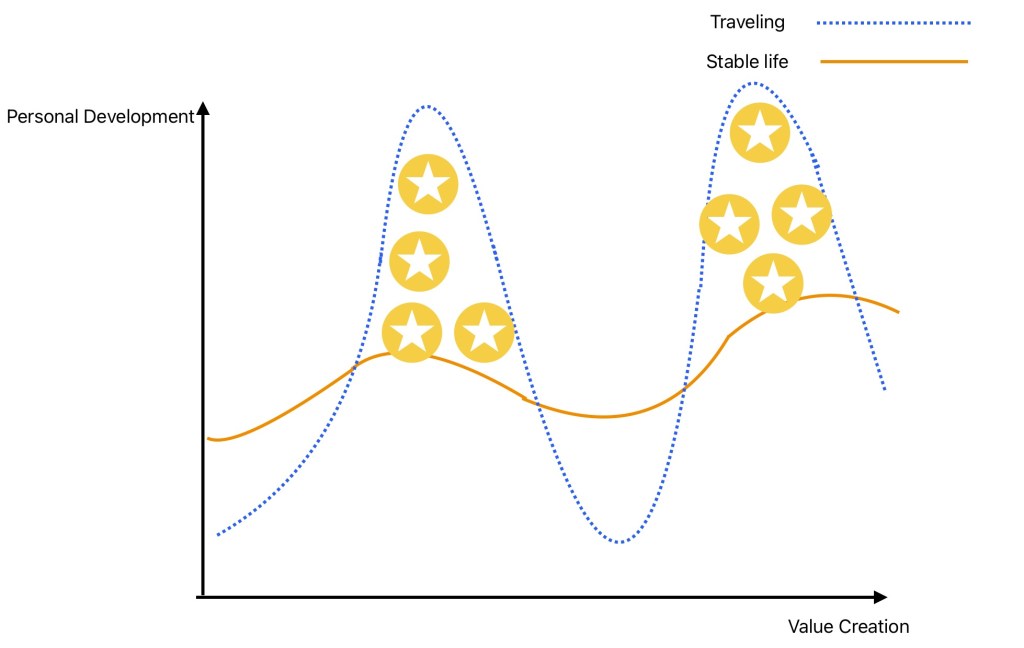
Option A) Going back home. I have created the below graph to show you, what I’m talking about. Traveling is amazing and it brings you lots of ups and downs, which means, you are effectively out of your comfort-zone, and you are de facto growing as a person. But it only worths doing, if it comes with some value creation. What is the value I can add to the world by doing this? Is this something I’m doing for self-indulgence, out of caressing myself OR is there something beyond I can do, to add value to my surrounding?  I can give you 2 examples:

  1. During the ocean crossing, our wind-pilot of the boat went off, which meant, the boat has lost its automatic steering solution. Erik, the boat’s captain offered to call for an evacuation. We were in the middle of the ocean, with no help in probably few hundred miles range, just the 3 of us. Sam and I said, ‘there is no way you’ll evacuate us from this boat. We are in this together, and we will push this through.’ And we did. In 33 days. Manually steering the boat for almost 20 days. That means you are waking up every 3 hours for a 1.5 hour shift. Imagine. Erik later told, we were his best crew so far and he couldn’t have done this without us.
  2. I have been working on delivering and transforming a yacht the past 4 weeks. The first mate of the boat, went harsh on me, several times. I was like, fine, as long as it’s not personal, I can take that, have a thickened skin and have experience with these kind of people. I felt she was representing the industry standards in yachting, so I was like, ‘okay, that’s the bar I need to hit to enter the industry. I think I can hit that.’ When we said our farewells 2 days ago, she was sobbing, thanking me, saying ‘We couldn’t have done this without you.’ That’s all I needed to hear. It meant, there was value created, and I grew as a person in those 4 weeks. I can be trashed, being harsh upon, it doesn’t matter. As long as I’m driving value and growing.

So below, you can see the stars, where it’s worth aiming for, when traveling long term. You can create value, just by seeing beautiful things of the world too. You will bring that back to your life and share it with others. I’m not saying you need to work your ass off while traveling, but more like setting the right intentions how it worths traveling. 

On the other hand, stable life also offers growth in a more predictable and stable way. We are all growing in a way in the end, as long as we are open for growth. 

So when I’m talking about traveling, I’m setting the standards of hitting the star flagged area. That’s where magic happens. So I need to be on projects that are hitting the red bar. Otherwise, there is no point for me staying around here, wasting my and others’ valuable time. So the alternative projects need to carry weight and value. Let’s have a look at those.
Option B) Getting my ass back down to St Maarten to complete the STCW training, that I’ve been postponing now for almost 2 months. Then, being commercially endorsed for working on charters, maybe get some experience and finally, find a boat to Central America mainland and move on progressing down towards Patagonia.

Option C) Get use of the US Visa and find other interesting boating projects in the summer season on the East coast. Coming back to the graph, I feel like I could get some more learnings in boating. But I would not do other kind of jobs, my interests are only in boating. In the ‘Dilemma’ post, I’ve described that I’m tempted to do the journey down to Patagonia by buying my own sailing boat. Then I sort of decompressed the idea in the ‘Follow the flow’ post, because I felt it was too heavy on me, but staying in the boating industry is clearly heading me towards the direction of how I could move the needle on that front little by little.

Let’s look at the options logically. C) doesn’t close out B) and A). A) kinda closes out B) and C). B) closes out C), but it doesn’t close out A). I’m not a GMAT guru, trust me, but it seems like C) wins for now. So I guess, I will need to find out, if I can get my hands on other cool boating projects around the East coast and learn more about boating without having much at stake in safe and controlled environments. If not, then I guess, well, B) will win. And I can always go with A) at any point in time whenever I feel, the fuel runs out. 

Thanks for reading!
Día 193: Reflexiones, alias más de medio año en la carretera de Hungría a Patagonia… ¿Sigues estando seguro de eso?

Ya es hora de parar un poco y mirar hacia atrás para ver cómo se ve este viaje hasta ahora en números. Por cierto, creo que la he cagado contando los días. En fin.

Empecé a apuntar el número de países (10+1 territorio), islas (4) y continentes (3) que he tocado durante este viaje hasta ahora. También hice algunos cálculos sobre la distancia que he recorrido aproximadamente por tierra (4.000 km o 2.500 millas), por mar (8.000 km, 5.000 millas o 4.400 millas náuticas) y en avión (5.000 km o 3.100 millas).

Pero entonces pensé: ¿qué sentido tiene?

¿He estudiado a fondo la historia y las culturas de cada uno de estos países para ponerme una medalla en el pecho y decir orgullosamente «yo estuve allí»?

La respuesta obvia es no.

He viajado por algunos de estos países, en otros he pasado muchísimo tiempo, pero me he dado cuenta de que realmente no tiene sentido coleccionar países como si fueran sellos.

Diferentes vibras, diferentes estilos

Conocí al esrilanqués más viajado que he visto en St Martin, un tipo llamado Leo, que vivió en Australia y que llevaba camino de superar los 200 países + territorios en su colección, de los más de 240 reconocidos por la ONU.

Era un tipo inteligente, un contable jubilado.

Pasaba las tardes en el muelle del hostal, emborrachándose solo y comprobando de vez en cuando su cartera de inversiones.

Era un gran compañero de conversación y parecía feliz con su vida, pero tuve que darme cuenta de que no es mi estilo coleccionar países como si fueran sellos en un álbum.

No quiero sentir la necesidad de visitar un país simplemente para tacharlo de una lista.

Si llego a visitar uno, tampoco quiero encontrarme corriendo hacia la frontera solo para añadir unos cuantos más a la lista, simplemente porque están cerca.

No se trata de juzgar a los que hacen esto. Supongo que simplemente soy de otro tipo.

También estoy intentando minimizar mi huella de carbono estos días, a veces con más y a veces con menos éxito, así que cuando me contó que había volado unas 100 veces para avanzar en su colección, mi nivel de ansiedad subió durante un segundo y después pensé:

«Genial, disfruta.»

Leo era un tipo estupendo, además, muy abierto de mente para tener más de 60 años. Disfruté mucho hablando con él y aprendiendo de él.

Ahora escucho la voz de Erik —mi excapitán, con quien crucé el Atlántico— en mi cabeza:

«Aron, ¡el carbono es vida! ¡Sin carbono no hay vida en este planeta! ¡El cambio climático es una mierda! ¡Esto está en la agenda del gobierno mundial para desviar la atención de la gente de lo que realmente importa! ¡Los gobiernos están amañados! ¡Poder para el pueblo!»

En otro orden de cosas, los números no son grandes narradores.

No ofrecen una gran perspectiva sobre lo que realmente ha ocurrido en el camino.

Cuando viajas durante más tiempo, te das cuenta de que, igual que en la vida, necesitas crear tu propio ritmo y tu propio estilo: cómo avanzas de una manera que te resulte auténtica.

Con qué tipo de personas te rodeas.

Cuánto dinero estás dispuesto a gastar.

En qué condiciones estás dispuesto a vivir.

Qué tan firmes son tus límites.

Y hasta qué punto estás abierto a diferentes tipos de experiencias.

Si eres viajero, se puede asumir que ya tienes una mente más abierta que la media, pero incluso dentro de ese rango existen espectros tremendamente diferentes.

Por ejemplo: ¿vivirías en una tienda de campaña o en una hamaca en el Caribe, o estás dispuesto a pagar un hostal barato?

¿O tienes todo el dinero del mundo para gastar y pasas tu tiempo en auténtico lujo, viajando en taxi a todas partes?

Supongo que, basándome en lo que he aprendido sobre mí mismo y sobre mis compañeros de viaje hasta ahora, estoy en la parte baja-media de la escala.

Eso significa que puedo permitirme el rango medio, pero prefiero mantenerme en la parte baja.

Es la mente frugal de contable que llevo dentro, contra la que no puedo hacer nada aparte de aceptarla.

Por otro lado, la mayoría de los tipos que he conocido tenían veintitantos años, cuyos presupuestos obviamente están en el extremo inferior comparados con los de alguien que se acerca a los treinta y cinco.

Joder.

Escribir esto es una dolorosa forma de reconocerlo.

Acercándome a Omar

Cuando estaba en la fase de planificación de mi viaje, para enfrentarme a mi síndrome del impostor y acercarme un poco más al mundo de los viajes, contacté con un antiguo compañero de trabajo mío, Omar, con quien tuve una conversación bastante larga.

Se convirtió en viajero después de pasar un tiempo en el mundo corporativo y su perfil de Instagram despegó después de empezar a documentar su proyecto sin vuelos de Egipto a Japón.

Preparé una encuesta completa y lo bombardeé con preguntas interminables de todo tipo.

Me lo tomaba mortalmente en serio y él tuvo la paciencia suficiente para responder a todas mis preocupaciones.

Cuando hablamos, él ya estaba en su fase de «estrellato de Instagram», ganando el premio al mejor contenido de viajes de 2024 —no estoy seguro de qué sociedad decide eso—, así que aprecié muchísimo que sacara tiempo para mí.

Puedes echar un vistazo a su cuenta de Instagram: @Omar.nok.

Avanzó constantemente hacia su objetivo de ir de Egipto a Japón viajando por Asia, lo cual no es poca cosa teniendo que atravesar países con situaciones políticas bastante preocupantes, como Afganistán o Irán.

Completó todo su proyecto en unos 250 días.

Cuando empecé mi propio viaje, pensé:

«Voy a ser como Omar.»

Sería imparable avanzando hacia mi objetivo, cruzando el Atlántico en barco y después encontrando otros barcos para llegar al continente.

Sería influencer en poco tiempo.

La gente me querría.

Sería el centro de atención allá donde fuera.

No es broma.

A estas alturas, sinceramente pensaba que estaría atravesando la selva en algún lugar de Colombia continental con un machete, luchando contra los mosquitos para evitar contraer malaria.

En cambio, estoy sentado en un café en Providence, Rhode Island, Estados Unidos, escribiendo este post, esperando que haya al menos una persona ahí fuera en el universo para quien valga la pena escribirlo, que realmente lo esté leyendo y que quizá esto pueda mover la aguja e inspirar al menos una vida.

¿Qué demonios ha pasado?!

Te voy a contar lo que pasó.

Dos cosas.

Empecemos por la primera.

Cuando empecé a planear el viaje había dos puntos principales en la agenda:

  • Aprender a navegar y encontrar un velero para cruzar el océano.
  • Continuar el viaje por tierra hacia Patagonia desde Centroamérica hasta Sudamérica.

Para abordar la parte de la navegación, empecé a leer todo tipo de materiales sobre navegación, incluyendo las memorias de Sir Francis Chichester.

Nunca había navegado antes y solo tenía una idea de lo que significaba navegar por el océano gracias al libro de Nándor Fa, que es el mayor icono de la navegación en Hungría.

Mencionó en un podcast que Chichester había sido una de sus inspiraciones, así que pensé que sería buena idea empezar por sus memorias.

Chichester se convirtió en mi mejor amigo.

Por las noches leía sus libros y las locuras que había hecho volando sobre Europa, África y Asia con un avión clásico del tipo Gipsy Moth y después, tras estrellar su hidroavión en Japón y casi morir, se metió en la navegación en el Reino Unido.

Ganó la primera competición de travesía en solitario del Atlántico de este a oeste y después dio la vuelta al mundo con su Gipsy Moth IV, un queche de 53 pies.

Estaba tan perdido en sus historias que, en cierto modo, me olvidé de la parte de Patagonia de mi viaje.

Después empecé a viajar y adopté el enfoque de:

«Vamos a ver qué pasa.»

Completé mi primer curso de navegación en Gibraltar y estaba totalmente concentrado en asegurarme de que la parte náutica del viaje saliera bien.

Entonces conocí a Erik.

Cruzamos el océano juntos y durante el viaje me convenció —aunque tampoco necesitaba demasiada persuasión— de que debería investigar más a fondo el mundo de la navegación.

Así que lo hice.

Después de llegar a St Maarten / St Martin, en lugar de buscar el siguiente barco que me llevara al continente, empecé a buscar trabajo para trabajar en barcos.

Y encontré uno.

Ayudaba a reparar, mantener y limpiar barcos de todo tipo, empezando por pequeños monocascos, catamaranes, lanchas a motor y veleros más grandes.

Solo fue aproximadamente un mes practicando el oficio, pero sabía que quería aprender más sobre barcos.

Así que me apunté al STCW para obtener la certificación comercial que me permitiera trabajar como tripulación en todo tipo de barcos.

Después, gracias a Sam —mi compañero de tripulación y hermano elegido, con quien crucé el océano junto a Erik—, pudimos pasar dos semanas cuidando un catamarán de 50 pies.

Aprendimos muchísimo sobre motores fueraborda.

Después, justo antes de que empezara mi curso, conocí a Santiago, el capitán del Ikigai, quien primero me ofreció un trabajo por días en su barco y después un puesto como tripulante para llevar el barco hasta Estados Unidos.

Cuando subí a bordo ya tenía una buena sensación.

Y cuando apareció con la oferta, simplemente no pude decir que no.

Unas semanas después, tras conseguir el visado estadounidense en Trinidad, me encontré primero en Bermuda y después llevando el yate de 84 pies hasta Newport, transformando el barco de condiciones de alquiler a condiciones de regata oceánica.

No fue fácil en absoluto, puedo asegurártelo.

Había muchísimo dinero en juego por parte de todos los implicados, con niveles de estrés elevados a bordo, pero de alguna manera conseguimos sacarlo adelante.

Y volví a aprender algunas cosas sobre navegación oceánica y sobre el negocio de los yates.

La segunda

No me convertí en influencer.

Qué vergüenza.

Cuando empecé a preparar vídeos me encontré con múltiples obstáculos.

Cuando abrí mi cuenta de Instagram, rápidamente tuve que darme cuenta de que no sabía editar vídeos.

No tenía ni idea de cómo hacerlo.

Nunca había tenido una cuenta de Instagram y durante los siete años anteriores había estado bastante alejado de las redes sociales.

Estaba protestando contra ellas.

Sentía que la mayor parte del contenido de Instagram era falso y superficial.

Que solo provocaba celos innecesarios en la humanidad y alimentaba a la sociedad para consumir cada vez más, simplemente porque:

«Si los demás pueden hacerlo, ¿por qué yo no?»

Sin embargo, el contenido de Omar me gustaba bastante.

Sentía que todavía podía conservar cierto nivel de autenticidad con el que yo podía conectar.

No tenía una máscara ni una sonrisa falsa.

Y eso era lo más importante para mí.

Así que decidí empezar a aprender desde cero cómo montar vídeos.

Siguiendo el consejo de MrBeast, empecé a trabajar hacia mis primeros 100 vídeos.

Ahora estoy alrededor del número 20.

Me digo:

«Si el vídeo número 101 sigue siendo una mierda, lo dejo.»

Hasta entonces, todo consiste en aprender el oficio.

Pero sigue siendo difícil, porque ya has establecido los estándares y expectativas equivocados al tomar a Omar como referencia.

¿Por qué el algoritmo no recoge el contenido?

¿Qué está mal?

Cuando inviertes trabajo y piensas que quizá finalmente va a despegar, y no lo hace, puede doler.

Pero al mismo tiempo siempre es un buen feedback.

Por otro lado, está el «factor Artemi».

Artemi, otro viajero que conocí, claramente ha conseguido hacerlo funcionar, con millones de visualizaciones en su cuenta y una tasa de crecimiento constante, lo que demuestra que no es imposible en absoluto.

Puedes echar un vistazo a su cuenta de Instagram: @artemigrimm.

Lo hace en alemán. Creo que hace cosas bastante buenas, a veces un poco provocadoras.

Siempre le digo:

«No te mates trabajando, que al final no merece la pena.»

Aunque, para poner los últimos seis meses en perspectiva, creo que he mejorado mi contenido de vídeo.

Mi primer vídeo tenía unas cinco fotos y cinco vídeos hechos en 30 minutos, puestos uno encima de otro con un audio.

Mi vídeo sobre mi visita a Nueva York probablemente tenía unas 1.000 ediciones, en las que trabajé durante unas 15–20 horas.

Eso, al final, indica cierto progreso.

No encuentro la fórmula correcta para mantenerme auténtico e interesante al mismo tiempo.

Los vídeos que estoy haciendo ahora claramente no están funcionando con el algoritmo de Instagram.

Por un lado, eso no cumple las expectativas.

Por otro, me proporciona una enorme superficie para experimentar y deja espacio para respirar.

Si solo hay un puñado de seguidores, puedo probar todo tipo de cosas y avanzar hacia mis objetivos sin demasiada presión, mientras sigo aprendiendo el oficio de la navegación y la marinería.

No sé si quiero más seguidores.

Esta es la parte más importante.

Cuando no estás 100 % comprometido con lo que estás haciendo y trabajando para conseguir que ocurra, los resultados no llegan.

No hay consistencia en mi contenido ni en mis publicaciones de reels.

El contenido es aburrido o simplemente algo interesante.

Parece más un diario de viaje que quieres enseñar a tu familia al final del viaje durante las reuniones navideñas que algo capaz de captar la atención del público general.

Este niño problemático está impulsado por el hecho de que estoy desconcertado sobre si quiero ser viajero o si quiero trabajar más en barcos.

Si me preguntas, soy una especie de híbrido entre las dos cosas.

Pero solo puedes captar una atención seria haciendo compromisos audaces y trabajando hacia ellos de manera constante.

Y hasta ahora he estado perdiendo impulso en ese frente.

Aunque el proyecto de Patagonia es una idea genial, he estado perdiendo seriamente la consistencia a la hora de avanzar hacia el objetivo.

Lo que significa perder atención.

Y al final está bien.

Sigo aprendiendo muchísimo sobre navegación y viajes por el camino.

Pero la espada, como siempre, tiene dos filos.

En el otro lado estoy sacrificando que mis viajes se vean más presentables.

Cuando te estás abriendo camino en la industria náutica, no estás perdiendo el tiempo creando contenido.

Los demás están invirtiendo tiempo y energía en ti y tienen grandes expectativas de que cumplas.

Así que no estás pasando tiempo pensando:

«¿Cómo debería colocar la cámara para grabar bien esta parte?»

Para darte un ejemplo, después de aproximadamente un mes trabajando juntos, Tiago, de la última entrega y transformación del barco, había confiado lo suficiente en mí como para decir:

«Vale, siéntete libre de hacer cualquier tipo de vídeo que quieras.»

Pero después se incorporaron nuevos miembros de la tripulación, profesionales de alto nivel, con los que tuve que volver a construir confianza desde cero.

No vas a ponerte delante de Dee Caffari y decir:

«Voy a trabajar en este barco, pero también voy a grabar contenido al mismo tiempo.»

Simplemente inclinas la cabeza, te callas y trabajas duro para no encontrar la manera de salir del barco de un día para otro.

Por cierto, Dee es una persona muy buena.

No lo digo para insinuar nada sobre su personalidad, sino para explicar cómo estableces las expectativas correctas cuando trabajas con este tipo de profesionales y los respetas.

Aburrido. Muchas palabras. Dime, ¿qué sigue?

A estas alturas vuelven a aparecer múltiples opciones entre las que elegir.

Primero aparece la configuración por defecto:

Opción A) Volver a casa

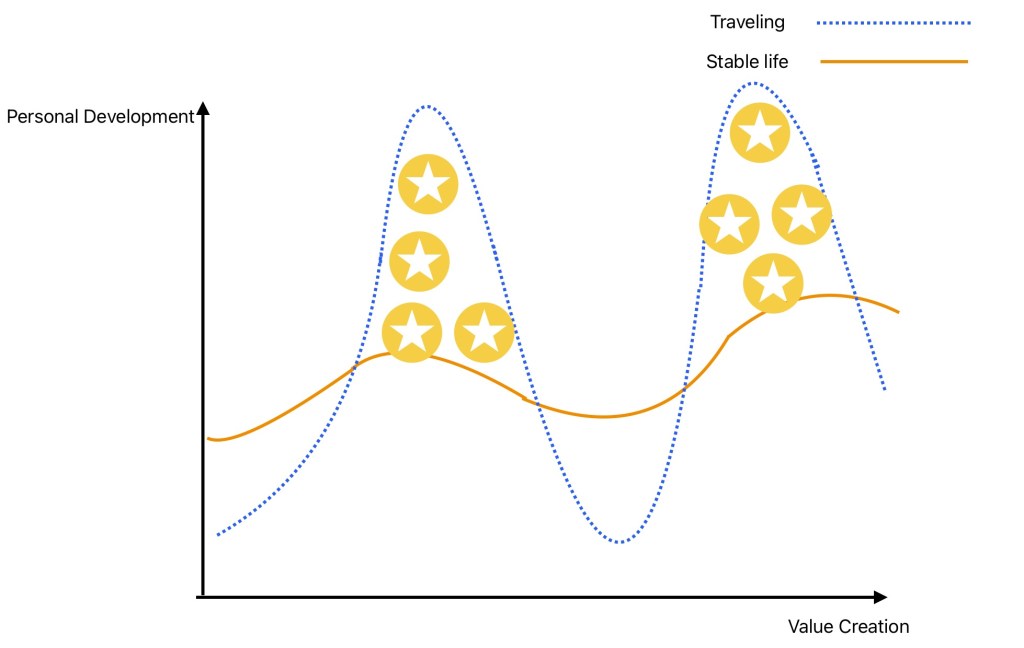
He creado el siguiente gráfico para mostrarte de qué estoy hablando.

Viajar es increíble y te proporciona muchísimos altibajos, lo que significa que efectivamente estás fuera de tu zona de confort y, de facto, estás creciendo como persona.

Pero solo merece la pena hacerlo si viene acompañado de algún tipo de creación de valor.

¿Qué valor puedo aportar al mundo haciendo esto?

¿Es algo que estoy haciendo por indulgencia personal, por mimarme a mí mismo?

¿O hay algo más que pueda hacer para aportar valor a mi entorno?

Puedo darte dos ejemplos:

Durante la travesía oceánica, el piloto de viento del barco dejó de funcionar, lo que significaba que el barco había perdido su sistema de gobierno automático.

Erik, el capitán del barco, se ofreció a pedir una evacuación.

Estábamos en mitad del océano, probablemente a varios cientos de millas de cualquier tipo de ayuda, solo nosotros tres.

Sam y yo dijimos:

«No hay manera de que nos evacúes de este barco. Estamos juntos en esto y vamos a sacarlo adelante.»

Y lo hicimos.

Durante 33 días.

Gobernando manualmente el barco durante casi 20 días.

Eso significa despertarte cada tres horas para hacer un turno de una hora y media.

Imagínatelo.

Más tarde Erik nos dijo que habíamos sido su mejor tripulación hasta entonces y que no podría haberlo hecho sin nosotros.

He estado trabajando durante las últimas cuatro semanas en la entrega y transformación de un yate.

El primer oficial del barco fue bastante duro conmigo varias veces.

Yo pensé:

«Vale. Mientras no sea algo personal, puedo soportarlo. Puedo tener la piel más gruesa y tengo experiencia con este tipo de personas.»

Sentía que ella estaba representando los estándares de la industria del yachting, así que pensé:

«Vale. Este es el nivel que necesito alcanzar para entrar en la industria. Creo que puedo alcanzarlo.»

Cuando nos despedimos hace dos días, estaba llorando.

Me dio las gracias y dijo:

«No podríamos haber hecho esto sin ti.»

Eso es todo lo que necesitaba escuchar.

Significaba que había creado valor y que había crecido como persona durante esas cuatro semanas.

Pueden machacarme.

Pueden ser duros conmigo.

No importa.

Mientras esté aportando valor y creciendo.

Así que abajo puedes ver las estrellas, que representan hacia dónde merece la pena apuntar cuando viajas a largo plazo.

También puedes crear valor simplemente viendo cosas hermosas del mundo.

Te las llevarás de vuelta a tu vida y las compartirás con otras personas.

No estoy diciendo que tengas que dejarte el culo trabajando mientras viajas.

Más bien hablo de establecer las intenciones correctas sobre por qué merece la pena viajar.

Por otro lado, una vida estable también ofrece crecimiento de una manera más predecible y estable.

Al final, todos estamos creciendo de alguna manera, siempre que estemos abiertos al crecimiento.

Así que cuando hablo de viajar, estoy estableciendo el estándar de alcanzar la zona marcada con estrellas.

Ahí es donde ocurre la magia.

Así que necesito estar en proyectos que alcancen la barra roja.

De lo contrario, no tiene sentido que me quede aquí desperdiciando mi tiempo y el valioso tiempo de los demás.

Por lo tanto, los proyectos alternativos tienen que tener peso y aportar valor.

Veámoslos.

Opción B) Bajar de nuevo a St Maarten

Volver a St Maarten para completar el curso STCW, que llevo posponiendo casi dos meses.

Después, obtener la habilitación comercial para trabajar en barcos de alquiler, quizá conseguir algo de experiencia y, finalmente, encontrar un barco que me lleve hasta Centroamérica continental y continuar avanzando hacia Patagonia.

Opción C) Aprovechar el visado estadounidense

Aprovechar el visado estadounidense y buscar otros proyectos náuticos interesantes durante la temporada de verano en la costa este.

Volviendo al gráfico, siento que todavía podría aprender algunas cosas más sobre navegación.

Pero no haría otro tipo de trabajos.

Mi interés está únicamente en la navegación.

En el post «El dilema» expliqué que me tentaba hacer el viaje hasta Patagonia comprando mi propio velero.

Después, en el post «Sigue el flujo», descomprimí un poco esa idea porque sentía que era demasiado pesada para mí.

Pero permanecer dentro de la industria náutica claramente me está llevando en la dirección de descubrir cómo podría mover un poco la aguja en ese frente, paso a paso.

Veamos las opciones lógicamente.

C) no cierra B) ni A).

A) básicamente cierra B) y C).

B) cierra C), pero no cierra A).

No soy ningún gurú del GMAT, créeme, pero parece que C gana por ahora.

Así que supongo que tendré que averiguar si puedo encontrar otros proyectos náuticos interesantes en la costa este y aprender más sobre barcos sin tener demasiado en juego, en entornos seguros y controlados.

Si no, pues supongo que ganará B.

Y siempre puedo elegir A en cualquier momento cuando sienta que se acaba el combustible.

¡Gracias por leer!

Tag 160: Ikigai, aka der Grund, warum ich mein ‚No-Fly‘-Reiseprojekt gekapert habe

Gestern war ich auf dem Weg von Miami nach Bermuda, ungefähr 10.000 Meter über dem Meer, und hatte ein paar ziemlich verwirrte, verhedderte Gedanken über diese Reise.

Erik hat mir den indischen Spruch beigebracht, den er während seiner früheren Hitchhiking-Reise durch Mexiko gelernt hatte:

„Reise nicht schneller, als deine Seele dir folgen kann.“

Ich habe gerade das Gefühl, dass ich mit Lichtgeschwindigkeit unterwegs war und Schwierigkeiten habe, hinterherzukommen, was als Nächstes kommt.

Sam ist vor zwei Tagen und Erik gestern von St. Martin zurück nach Europa auf zwei verschiedenen Booten aufgebrochen. Und wie es momentan aussieht, bleibe ich in Amerika.

Das bedeutet, dass dies wirklich das Ende eines Kapitels und der Beginn eines neuen ist.

Ich glaube, an diesem Punkt habe ich die Tatsache verarbeitet, dass wir getrennte Wege gehen. Ich habe darüber bereits in einem früheren Beitrag ausführlicher geschrieben – dieser Prozess hat definitiv einige Zeit gebraucht.

Es ist schade, dass ich nicht mehr in diesen Blog schreibe, aber wann immer ich die Zeit finde, versuche ich, etwas Energie in den Schreibprozess zu stecken, was einen ruhigen Kopf und eine ruhige Umgebung erfordert.

Für mich ist es eine Art Meditation, ein Geständnis, das Raum und Zeit braucht.

In diesem Beitrag geht es darum, warum ich beschlossen habe, den „No-Fly“-Reisemodus zumindest vorübergehend zu beenden.

Und wie diese Entscheidung meine Sicht darauf geprägt hat, wie es mit meiner Reise weitergehen soll.

Ich trinke einfach nur meinen Kaffee

Ein Typ, langhaarig, gut gebaut, ungefähr in meinem Alter, stellte sich neben mich in der Lagoonies Sailor’s Bar in St. Maarten.

Ich trank gerade meinen Morgenkaffee und schrieb in mein Journal, also schenkte ich ihm nicht allzu viel Aufmerksamkeit.

Er wirkte ein bisschen mysteriös, schüchtern oder einfach nur höflich zurückhaltend.

Er hing schon eine Weile in der Bar herum und schien nach etwas zu suchen.

Als er schließlich zur Kasse ging, um seine Rechnung zu bezahlen, und sah, dass ich gerade über meine Segelqualifikationen schrieb, fragte er mich:

„Suchst du nach Tagesarbeit?“

Ich war ein bisschen überrascht von der Frage, weil er eher wie ein Gleichaltriger auf mich wirkte.

„Klar, warum nicht“, sagte ich.

Er stellte sich als Santiago aus Spanien vor.

Meine Arbeit in der Bootsreparaturwerkstatt war einige Wochen zuvor zu Ende gegangen und mein Cashflow bewegte sich rapide nach Süden.

Also klang jede Art von Einkommen zu diesem Zeitpunkt vielversprechend.

„Ist es dein Boot?“, fragte ich.

Er sagte nein.

„Ich bin der Kapitän.“

„Ein junger Kapitän. Selten wie ein schwarzer Schwan“, dachte ich.

Als ich fragte, wie groß das Boot sei, glaube ich, dass ich seine Antwort falsch verstanden hatte.

Ich hörte irgendetwas wie 40–45 Fuß.

Zur besseren Einordnung: Ein 40-Fuß-Boot ist ungefähr 12 Meter lang. Und nur zum Vergleich: Eriks Boot ist 32 Fuß, also etwas mehr als 9 Meter lang.

Er suchte zwei weitere Tagesarbeiter.

Ich dachte:

„Warum zum Teufel braucht er drei Tagesarbeiter auf einem 45-Fuß-Boot? Einer, höchstens zwei sollten doch reichen.“

Aber zu diesem Zeitpunkt machte ich mir darüber nicht allzu viele Gedanken.

Ich fragte:

„Geht es dabei um Geld?“

Er sagte:

„Ja.“

Und die Summe war mehr als vielversprechend.

Fast das Doppelte von dem, was ich mit der Reparatur von Booten verdient hatte.

Das Projekt begann interessant zu werden.

Gleichzeitig lernt man in der Bootsbranche ziemlich schnell, dass man erst dann wirklich auf einem Boot ist, wenn man tatsächlich auf dessen Deck steht.

Also nahm ich sein Angebot mit Vorsicht an:

„Ich werde sehen, wenn ich auf dem Boot bin.“

Ikigai

Am nächsten Tag holte er mich mit seinem Tender an derselben Bar ab und ich stellte fest, dass ich ihn bereits getroffen hatte.

Ein paar Wochen zuvor war er bei Shrimpy’s vorbeigekommen, dem Hostel, in dem ich damals mit Sam lebte – wir teilten uns ein Etagenbett in wahrer Luxus- und Überflussmanier.

Mit einer gehörigen Portion Sarkasmus.

Shrimpy’s ist übrigens nicht nur ein Hostel, sondern gleichzeitig auch eine Wäscherei, ein Second-Hand-Laden für Segler und eine Werkstatt.

Ein echter Salon für Segler also.

Dadurch hatten Sam und ich eine großartige Möglichkeit, andere Segler kennenzulernen, die gerade auf der Insel angekommen waren oder schon eine Weile dort lebten.

Sein Tender – womit gleichzeitig auch das Boot gemeint ist – hieß „Ikigai“, da die Tender nach ihren Booten benannt werden.

Ich hatte ihm damals sogar gesagt, als er bei Shrimpy’s Ponton vorbeikam, um die Wäsche zu organisieren:

„Das ist ein wunderschöner Name für ein Boot.“

Ikigai ist ein japanischer Begriff und beschreibt den Grund, warum du morgens aufwachst.

Es ist eine Tätigkeit, die eine Verbindung aus Sinn, einem Beitrag zur Gesellschaft und Flow darstellt.

Ikigai wird oft mit den sogenannten Blue Zones in Japan in Verbindung gebracht, wo ältere Menschen, die sich bereits dem Alter von hundert Jahren nähern, weiterhin aktiv bleiben, arbeiten und einen Beitrag zur Gemeinschaft leisten.

Er fuhr den Tender mit großer Selbstsicherheit und raste mit seinem 60-PS-Viertaktmotor wie ein Ferrari durch die Lagune von St. Maarten.

Ich musste meine Kappe mit der Hand festhalten, damit der scheinbare Wind sie mir nicht vom Kopf blies.

Wir fuhren zu viert zum Boot, zusammen mit zwei weiteren Tagesarbeitern, Toby und Kieghley.

Aus der Entfernung sah das Boot bereits größer als 45 Fuß aus.

Als wir näher kamen, fragte Toby, der andere Tagesarbeiter aus Australien:

„Wie groß ist dieses Boot noch mal?“

Und Santiago sagte nun, ohne jeglichen Raum für Missverständnisse:

„84 Fuß.“

„Verdammt, das ist ein riesiges Boot. Eher ein Schiff“, dachte ich.

Je näher wir kamen, desto größer wirkte das Schiff.

Als ich schließlich an Bord ging, war ich von dem Design des Bootes überwältigt.

„Das ist zweifellos das schönste Boot, auf dem ich jemals war“, dachte ich.

Ein 84 Fuß langes Segelboot. Und es sieht aus wie ein Wunder.

Unsere Aufgabe bestand darin, den Schmutz vom Teakholz zu schrubben, den Edelstahl und den Gelcoat von außen zu polieren.

Normale Tagesarbeiterarbeit.

Und das Schiff wirklich zum Glänzen zu bringen.

Das Angebot

Die Arbeit lief reibungslos, und an Bord herrschte eine gute Stimmung.

Der Besitzer, ein niederländischer Gentleman namens Arnoud, war ebenfalls auf dem Boot, allerdings gingen er und seine Begleitung kurz darauf zum Wakeboarden.

Als wohlhabender Mann war er uns gegenüber jedoch von Anfang an aufmerksam und höflich.

Mit der Zeit hatten wir nach der Arbeit ein paar Gespräche in Bars und er schien wirklich an unserer Geschichte interessiert zu sein.

Nach dem ersten halben Arbeitstag, während der Mittagspause, rief Santiago uns zu sich und sagte:

„Jungs, ich suche Crew, um dieses Boot von St. Maarten nach Newport zu bringen.

Die Route geht über Bermuda und New York, mit Newport als letztem Ziel.

Wir werden ein paar Fotos mit dem Boot vor der Freiheitsstatue machen.

Es ist ein bezahlter Job.

Ich kann eine Person aus der Crew bezahlen. Wenn mehr Leute mitkommen, seid ihr natürlich willkommen, aber dann wird die Bezahlung auf die Crew aufgeteilt.

Wenn wir in Newport ankommen, kann ich euch zurückfliegen.“

Wir waren von der Idee ziemlich angetan.

So funktioniert es also auf diesem Level.

Das Ganze klang super aufregend.

Obwohl das Angebot vielversprechend war, war klar, dass sich der Job finanziell eigentlich nur lohnen würde, wenn nur eine Person mitkommt.

Da Toby und Kieghley – ja, Kieghley ist ein verdammt hartes Mädchen, das auf Booten arbeitet und die Jungs mit ihrer Arbeitsmoral alt aussehen lässt – stabilere Jobs auf der Insel hatten, schlossen sie Überstunden im Grunde aus.

Ich wollte, dass sie mitkommen, weil es einfach mehr Spaß macht, wenn mehr Leute dabei sind – unabhängig von der Bezahlung.

Aber offenbar blieb mir nur die Möglichkeit, Santiago und Ikigai zu begleiten.

Am Scheideweg

„Du brauchst allerdings ein B1/B2-Visum, um auf dem Boot mitzufahren.

ESTA reicht nicht.

Es gibt keine US-Botschaft in St. Maarten, also musst du so schnell wie möglich auf eine andere Insel fliegen, um das Visainterview zu machen.

Entweder Trinidad, die Dominikanische Republik oder Barbados.

Ich habe es in Trinidad gemacht, dort lief alles super.“

Santiago sagte das ziemlich beiläufig.

„Wow“, dachte ich.

„Wow. Moment mal.

Das ist ein echter Rückschlag.

Das ist eine harte Nummer.

Dafür müsste ich meine Idee vom ‚No-Fly‘-Reiseprojekt aufgeben.

Und es geht auch noch in die falsche Richtung.“

Die Energie im Raum war allerdings so hoch und die Stimmung so positiv, dass ich damals dachte:

„Ich mache es.

Ich habe bereits einen Ozean überquert.

Ich bin ungefähr 9.000 km ohne Flug gereist, habe in Hitchhiker-Camps gelebt und anderthalb Monate auf See verbracht.

Das war ein solider Anfang.

Aber wenn eine Gelegenheit anklopft, werde ich jetzt nicht derjenige sein, der sie ablehnt.

Es bringt mich schließlich keinen einzigen Kilometer näher an mein eigentliches Ziel, Patagonien.

Ich kann danach immer noch wieder zurück nach St. Martin und dort wieder bei null anfangen und die Reise mit Booten fortsetzen.

Und diese Erfahrung könnte mir im Laufe der Zeit sogar weitere ‚No-Fly‘-Projekte ermöglichen.“

Ohne einen zweiten Gedanken war ich bereit.

Ich füllte den Antrag für das B1/B2-Visum aus, mit einer soliden Hintergrundgeschichte.

Zur Erklärung: Ein B1/B2-Visum ist notwendig, wenn man US-Gewässer befährt.

Bei einer Einreise per Flugzeug würde für EU-Bürger eine ESTA-Genehmigung ausreichen.

Ich hatte sowieso schon eine Weile darüber nachgedacht, mir damals ein B1/B2-Visum zu besorgen, was mir wiederum ermöglichen würde, Segelboote in US-Gewässern zu chartern, dabei etwas Geld zu verdienen und gleichzeitig mehr Bootserfahrung zu sammeln.

Es klang also nach einer Win-win-Situation.

Eine echte Manifestation der Idee, die ich ursprünglich im Kopf hatte.

Und ich würde endlich Trinidad sehen.

Seit ich Fabio und Leanna damals in Las Palmas kennengelernt hatte, war Trinidad immer irgendwo in meinem Hinterkopf.

Ich war seit mehr als zwei Monaten nicht mehr von St. Martin/Maarten weggekommen.

Es war also Zeit, bei etwas den Abzug zu betätigen.

Ich war auf der Insel zu bequem geworden und hatte mir ein Anti-Reise-Leben aufgebaut.

Also sagte ich:

„Los geht’s.“

Mentale Vorbereitung

Seitdem ist das Boot von St. Maarten Richtung Bermuda aufgebrochen, während ich mit einem Zwischenstopp über Miami zu ihm fliege.

Das ist mein erster Auftrag als Segler: Ikigai als Crew nach New York zu bringen und von dort weiter nach Newport, wo das Boot an einem Atlantikrennen von West nach Ost teilnehmen wird.

Einerseits freue ich mich riesig über die Gelegenheit, die mich gefunden hat, und über das Vertrauen, das Santiago und das Ikigai-Team trotz meiner fehlenden Qualifikationen in mich setzen.

Andererseits weiß ich, dass während der Fahrt ein anderes Maß an Präsenz von mir verlangt werden wird.

Ich bin seit mehr als zwei Monaten nicht mehr gesegelt und die Segelmuskeln können ziemlich schnell einrosten.

Wie verhält man sich an Bord?

Worauf muss man achten?

Wie hält man Körper und Geist in Form?

All das gehört zum Leben auf See.

Auch wenn ich anderthalb Monate auf Eriks Boot verbracht und dabei den Atlantik überquert habe, ist ein Schiff dieser Größe eine völlig andere Liga.

Ein Segelboot auf hoher See ist für sich genommen schon eine tödliche Waffe – und dabei haben wir das Meer selbst noch gar nicht berücksichtigt, wo jede Menge Dinge schiefgehen können.

Segelleinen und Schoten können Finger oder Hände abtrennen.

Der Baum kann Köpfe zertrümmern.

Kein Witz.

Eine Mit-Hitchhikerin musste ihre Reise gerade aufgrund einer Verletzung beenden, die dadurch verursacht wurde, dass eine Genuaschot ihre Hand aufgeschnitten und ihr Handgelenk ausgerenkt hat.

Während ich das hier schreibe, befindet sie sich bereits bei ihrer zweiten Operation.

Ich wünsche ihr von hier aus alles Gute für ihre Genesung.

Nach Newport zu fahren wird mir einen Einblick in die professionelle Welt des Rennsegelns ermöglichen.

Ich betrachte diese Reise als die Frucht der Beharrlichkeit, die ich in den vergangenen sechs Monaten in diesen Prozess gesteckt habe:

angefangen mit meinem ersten Segelkurs im vergangenen Dezember in Gibraltar, über das Hitchhiken auf Booten in Europa, um den Atlantik zu überqueren, die Arbeit mit Erik an Bord, um sein Boot sicher nach Amerika zu bringen, bis hin zur Tagesarbeit in der Karibik, um meine Reise finanzieren und gleichzeitig mehr über die Bootsbranche lernen zu können.

Gleichzeitig klang es für mich auch nach einer echten Herausforderung für einen Reisenden, an einem neuen Ort aufzutauchen und sich dort dem Unbekannten zu stellen.

Und offensichtlich konnte ich auch dieser Anziehungskraft nicht widerstehen.

Reisepläne verändern

Mein „No-Fly“-Reiseprojekt hat sich zu diesem Zeitpunkt in etwas anderes verwandelt.

Das ist wichtig zu erwähnen, denn einer der Gründe, warum ich den Ozean überqueren und ohne zu fliegen bis nach Patagonien gelangen wollte, war von Angst und Sorgen über die Zukunft dieses Planeten angetrieben.

Umweltangst.

Kriegsangst.

KI-Angst.

Die Angst davor, ob ich meinen eigenen Kindern irgendwann eine bessere Zukunft bieten kann als die, die ich selbst hatte.

Und die Frage, ob es überhaupt ethisch vertretbar ist, eigene Kinder zu bekommen, wenn fast 8 Milliarden Menschen auf diesem Planeten leben.

Wäre es nicht ethischer, eines der Kinder auszuwählen, die bereits hier sind, und ihm ein besseres Leben zu ermöglichen?

Ich möchte an dieser Stelle nicht zu sehr ins Detail gehen.

Ich hoffe, dass ich irgendwann in einem anderen Beitrag darauf zurückkommen und diese Gedanken genauer auseinandernehmen kann.

Also habe ich mich gefragt:

Wenn dies nun kein „No-Fly“-Projekt mehr ist, was ist es dann eigentlich?

Ich habe diese Reise nicht nur zu meiner eigenen Unterhaltung begonnen.

Ein wichtiger Faktor war, eine gesunde Form der Entlastung von den oben genannten Ängsten zu finden und gleichzeitig von den völlig unterschiedlichen Menschen zu lernen, denen man auf einer solchen Reise begegnen kann.

Und nicht zuletzt wollte ich vielfältige Erfahrungen aus Situationen sammeln, die während des Reisens zufällig entstehen können.

Bedeutet das, dass sich einige dieser Ängste mit der Zeit aufgelöst haben und ich meinen Segen zum Fliegen gegeben habe?

Keine Ahnung.

Ich hätte mir niemals vorstellen können, von Europa nach Amerika zu fliegen.

Aber wer weiß?

Vielleicht hätte ich meine Meinung geändert und wäre trotzdem geflogen, wenn ich nicht zufällig Glück mit Erik gehabt hätte.

Eine spirituelle Reise, den Träumen und dem Flow folgend

An diesem Punkt muss ich meine Reise in etwas umrahmen, das mehr ist als ein simples „No-Fly“-Reiseprojekt.

Und ich muss das, was ich bisher als „Glück“ bezeichnet habe, anders benennen – auf eine Art, die besser erfasst, wie ich die Menschen und Situationen verstehe, denen ich auf diesem Weg begegnet bin und mit denen ich zu tun hatte.

Ich glaube daran, dass die Menschen, die ich auf dieser Reise getroffen habe, und die Situationen, die ich durchlebt habe, nicht einfach nur das Ergebnis von purem Glück waren.

Eher eine Art Cocktail daraus, wie das Universum auf seltsame Weise seine Karten für mich ausgespielt hat.

Man könnte es die Manifestation einer gottähnlichen Erfahrung nennen.

Und es hat nur funktioniert, weil ich tiefes Vertrauen in den Prozess hatte.

Ohne dieses Vertrauen wäre das Ganze wahrscheinlich bereits am ersten Tag zum Scheitern verurteilt gewesen.

Bevor ich diese Reise begann, hatte ich große Unsicherheiten im Umgang mit äußeren Erwartungen, die nicht mit dem übereinstimmten, was ich selbst tun wollte.

Meine Mutter wollte, dass ich sesshaft werde, einen Job finde und ein normales Leben führe.

Ich wollte nichts davon.

Ich konnte es einfach nicht.

Ich war dazu nicht in der Lage.

Ich glaube, eine Reise wie diese funktioniert auch gar nicht anders.

Du musst einen ausreichend starken Grund haben, warum du dich von deinen Liebsten entfernen und bei Fremden und in extremen Situationen Zuflucht suchen möchtest.

Coelhos Der Alchimist hat einen tiefen Eindruck bei mir hinterlassen, nachdem ich das Buch kurz vor Beginn der Reise gelesen hatte.

Santiagos Reise war genau das, was ich selbst erleben wollte.

In seltsame Situationen geraten, die ich lösen musste, und durch Widerstandskraft, Vertrauen und die richtigen Absichten Widrigkeiten überwinden.

Einen Traum haben, der stark genug ist, dass es sich lohnt, dafür zu kämpfen.

Und ich habe diesen Traum erschaffen, indem ich Patagonien auf der Karte markiert habe.

Am Anfang dieser Reise war ich so allein mit diesem Prozess, dass ich nur noch um Hilfe beten konnte.

Ich war noch nie gesegelt und fragte deshalb zu Beginn ChatGPT, was ich tun sollte.

Kein Witz.

Ich trat ein paar Facebook-Gruppen bei, um Menschen zu finden, die Ozeane überqueren wollten, weil ich überhaupt keine Ahnung hatte, wie ich anfangen sollte, über diesen Prozess nachzudenken.

Ich sah Marcins Beitrag.

Er war ein polnischer Hitchhiker, der damals im Camp in La Línea saß und nach Booten suchte.

Irgendetwas an seinem Beitrag klickte bei mir.

Er hatte gerade seinen Job als Software Engineer aufgegeben, um zu reisen.

Ich schrieb ihm auf WhatsApp.

Er antwortete.

Sechs Monate später hatten wir erst gestern einen Anruf.

Er rief mich aus Medellín an, aus einem Hostel in Kolumbien, wohin er per Hitchhiking auf Booten über den Atlantik und durch die Karibik gelangt war.

Damals in La Línea war er kurz davor gewesen, aufzugeben, nachdem er einen Monat lang erfolglos nach einem Boot gesucht hatte.

An diesem Morgen bekam er eine Nachricht von einem Segler aus Polen.

Er schloss sich einem Regattaboot an, das den Ozean überquerte.

Und zwar wirklich im Rennmodus.

Ich sitze inzwischen auf Bermuda und warte darauf, dass mein Boot ankommt, um meinen ersten Auftrag als Segelcrew zu beginnen.

Was ist das, wenn nicht die Manifestation und Verwirklichung von Träumen?

Jede dieser Erfahrungen wurde allerdings durch irgendeine Form von Investition und Opfer freigeschaltet.

Es ist nicht alles so glänzend und strahlend, wie es von außen vielleicht aussieht.

Als Reisender gibt es auch jede Menge Dinge, mit denen man umgehen muss.

Ich erzähle dir ein paar weitere Beispiele.

Ich wollte unbedingt mit jemandem den Ozean überqueren, der mir das Segeln beibringen konnte.

Bevor ich angefangen hatte, romantisierte ich das Segeln der 60er-Jahre und des frühen 20. Jahrhunderts mit Chichester und Moitessier.

Also fand ich Erik – durch „pures Glück“ –, dessen Segelhelden Slocum und Moitessier waren.

Eine Art Moitessier für sich selbst.

Ich musste finanziell ein Opfer bringen, um diese Reise freizuschalten.

Ich wollte, dass die Ozeanüberquerung eine großartige Erfahrung wird.

Vor ein paar Wochen sagte er, dass Sam und ich während seiner bisherigen Segelzeit seine beste Crew gewesen seien.

Nicht, weil es einfach gewesen wäre, sondern eher wegen der problemlösungsorientierten Mentalität, die Sam und ich während der Überquerung hatten.

Der Windpilot ging mitten auf dem Ozean kaputt und wir steuerten 18 Tage lang manuell.

War es einfach, alle drei Stunden aufzuwachen und eine 1,5-Stunden-Schicht zu übernehmen?

Nicht wirklich.

Dann überquerte ich den Ozean und wollte für jemanden arbeiten, der mir etwas über Boote beibringen konnte.

Also traf ich Lionel – durch „pures Glück“ –, der seine Werkstatt betrieb und mir die Chance gab, für ihn zu arbeiten.

Seine Mitarbeiter und meine Kollegen brachten mir alle möglichen Dinge über Boote bei.

Mein Opfer war die Zeit und Energie, die ich investierte, indem ich die Idee aufgab, mit meiner Reise weiter nach Westen voranzukommen.

Dann endete die Arbeit.

Aber ich glaubte, dass vielleicht etwas Größeres im Entstehen war.

Dann kam das Boat-Sitting und schließlich traf ich Santiago – durch „pures Glück“.

Mein Opfer für diese Erfahrung bestand darin, das „No-Fly“-Projekt aufzugeben.

Und natürlich gab es auch harte Tagesarbeit bei 30 °C.

An diesem Punkt frage ich mich, was als Nächstes in diesem Prozess kommt.

Der Flow hat mich bisher nach Bermuda gebracht.

Mit den Worten des chinesischen Bauern aus der berühmten Geschichte kann ich nur sagen:

„Wir werden sehen.“

Oder mit Eriks Worten:

„Ich erzähl’s dir später.“

Ich werde unter meiner eigenen Verantwortung mein Bestes geben, um so viel wie möglich aus dieser Erfahrung herauszuholen, während ich als Crew nach Newport segle.

Und was danach kommt, ist ein Rätsel.

Ich werde die Augen offen halten und sehen, wohin sie mich führen.

160. nap: Ikigai – avagy miért adtam fel a „repülésmentes” utazási projektemet

Tegnap éppen Bermuda felé tartottam Miamiból, nagyjából 10 000 méterrel a tenger felett, és meglehetősen kusza gondolatok kavarogtak bennem ezzel az utazással kapcsolatban.

Erik tanított nekem egy indián mondást, amit még mexikói stoppolásai idején tanult:

„Ne utazz gyorsabban, mint ahogy a lelked követni tud.”

Mostanában úgy érzem, hogy fénysebességgel utazom, és nehezemre esik utolérni magam.

Sam két napja indult el a St Martin-ról vissza Európába, Erik pedig tegnap hagyta el a szigetet – két különböző hajóval Európa felé. Én pedig, ahogy most áll a helyzet, Amerikában maradok.

Ez tényleg egy fejezet végét és egy új kezdetét jelenti.

Azt hiszem, mostanra sikerült feldolgoznom, hogy külön utakon folytatjuk. Erről már írtam részletesebben egy korábbi bejegyzésben, és az biztos, hogy időbe telt, mire a dolgok a helyükre kerültek bennem.

Kár, hogy nem írok többet erre a blogra, de amikor van időm, próbálok energiát tenni az írásba. Ehhez viszont nyugodt elme és nyugodt környezet kell.

Nekem ez egyfajta meditáció. Egy vallomás, amihez tér és idő szükséges.

Ez a bejegyzés arról fog szólni, miért döntöttem úgy, hogy – legalább egy időre – felhagyok a „repülésmentes” utazási móddal.

És arról is, hogyan változtatta ez meg azt, ahogyan a további utazásomra tekintek.

Csak iszom a kávémat

Egy hosszú hajú, jó kiállású, nagyjából velem egykorú srác lépett mellém a Lagoonies nevű tengerészbárban St. Maarten szigetén.

A reggeli kávémat ittam és naplót írtam, úgyhogy nem igazán foglalkoztam vele.

Kicsit titokzatosnak, félénknek, vagy egyszerűen csak udvariasan visszafogottnak tűnt.

Már egy ideje a bárban üldögélt, és úgy látszott, keres valamit. Amikor a kasszához lépett fizetni, és látta, hogy a vitorlás képesítéseimről írok, végül megkérdezte:

„Munkát keresel?”

Kissé meglepett a kérdés, főleg mert inkább tűnt velem egykorú srácnak, mint valami főnöknek.

„Persze. Miért ne?”

Bemutatkozott. Santiago volt, Spanyolországból.

A hajójavító műhelyben végzett munkám néhány héttel korábban véget ért, a pénzforrásaim pedig rohamosan apadtak, úgyhogy bármilyen bevétel ígéretesen hangzott.

„A te hajód?” – kérdeztem.

Nem.

„Én vagyok a kapitány.”

Egy fiatal kapitány.

Ritka, mint a fekete hattyú – gondoltam.

Amikor megkérdeztem, mekkora a hajó, azt hiszem, félreértettem a válaszát.

Valami 40–45 láb körülit hallottam. Hogy legyen viszonyítási alap: egy 40 lábas hajó nagyjából 12 méter hosszú, Erik hajója pedig 32 láb, vagyis valamivel több mint 9 méter.

Két másik napibérest is keresett, én pedig azon gondolkodtam:

Mi a fenének kell három ember egy 45 lábas hajóra? Egynek, maximum kettőnek bőven elégnek kellene lennie.

De akkor még nem igazán érdekelt.

„Fizetnek érte?”

„Igen.”

És a szám, amit mondott, több mint ígéretes volt.

Szerzői adalék 2026 Szept 12: napi 150 dollárt, akkori árfolyamon nagyjából 50 ezer forintot kerestem a hajón végül, kb egy hónapon keresztül. Ami azért elég jó, mert közben nincsenek kiadásaid. Nem kell szállásért, kajáért fizetni. Cserébe nincs életed és elég stresszes a meló.

Majdnem kétszer annyi, mint amennyit a hajójavítással kerestem.

Kezdett érdekessé válni a projekt.

Ugyanakkor a hajóiparban hamar megtanulod, hogy addig nem lehetsz biztos benne, hogy egy hajón dolgozol, amíg ténylegesen rá nem léptél a fedélzetére.

Úgyhogy óvatosan fogadtam el az ajánlatot.

Majd meglátjuk, amikor a hajón leszek.

Ikigai

Másnap, amikor ugyanannál a bárnál felvett a dingijével (motoros gumicsónak), rájöttem, hogy már találkoztunk.

Néhány héttel korábban beugrott Shrimpy’s-be, abba a hostelbe, ahol Sammel laktam egy emeletes ágyon, az igazi luxus és bőség jegyében. Remélem a szarkazmus átjön.

Shrimpy’s egyébként nem csak hostel. Egyben mosoda, tengerészeknek szánt használtbolt és műhely is – egy igazi tengerészszalon.

Nekünk, Samnek és nekem ez remek lehetőséget adott arra, hogy találkozzunk más tengerészekkel, akik éppen megérkeztek a szigetre, vagy már egy ideje ott éltek.

A dingijét – ami egyébként magának a hajónak a neve után kapta a nevét – Ikigainak hívták.

Még akkor, amikor a Shrimpy’s pontonján üldögéltünk, és Santiago (a kapitány) a mosodai dolgait intézte, meg is jegyeztem:

„Gyönyörű név egy hajónak.”

Az Ikigai egy japán kifejezés, és nagyjából azt a „miértet” jelenti, amiért reggel felkelsz.

Egy olyan tevékenység, amelyben találkozik az életcél, a társadalomhoz való értékteremtő hozzájárulás és a flow állapota.

Az ikigait gyakran hozzák összefüggésbe Japán úgynevezett kék zónáival is, ahol az idősek még kilencvenéves koruk körül is aktívak maradnak, dolgoznak és hozzájárulnak a közösségi élethez.

Santiago elképesztő magabiztossággal vezette a dingit (ekkora hajóknál tender a neve). A 60 lóerős, négyütemű motor úgy száguldott végig a St. Maarten-i lagúnán, mint egy Ferrari.

A sapkámat a kezemmel kellett lefognom, hogy a menetszél le ne vigye.

Négyen mentünk a hajóhoz: Santiago, én, valamint két másik napimunkás, az Ausztrál Toby és a wales-i Kieghley.

A hajó már távolról is nagyobbnak tűnt 45 lábnál.

Ahogy közeledtünk, Toby, az ausztrál srác megkérdezte:

„Mekkora is ez a hajó?”

Santiago pedig most már minden félreértést kizárva válaszolt:

„84 láb.”

Bazdmeg.

Ez mocskosul nagy. Gondoltam elismerőleg.

Inkább rendes hajónak, mint vitorlásnak tűnik – gondoltam.

Ahogy közeledtünk, egyre nagyobbnak látszott.

Amikor felléptem a fedélzetre, teljesen lenyűgözött a hajó kialakítása.

„Ez kétségtelenül a legszebb hajó, amire valaha felléptem.”

Egy 84 lábas vitorlás volt.

És úgy nézett ki, mint valami csoda.

A munkánk egyszerű volt: le kellett súrolnunk a teakfa fedélzetre rakódott koszt, valamint kívülről felpolírozni a rozsdamentes acélt és a gélt.

Tipikus napibéres-meló.

A hajót egyszerűen ragyogóvá kellett varázsolnunk.

Az ajánlat

A munka simán ment, jó hangulat volt a fedélzeten.

A tulajdonos, egy Arnoud nevű holland úriember szintén a hajón volt, de nem sokkal később elmentek vízisíelni.

Gazdag ember létére már az első pillanattól kezdve figyelmes és udvarias volt velünk.

Később munka után néhányszor beszélgettünk bárokban, és úgy tűnt, őszintén érdekli a történetünk.

Az első fél nap után, ebédidőben Santiago félrehívott minket.

„Srácok, legénységet keresek, hogy elvigyük ezt a hajót St. Maartenről Newportba (New York mellett található, Rhode Island egyik legfontosabb kikötője).

Az útvonal Bermudán és New Yorkon keresztül vezet, a végállomás Newport.

Készítünk majd néhány fotót a Szabadság-szobor előtt a hajóval.

Fizetett munka.

Egy embernek tudok teljes fizetést adni. Ha többen jöttök, természetesen jöhettek, de a fizetés megoszlik a legénység között.

Amikor megérkezünk Newportba, vissza tudlak repíteni titeket.”

Felcsillant a szemünk.

Szóval így működnek ezen a szinten a dolgok.

Az egész elképesztően izgalmasnak hangzott.

Pénzügyileg viszont csak akkor érte volna meg igazán, ha egyedül csatlakozom.

Tobynak és Kieghleynek ugyanis stabilabb munkája volt a szigeten, így ők nagyjából kizárták, hogy otthagyják azt.

Pedig szerettem volna, ha ők is jönnek.

Sokkal jobb móka lett volna együtt menni – függetlenül a pénztől.

De végül úgy nézett ki, hogy nekem kell csatlakoznom Santiagóhoz és az Ikigaihoz.

Útkereszteződés

„Viszont B1/B2 vízum kell ahhoz, hogy csatlakozz a hajóhoz. Az ESTA nem elég. (Az ESTA az Uniós civil engedély az USA-ba belépésre)

St. Maartenen nincs amerikai nagykövetség, úgyhogy minél hamarabb át kell repülnöd egy másik szigetre a vízuminterjú miatt.

Trinidad, Dominikai Köztársaság vagy Barbados.

Én Trinidadon csináltam, teljesen simán ment.”

„Hűha.”

Ez komoly.

Várjunk egy pillanatot.

Ez bizony komoly dilemma.

Ez egy nagy pofon. Ehhez fel kell adnom a „repülésmentes” utazási projektemet.

Ráadásul rossz irányba is megy.

A szobában viszont annyira vibrált az energia, és annyira pozitív volt a hangulat, hogy azt gondoltam:

„Megcsinálom.”

Már átkeltem egy óceánon.

Körülbelül 9000 kilométert utaztam repülés nélkül.

Éltem stoppolós táborokban.

Másfél hónapot töltöttem a tengeren.

Ez már egy elég komoly kezdet volt.

De amikor egy lehetőség kopogtat az ajtódon, nem én leszek az, aki elutasítja.

Még ha ez egy centivel sem visz közelebb a valódi célomhoz, Patagóniához.

Végül is visszamehetek St. Martinra, és folytathatom az utat hajókkal.

És ez az élmény talán később még több „repülésmentes” projekt ajtaját nyithatja ki előttem.

Nem gondolkodtam tovább.

Készen álltam.

Kitöltöttem a B1/B2 vízumhoz szükséges jelentkezést, egy elég jól felépített háttértörténettel.

A B1/B2 vízumra azért van szükség, hogy az amerikai vizekre beléphess hajóval.

Repülővel egy európai uniós állampolgárnak elég lenne az ESTA.

Már egy ideje gondolkodtam azon, hogy megszerzem a B1/B2-t, mert így akár amerikai vizeken is dolgozhatné vitorlásokon, pénzt kereshetnék és közben még több hajózási tapasztalatot szerezhetnék.

Így az egész egy win-win helyzetnek tűnt.

Pontosan annak a gondolatnak a megvalósulása, ami eredetileg is a fejemben volt.

És végre Trinidadot is láthatom.

Fabióval és Leannával (2 stoppos barát, akiket a Kanári-szigeteken ismertem meg, ők Trinidadban éltek) még Las Palmasban találkoztam, és Trinidad azóta ott motoszkált a fejemben.

Több mint két hónapja nem mozdultam el St. Martin/Maartenről.

Ideje volt végre meghúzni a ravaszt valamire.

Túlságosan kényelmes lettem a szigeten.

Kezdtem kialakítani egy utazásmentes életet.

Úgyhogy azt mondtam:

„Gyerünk.”

Mentális felkészülés

Azóta a hajó elindult St. Maartenről Bermuda felé, én pedig Miamin keresztül repülök utána.

Ez az első igazi megbízásom vitorlázóként.

Legénységi tagként segítek eljuttatni az Ikigait New Yorkba, onnan pedig tovább Newportba, ahol a hajó részt vesz egy nyugatról keletre tartó Atlanti-óceáni átkelési versenyen.

Egyrészt izgatott vagyok a lehetőség miatt, ami megtalált, és azért a bizalomért is, amit Santiagótól és az Ikigai csapatától kaptam annak ellenére, hogy alig vannak képesítéseim.

Másrészt tudom, hogy a hajón egy teljesen más szintű jelenlétre lesz szükség tőlem.

Több mint két hónapja nem vitorláztam.

A vitorlázóizmok pedig könnyen berozsdásodnak.

Hogyan viselkedsz a fedélzeten?

Mire kell figyelned?

Hogyan tartod formában a testedet és az elmédet?

Ezek mind a tengeri élet részei.

Másfél hónapot töltöttem Erik hajóján az Atlanti-óceán átkelésével, de ez a méret már teljesen más kategória.

Egy nyílt tengeren közlekedő vitorlás önmagában is halálos fegyver.

És ebbe még bele sem számoltuk a tengert, ahol rengeteg dolog romolhat el vagy mehet félre.

A kötelek és csörlőkötelek le tudják vágni az ujjadat vagy akár a kezedet.

A bum pedig szét tudja verni a fejedet.

Ez nem vicc.

Egy másik stoppoló lány például nemrég kénytelen volt befejezni az útját, miután egy genovakötél megsebesítette a kezét és kificamította a csuklóját.

Miközben ezt írom, már a második műtétjén esik át.

A legjobbakat kívánom neki a gyógyulásához.

Newport lehetőséget ad arra, hogy betekintést nyerjek a profi, versenyvitorlázás világba.

Én erre az útra, annak a hat hónapnyi kitartásnak a gyümölcseként tekintek, amelyet az első vitorlásórám óta beletettem ebbe a folyamatba.

Akkor még Gibraltáron voltam, tavaly decemberben.

Onnan kezdve hajókat stoppoltam Európában, hogy átkelhessek az Atlanti-óceánon.

Erikkel dolgoztam a fedélzeten, hogy biztonságosan eljuttassuk a hajóját Amerikába.

A Karib-térségben napibéresként dolgoztam, hogy fenn tudjam tartani az utazást, miközben egyre többet tanultam a hajózás világáról.

Közben pedig az is vonzott, hogy új helyre érkezem, és ott újra szembenézek az ismeretlennel.

Egy igazi utazói kihívás.

Ezt egyszerűen nem tudtam figyelmen kívül hagyni.

Az utazási terv átalakulása

A „repülésmentes” utazási projektem ekkorra kezdett valami mássá alakulni.

És ezt fontos kiemelni.

Mert annak, hogy eredetileg át akartam kelni az óceánon, majd repülés nélkül egészen Patagóniáig eljutni, részben félelem és szorongás volt a motorja.

Szorongás a bolygó jövője miatt.

Környezeti szorongás.

Háborús szorongás.

A mesterséges intelligencia miatti szorongás.

És az a félelem, hogy vajon képes leszek-e egyszer majd fényesebb jövőt biztosítani a saját gyerekeimnek, mint amilyen az enyém volt.

És közben az is felmerült bennem:

Egyáltalán etikus-e saját gyereket vállalni egy majdnem nyolcmilliárd ember által lakott bolygón?

Nem lenne etikusabb inkább választani egyet azok közül, akik már itt vannak, és jobb életet adni nekik?

Erről most nem akarok túl részletesen írni.

Remélem, egyszer eljutok oda, hogy egy másik bejegyzésben rendesen kibontsam ezt a gondolatot.

De elkezdtem azon gondolkodni:

Ha ez már nem egy „repülésmentes” projekt, akkor valójában mi ez?

Nem kizárólag a saját szórakozásom miatt indultam el.

Fontos része volt annak, hogy valamilyen egészséges kiutat találjak a fent említett szorongásokból.

Közben pedig szerettem volna tanulni azoktól a teljesen különböző hátterű emberektől, akikkel egy ilyen utazás során találkozhatsz.

És nem utolsósorban változatos tapasztalatokat akartam szerezni azokból a helyzetekből, amelyek véletlenszerűen alakulhatnak ki egy ilyen út közben.

Akkor ez azt jelenti, hogy ezek közül néhány szorongás idővel feloldódott?

És hogy most már megengedem magamnak a repülést?

Fogalmam sincs.

El sem tudtam volna képzelni, hogy Európából Amerikába repülök.

De ki tudja?

Talán ha nem lett volna olyan szerencsém, hogy megismerem Eriket, előbb-utóbb meggondoltam volna magam, és mégis repülőre szállok.

Egy spirituális utazás az álmok és az áramlás (a flow) követésével

Ezen a ponton újra kell kereteznem az utazásom indítékait.

Ennek valamivel többnek kell lennie, mint egy egyszerű „repülésmentes” utazási projekt.

És a „puszta szerencsét” is másképp kell értelmeznem.

Valami olyasmiként, ami jobban megragadja azoknak az embereknek és helyzeteknek a lényegét, akikkel útközben találkoztam.

Hiszek abban, hogy az emberek, akikkel találkoztam, és a helyzetek, amelyeken keresztülmentem, nem pusztán a véletlen művei voltak.

Inkább valamiféle pokerasztalnak érzem, ahol az univerzum furcsa módon osztotta nekem a lapokat.

Nevezhetjük egy isteninek ható élmény megnyilvánulásának is.

És csak azért működött, mert mélyen hittem a folyamatban.

Hit nélkül már az első naptól kudarcra lett volna ítélve.

Mielőtt elindultam, mély bizonytalanságokkal küzdöttem azzal kapcsolatban, hogy a külső elvárások mennyire nem találkoztak azzal, amit én szerettem volna.

Anyám azt akarta, hogy telepedjek le, találjak munkát, és éljek normális életet.

Én pedig egyiket sem akartam.

Egyszerűen nem ment.

Képtelen voltam rá.

Azt hiszem, egy ilyen utazás valójában másképp nem is működik.

Elég erős okod kell, hogy legyen arra, hogy el tudj szakadni azoktól, akiket szeretsz, és idegen emberekben, valamint extrém helyzetekben keress megváltást.

Paulo Coelho Az alkimista című könyve mély benyomást tett rám.

Közvetlenül az utazásom előtt olvastam.

Santiago útja pontosan az volt, amire én is vágytam.

Furcsa helyzetekbe kerülni, amelyeket meg kell oldanom.

Kitartással, hittel és megfelelő szándékkal átjutni a nehézségeken.

Egy olyan erős álmot követni, amelyért érdemes küzdeni.

Én pedig ezt az álmot azzal teremtettem meg, hogy ráböktem Patagóniára a térképen.

Az utazás elején annyira egyedül éreztem magam ebben az egészben, hogy nem maradt más, mint segítségért imádkozni.

Korábban soha nem vitorláztam.

Kezdésként még a ChatGPT-től is megkérdeztem, mit kellene csinálnom.

Nem viccelek.

Beléptem néhány Facebook-csoportba, hogy megnézzem, kik azok, akik óceánokat akarnak átszelni, mert fogalmam sem volt arról, hogyan kellene egyáltalán elkezdenem gondolkodni erről az egész folyamatról.

Aztán megláttam Marcin, egy lengyel stoppoló (az angol hitchhiker-ként hivatkozik a stopposokra) bejegyzését.

Akkor éppen a La Linea-i stoppos táborban ült Spanyolországban, és hajót keresett, hogy átkeljen a tengeren.

Valahogy megláttam az embert a Facebook posztja mögött. Szimpatizáltam vele.

Ő is éppen otthagyta a szoftverfejlesztői munkáját, hogy utazzon.

Írtam neki WhatsAppon.

Válaszolt.

Hat hónappal később, pont tegnap beszéltünk telefonon.

Ő Medellínből, egy kolumbiai hostelből hívott.

Szerzői adalék, 2026 Szept 12: Ha olvasod ezt a blogot, minden tiszteletem a tiéd és megérdemled, hogy tudd, jelenleg pont ebben a hostelben tartózkodom. Itt élek és dolgozok jelenleg. Ezt azért emelem ki, mert valójában csak a legszűkebb köröm tudja, hol vagyok jelenleg.

Oda is hajókat stoppolva jutott el az Atlanti-óceánon és a Karib-térségen keresztül.

La Lineában egy hónapnyi sikertelen hajókeresés után már éppen feladni készült.

Aznap reggel viszont kapott egy üzenetet egy lengyelországi tengerésztől.

Felkerült egy regattahajóra, amely átkelt az óceánon.

Versenytempóban.

Én pedig most Bermudán ülök, és arra várok, hogy megérkezzen a hajóm, hogy megkezdhessem az első megbízásomat vitorlás legénységi tagként.

Ha ez nem egy álom megnyilvánulása és megvalósulása, akkor mi az?

Persze minden egyes tapasztalat mögött volt valamilyen befektetés és áldozat.

Kívülről talán minden ragyogónak és csodálatosnak tűnik.

De utazóként rengeteg dologgal kell megküzdened.

Mondok néhány példát.

Kétségbeesetten szerettem volna úgy átkelni az óceánon, hogy valaki megtanítson vitorlázni.

Mielőtt elindultam, romantizáltam a hatvanas évekbeli és még korábbi vitorlázást, Chichestert és Moitessiert.

Aztán „puszta szerencséből” megismertem Eriket, akinek szintén Slocum és Moitessier voltak a vitorlázási hősei.

Szerzői adalék, 2026 Szept 12: Chichester és Slocum 2 különböző személy, ami közös, azaz, hogy mind Chichester, mind Slocum, mind Moitessier szólóvitorlások voltak, mindannyian írtak élménybeszámolókat és mind a hárman nagyban befolyásolták a vitorlástársadalmat kalandjaik elmesélésével

Egyfajta Moitessier a maga módján.

Anyagilag áldozatot kellett hoznom azért, hogy ez az út megvalósulhasson.

Azt akartam, hogy az óceán átkelése fantasztikus élmény legyen.

Néhány héttel ezelőtt Erik azt mondta, hogy Sam és én voltunk az eddigi legjobb legénysége.

Nem azért, mert könnyű volt.

Hanem inkább azért, mert a problémamegoldásra fókuszáló hozzáállásunk volt az átkelés során.

Az óceán közepén elromlott a szélkormány.

Szerzői adalék, 2026 Szept 12: Ez tartja automatikusan irányban a hajót. Ha ez nem működik a nyílt tengeren, a hajót kézileg kell irányítani, ami nagyobb távoknál komoly kihívást jelenthet a hajóélet szervezése szempontjából

Mi pedig 18 napon keresztül kézzel kormányoztunk.

Könnyű volt háromóránként felkelni, majd másfél órát kormányozni?

Egyáltalán nem.

Ezután, amikor átkeltem az óceánon, szerettem volna valakinek dolgozni, aki megtanít valamire a hajókról.

Így „puszta szerencséből” megismertem Lionelt.

Ő vezette a műhelyét, és lehetőséget adott arra, hogy ott dolgozzak.

A kollégáim pedig rengeteg dolgot megtanítottak nekem a hajókról.

Az én áldozatom itt az idő és az energia volt, amit a hajókról tanulásba fektettem, illetve, hogy egy időre feladjam a Patagónia felé haladás gondolatát.

Aztán a munka véget ért.

De hittem abban, hogy talán valami nagyobb dolog készülődik.

Aztán jött a hajóőrzés.

És végül „puszta szerencséből” megismertem Santiagót.

Ennek az élménynek az ára az volt, hogy feladjam a „repülésmentes” projektet.

És persze ott volt a kemény, 30 fokos melegben végzett napimunka is.

Most pedig azon gondolkodom:

Mi jön ezután?

Az áramlás eddig Bermudára hozott.

A kínai földműves történetének híres szavaival élve, csak annyit mondhatok:

„Majd meglátjuk.”

Szerzői adalék, 2026 Szept 12: a történetet itt lehet elolvasni

Vagy Erik szavaival:

„Majd később elmondom.”

Én pedig megteszem, ami rajtam múlik, hogy a legtöbbet hozzam ki ebből az élményből, amíg az irányításom alatt áll, miközben Newport felé hajózunk.

Hogy mi jön ezután?

Rejtély.

Nyitva tartom a szemeim.

És meglátom, merre vezetnek.

Día 160: Ikigai, alias la razón por la que he secuestrado mi proyecto de viaje «sin vuelos»

Ayer iba de camino a Bermuda desde Miami, a unos 10.000 metros sobre el nivel del mar, y tenía algunos pensamientos confusos y enredados sobre este viaje. Erik me enseñó una frase indigena que había aprendido mientras hacía autostop por México en sus primeros años: «No viajes más rápido de lo que tu alma pueda seguirte.»

Siento que ahora he estado viajando a la velocidad de la luz y me cuesta seguirle el ritmo a lo que viene después.

Sam se fue hace dos días y Erik ayer desde St Martin, de vuelta a Europa en dos barcos diferentes. Y tal como están las cosas, yo me voy a quedar por América, así que esto es realmente el final de un capítulo y el comienzo de uno nuevo.

Creo que a estas alturas ya he procesado el hecho de que nos hayamos separado. Ya escribí sobre ello con más detalle en un post anterior, y definitivamente me llevó algo de tiempo asimilarlo.

Es una pena no publicar más en este blog, pero cada vez que tengo tiempo intento dedicarle algo de esfuerzo al proceso de escritura, que requiere una mente tranquila y un entorno adecuado. Es una especie de meditación para mí, una confesión que necesita espacio y tiempo.

Este post hablará de por qué he decidido abandonar temporalmente el modo de viaje «sin vuelos». Y de cómo esto ha cambiado mi manera de pensar sobre el viaje que tengo por delante.

Solo estoy tomándome mi café

Un tipo de pelo largo, bien parecido y más o menos de mi edad se acercó a mí en el bar de marineros Lagoonies, en St Maarten.

Yo estaba tomándome mi café de la mañana y escribiendo en mi diario, así que no le presté demasiada atención.

Parecía un poco misterioso, tímido o simplemente educadamente reservado.

Llevaba un rato rondando por el bar y parecía estar buscando algo. Cuando se acercó a la caja para pagar, como había visto que yo estaba escribiendo sobre mis certificaciones náuticas, finalmente me preguntó:

—¿Estás buscando trabajo por días?

Me sorprendió un poco la pregunta viniendo de él, porque parecía más bien un compañero de mi edad.

—Claro, ¿por qué no?

Se presentó como Santiago, de España.

Mi trabajo en el taller de reparación de barcos había terminado unas semanas antes y mi flujo de caja estaba cayendo en picado, así que cualquier tipo de ingreso sonaba prometedor en aquel momento.

—¿Es tu barco? —pregunté.

Me dijo que no.

—Soy el capitán.

Un capitán joven. Raro como un cisne negro, pensé.

Cuando le pregunté cuánto medía el barco, creo que entendí mal su respuesta.

Escuché algo así como 40–45 pies. Para entendernos, un barco de 40 pies mide unos 12 metros de largo, y solo como comparación, el barco de Erik mide 32 pies, es decir, algo más de 9 metros.

Buscaba a otros dos trabajadores por días, así que pensé:

«¿Por qué demonios necesita tres trabajadores para un barco de 45 pies? Con uno, o como mucho dos, debería ser suficiente.»

Pero en aquel momento no me preocupó demasiado.

—¿Hay dinero de por medio?

—Sí.

Y la cantidad era más que prometedora.

Casi el doble de lo que ganaba reparando barcos.

El proyecto empezaba a ponerse interesante.

Al mismo tiempo, aprendes rápidamente en la industria náutica que solo estás realmente a bordo cuando has puesto los pies sobre la cubierta, así que acepté su oferta con cautela.

«Ya veré cuando esté en el barco.»

Ikigai

Al día siguiente, cuando vino a recogerme con su lancha auxiliar en el mismo bar, me di cuenta de que ya lo había conocido.

Unas semanas antes había pasado por Shrimpy’s, el hostal donde vivía en aquel momento con Sam, compartiendo una litera en el auténtico lujo y abundancia.

Con todo el sarcasmo incluido.

Shrimpy’s, por cierto, no es solo un hostal, sino también una lavandería, una tienda de segunda mano para marineros y un taller. Un auténtico salón de marineros, que nos dio a Sam y a mí una gran oportunidad de conocer a otros navegantes que acababan de llegar a la isla o que ya llevaban allí algún tiempo.

Su lancha auxiliar —que recibe el mismo nombre que el barco— se llamaba «Ikigai».

Incluso se lo había dicho aquella vez, mientras estábamos relajándonos en el pontón de Shrimpy’s cuando pasó por allí para llevar la ropa a la lavandería:

«Es un nombre precioso para un barco.»

Ikigai es una expresión japonesa y encapsula la razón por la que te levantas por la mañana.

Es una actividad que fusiona propósito, contribución de valor a la sociedad y estado de flujo.

Ikigai suele relacionarse con las zonas azules de Japón, donde las personas mayores, incluso cerca de los cien años, siguen activas, trabajando y contribuyendo a la comunidad.

Santiago manejaba la lancha con una confianza impresionante. Atravesaba la laguna de St Maarten como un Ferrari con su motor fueraborda de cuatro tiempos y 60 caballos.

Yo tenía que sujetarme la gorra con la mano para que el viento aparente no me la arrancara.

Fuimos al barco los cuatro, junto con los otros dos trabajadores por días, Toby y Kieghley.

Desde la distancia, el barco parecía más grande que 45 pies.

A medida que nos acercábamos, Toby, el otro trabajador por días, australiano, preguntó:

—¿Cuánto mide este barco otra vez?

Y Santiago respondió, esta vez sin posibilidad alguna de malentendido:

—84 pies.

«Joder, eso es un barco enorme. Más bien parece un barco de verdad.»

Eso estaba pensando.

Cuanto más nos acercábamos, más grande parecía.

Cuando subí a bordo, me quedé alucinado con el diseño del barco.

«Sin duda, este es el barco más bonito en el que he estado.»

Pensé.

«Es un velero de 84 pies. Y parece una maravilla.»

Nuestro trabajo consistía en quitar la suciedad de la madera de teca, pulir el acero inoxidable y el gelcoat exterior.

El trabajo habitual de un trabajador por días.

Y hacer que el barco brillara de verdad.

La oferta

El trabajo fue sobre ruedas. Había buen ambiente a bordo.

El propietario, un holandés llamado Arnoud, también estaba en el barco, aunque poco después se fueron a hacer surf acuático.

A pesar de ser un hombre rico, desde el primer momento fue atento y educado con nosotros.

Con el tiempo, tuvimos un par de conversaciones después del trabajo en bares y parecía genuinamente interesado en nuestra historia.

Después de la primera mitad de la jornada, a la hora del almuerzo, Santiago nos llamó aparte y dijo:

—Chicos, estoy buscando tripulación para llevar este barco desde St Maarten hasta Newport.

—El itinerario es pasando por Bermuda y Nueva York, con Newport como destino final. Nos haremos unas fotos delante de la Estatua de la Libertad con el barco.

—Es un trabajo pagado. Puedo pagar a un miembro de la tripulación. Si se apunta más gente, sois bienvenidos, pero el sueldo se divide entre todos. Cuando lleguemos a Newport, puedo llevaros de vuelta en avión.

La idea nos intrigó.

Así que así funciona esto a este nivel.

Todo sonaba increíblemente emocionante.

Aunque la oferta era prometedora, estaba claro que el trabajo solo tendría sentido económicamente si se apuntaba una sola persona.

Como Toby y Kieghley —sí, Kieghley es una chica jodidamente dura que trabaja en barcos y que deja en ridículo a muchos tíos con su ética de trabajo— tenían trabajos más estables en la isla, prácticamente descartaron hacer horas extra.

Yo quería que se apuntaran, porque es más divertido si se puede ir más gente, independientemente del dinero.

Pero aparentemente me quedaba la opción de unirme a Santiago y a Ikigai.

Encrucijada

—Necesitas una visa B1/B2 para subirte al barco. El ESTA no es suficiente. No hay embajada de Estados Unidos en St Maarten, así que tienes que volar cuanto antes a otra isla para hacer la entrevista de la visa. Puede ser Trinidad, República Dominicana o Barbados. Yo lo hice en Trinidad y todo fue muy bien.

«Wow.»

Pensé.

«Wow. Espera un segundo. Esto es un problema de verdad. Uno gordo. Para esto tengo que abandonar la idea de mi proyecto de viaje sin vuelos.»

Y además iba en la dirección equivocada respecto a mi destino.

Pero la energía en la habitación era tan alta y el ambiente tan positivo que pensé:

«Lo voy a hacer.»

Ya había cruzado un océano.

Había recorrido unos 9.000 kilómetros sin volar, vivido en campamentos de autostop y pasado un mes y medio en el mar.

Había sido un comienzo sólido.

Pero cuando una oportunidad te está llamando a la puerta, yo no iba a ser quien la rechazara en ese momento.

Después de todo, esto no me acercaba ni un centímetro a mi destino real: Patagonia.

Todavía podía volver al punto de partida, a St Martin, después de este viaje y continuar el viaje en barco.

Y quizá esta experiencia incluso me abriría más proyectos «sin vuelos» en el futuro.

Sin pensármelo dos veces, estaba decidido.

Preparé el formulario de solicitud para la visa B1/B2 con una historia sólida de fondo.

Para que se entienda, la visa B1/B2 es necesaria para acceder a aguas estadounidenses.

Si vuelas, para los ciudadanos de la UE basta con obtener un ESTA.

Ya llevaba un tiempo pensando en sacarme la B1/B2, porque eso me permitiría alquilar veleros en aguas estadounidenses, ganar algo de dinero y adquirir más experiencia náutica al mismo tiempo.

Así que sonaba como un auténtico win-win.

Una verdadera manifestación de la idea que originalmente tenía en mente.

Y por fin podría conocer Trinidad.

Desde que conocí a Fabio y Leanna en Las Palmas, Trinidad llevaba un tiempo rondándome la cabeza.

Llevaba más de dos meses sin moverme de St Martin/Maarten, así que era hora de tomar una decisión.

Me había acomodado demasiado en la isla, construyendo una especie de vida antiviajero.

Así que dije:

Vamos.

Preparación mental

Desde entonces, el barco ha salido de St Maarten rumbo a Bermuda, así que yo he volado hasta allí haciendo escala en Miami.

Esta es mi primera misión como marinero: ayudar a llevar el Ikigai como parte de la tripulación hasta Nueva York y, desde allí, continuar hasta Newport, donde el barco participará en una regata de travesía del Atlántico de oeste a este.

Por un lado, estoy emocionado por la oportunidad que me ha encontrado y por el nivel de confianza que Santiago y el equipo de Ikigai han depositado en mí a pesar de mi falta de cualificaciones.

Por otro lado, sé que durante la travesía necesitaré otro nivel de presencia.

Llevo más de dos meses sin navegar y los músculos de la navegación pueden oxidarse fácilmente.

Cómo comportarse a bordo, qué cosas vigilar, cómo cuidar tu cuerpo y tu mente para mantenerte en forma… todo forma parte de vivir una vida en el mar.

Aunque pasé un mes y medio en el barco de Erik cruzando el Atlántico, un barco de este tamaño es un juego completamente diferente.

Un velero en mar abierto ya es, por sí solo, un arma letal.

Y eso sin siquiera tener en cuenta el mar, donde pueden salir mal múltiples cosas.

Las escotas y cabos pueden cortarte los dedos o las manos.

La botavara puede reventarte la cabeza.

No es ninguna broma.

Una compañera de autostop acaba de tener que terminar su viaje debido a una lesión causada por una escota del foque que le cortó la mano y le dislocó la muñeca.

Mientras escribo esto, está pasando por su segunda operación.

Le deseo lo mejor en su recuperación.

Ir a Newport me permitirá echar un vistazo al mundo profesional de las regatas y la navegación.

Considero este viaje como el fruto de la perseverancia que he puesto en el proceso durante los últimos seis meses:

Empezando por mi primera clase de navegación en Gibraltar el pasado diciembre, haciendo autostop con barcos por Europa para cruzar el Atlántico, trabajando con Erik a bordo para llevar su barco sano y salvo hasta América y trabajando por días en el Caribe para mantener económicamente mi viaje y aprender más sobre la industria náutica.

Al mismo tiempo, presentarme en un lugar nuevo y enfrentarme allí a lo desconocido sonaba como un auténtico desafío para un viajero, y tampoco podía evitar sentirme atraído por ello.

Transformando los planes de viaje

Mi proyecto de viaje «sin vuelos» se ha ido transformando en otra cosa a estas alturas.

Esto es importante señalarlo, porque parte de las razones por las que quería cruzar el océano y bajar hasta Patagonia sin volar estaban alimentadas por el miedo y la ansiedad respecto al futuro de este planeta.

Ansiedad medioambiental.

Ansiedad por la guerra.

Ansiedad por la IA.

Miedo a no ser capaz algún día de proporcionar a mis propios hijos un futuro mejor que el que yo tuve.

Y preguntándome si siquiera es ético tener hijos propios con casi 8.000 millones de personas en este planeta.

¿No sería más ético simplemente elegir a uno de los que ya están aquí y darle una vida mejor?

No voy a entrar demasiado en este tema por ahora.

Espero llegar algún día a procesarlo en profundidad en otro post.

Así que he estado pensando:

Si esto ya no es un proyecto «sin vuelos», entonces ¿qué es realmente?

No empecé este viaje solamente por diversión.

Un factor importante era encontrar una forma saludable de aliviar las ansiedades mencionadas anteriormente y, al mismo tiempo, aprender de los diferentes tipos de personas que uno puede conocer en un viaje así.

Y, por último, adquirir una experiencia diversa a través de las situaciones que pueden surgir aleatoriamente durante un viaje.

¿Significa esto que algunas de esas ansiedades se han disuelto con el tiempo y que ahora he dado mi bendición a volar?

No tengo ni idea.

No habría podido imaginarme volando desde Europa hasta América.

Pero quién sabe.

Quizá si no hubiera tenido la suerte de encontrar a Erik, habría cambiado de opinión igualmente y habría volado.

Un viaje espiritual siguiendo los sueños y el flujo

Ahí es donde tengo que reformular mi viaje en algo más acumulativo que un simple «proyecto de viaje sin vuelos».

Y llamar «suerte» a algo que explique mejor a las personas y situaciones que he ido encontrando y afrontando por el camino.

Creo que las personas que he conocido durante este viaje y las situaciones por las que he pasado no han sido simplemente una muestra de pura suerte, sino más bien un cóctel de cómo el universo ha ido jugando sus cartas de maneras extrañas para mí.

Podemos llamarlo una manifestación de una experiencia divina.

Y solo funcionó gracias a tener una fe profunda en el proceso.

Sin fe, estaba destinado a fracasar desde el día uno.

Antes de empezar este viaje tenía profundas inseguridades provocadas por no cumplir con las expectativas externas sobre lo que quería hacer.

Mi madre quería que sentara cabeza, encontrara trabajo y llevara una vida normal.

Yo no quería nada de eso.

Simplemente no podía.

Era incapaz.

Creo que un viaje como este realmente no funciona de otra manera.

Necesitas tener una razón suficientemente fuerte para querer separarte de tus seres queridos y buscar alivio en extraños y en situaciones extremas.

El Alquimista, de Coelho, tuvo un impacto profundo en mí. Lo leí justo antes de empezar el viaje.

El viaje de Santiago era exactamente lo que yo quería vivir.

Meterme en situaciones extrañas que tuviera que resolver y, mediante resiliencia, fe y las intenciones correctas, superar las adversidades.

Tener un sueño suficientemente grande como para que valiera la pena luchar por él.

Y yo creé ese sueño colocando Patagonia en el mapa.

Al principio de este viaje estaba tan solo en el proceso que lo único que podía hacer era rezar pidiendo ayuda.

Nunca había navegado antes y, para empezar, le pregunté a ChatGPT qué hacer.

No es broma.

Entré en algunos grupos de Facebook para encontrar personas que quisieran cruzar océanos, porque no tenía ni idea de cómo empezar siquiera a pensar en el proceso.

Vi el post de Marcin, un autostopista polaco que en aquel momento estaba sentado en el campamento de La Línea buscando barcos.

Algo hizo clic con su publicación.

Él acababa de dejar su trabajo como ingeniero de software para viajar.

Le escribí por WhatsApp.

Respondió.

Seis meses después, ayer mismo tuvimos una llamada.

Me llamaba desde Medellín, desde un hostal en Colombia, donde había hecho autostop en barcos atravesando el Atlántico y el Caribe.

De vuelta en La Línea, estaba a punto de darse por vencido después de un mes buscando barco sin éxito.

Aquella mañana recibió una nota de un marinero en Polonia.

Se unió a un barco de regatas que estaba cruzando el océano.

Compitiendo.

Yo estoy sentado en Bermuda, esperando a que llegue mi barco para comenzar mi primera misión como miembro de una tripulación de vela.

¿Qué es esto, si no una manifestación y realización de sueños?

Aunque cada experiencia se desbloqueó mediante algún tipo de inversión y sacrificio.

No todo es tan brillante y maravilloso como puede parecer desde fuera.

También hay muchísimo con lo que lidiar como viajero.

Te contaré algunos ejemplos más.

Quería desesperadamente cruzar el océano con alguien que pudiera enseñarme a navegar.

Antes de empezar, estaba romantizando la navegación de los años 60 y de principios del siglo XX, con Chichester y Moitessier.

Así que encontré a Erik por «pura suerte», cuyos héroes de la navegación eran Slochum y Moitessier.

Una especie de Moitessier por sí mismo.

Tuve que hacer un sacrificio económico para desbloquear ese viaje.

Quería que la travesía oceánica fuera una gran experiencia.

Hace unas semanas me dijo que Sam y yo habíamos sido su mejor tripulación hasta ese momento durante su trayectoria como navegante.

No porque hubiera sido fácil, sino más bien por la mentalidad centrada en resolver problemas que Sam y yo tuvimos durante la travesía.

El piloto de viento se rompió en mitad del océano y estuvimos gobernando manualmente durante 18 días.

¿Fue fácil despertarse cada tres horas para hacer un turno de una hora y media?

No precisamente.

Después de cruzar el océano, quería trabajar para alguien que pudiera enseñarme algo sobre barcos.

Así que conocí a Lionel por «pura suerte», que dirigía su propio taller y me dio la oportunidad de trabajar con él, teniendo a sus empleados y a mis compañeros de trabajo enseñándome todo tipo de cosas sobre barcos.

Mi sacrificio fue el tiempo y la energía que invertí, renunciando a la idea de seguir avanzando hacia el oeste con mi viaje.

Después el trabajo terminó.

Pero creí que quizá había algo más grande a punto de aparecer.

Entonces llegó el trabajo cuidando el barco y, finalmente, conocí a Santiago por «pura suerte».

Mi sacrificio por esta experiencia fue renunciar al proyecto «sin vuelos».

Y, por supuesto, también hubo mucho trabajo duro bajo 30 °C.

A estas alturas me pregunto qué será lo siguiente en el proceso.

El flujo me ha llevado hasta Bermuda.

Con las palabras del granjero chino de la famosa historia, solo puedo decir:

«Ya veremos.»

O, usando la frase de Erik:

«Te lo contaré más tarde.»

Haré todo lo que esté bajo mi control para sacar el máximo provecho de esta experiencia mientras navego hacia Newport.

Y lo que venga después es un misterio.

Mantendré los ojos abiertos y veré hacia dónde me llevan.

Day 160: Ikigai, aka the reason why I have hi-jacked my ‘no-fly’ travel project

Yesterday I was on my way to Bermuda from Miami approx 10.000 meters above the sea, and had some confused, tangled thoughts around this trip. Erik taught me the indian phrase, that he learned while hitchhiking through Mexico in his earlier days: ‘don’t travel faster, than your soul could follow.’ I feel, now I’ve been traveling with light-speed and I have hard time to catchup with, what’s next.

Sam has departed 2 days ago, and Erik yesterday from St Martin, back to Europe on two different boats, and as it stands, I’m staying around in America, so this is truly an end of a chapter and a start of a new one. I think at this point, I have processed the fact of us parting ways – I have written about this in more detail in the earlier post, that process definitely took me some time. 

It’s a pity, that I don’t post more to this blog, but whenever I get the time, I try to put some effort in the writing process, which requires a settled mind and surrounding. It’s a kind of meditation for me, a confession, that needs space and time. This post will talk about, why I have decided to stop the ‘no-fly’ travel mode, at least momentarily. And how this has shaped how to think about my journey onwards.

I’m just drinking my coffee

A dude, long haired, well-shaped, alike my age, stepped next to me in the Lagoonies sailor’s bar in St Maarten. I was drinking my morning coffee, journaling, so I didn’t bother much. He looked a bit mysterious, shy, or just politely preserved. He’s been hanging around in the bar for a while and he seemed he was looking for something and when he stepped at the cashier to pay his bill, since he saw I was writing about my sailing qualifications, he finally asked, ‘Are you looking for day-work?’ I said, a bit stunned by the question coming from him as he looked more like a peer to me,  ‘Sure, why not’. He introduced himself as Santiago from Spain. My work at the boat repair workshop came to an end a few weeks back, and my cash-flow was deeply heading south, so any sort of income at that point, sounded promising. ‘Is it your boat?’ I asked. He said, no, ‘I’m the captain’. ‘A young captain. Rare like a black swan’, I thought. When I asked how big the boat was, I think I misunderstood his answer. I heard out something like 40-45ft (for better understanding, a 40feet boat is about 12 meter long, and just for comparison, Erik’s boat is 32ft, which means, slightly over 9 meter long). He was looking for two more day-workers, so I thought, ‘Why on earth, does he need three day-workers on a 45ft boat? One, or at max two should be enough.’ But it didn’t concern me much at that point. I asked ‘Are finances involved?’ He said ‘Yes’. And the number was more than promising. Almost the double I made by repairing boats. The project started to look interesting. At the same time, you learn fast in the boating industry, that you are only on a boat, when you stepped on it’s deck, so I took his offer with caution, like ‘I’ll see, when I’m on the boat.’

Ikigai

The next day, when he picked me up with his tender at the same bar, I realized, I’ve met him already. A few weeks ago, he came by Shrimpy’s, the hostel I lived at, at the time with Sam, sharing a bunk bed in true luxury and abundance. With all sarcasm involved. Shrimpy’s is not just a hostel by the way, but also a laundry and a sailor’s second-hand shop and workshop, a real sailor’s salon, which gave us a great chance with Sam to meet other sailors, who have just arrived on the island or already lived there for a while. His tender, which means the boat as well, was called ‘Ikigai’ (since the tenders are named after the boats). I even told him back then, while chilling at Shrimpy’s pontoon, when he stopped by to arrange the laundry, ‘That’s a beautiful name for a boat.’ Ikigai is a Japanese expression and it incapsulates the ‘reason, why you wake up in the morning.’ It’s an activity, which is a fusion of purpose, value contribution to society and flow. Ikigai is often brought in parallel with the blue-zones of Japan, where the elders, close to their centurion age still stay active, working and contributing to the community.

He was highly confident running the tender, that blazed through the St Maarten lagoon with its 60 hp 4 stroke engine, like a Ferrari. I had to hold my cap down with my hand, so the apparent wind wouldn’t blow it off. We went to the boat the four of us, with two other day-workers, Toby and Kieghley. The boat looked bigger than 45ft from the distance. As we’ve got closer, Toby, the other day-worker from Australia asked, ‘How big is this boat again?’ And Santiago said, now without any room for misunderstanding, ‘It’s 84ft’. ‘Damn, that’s a big ass boat. More like a ship.’ I was thinking. As we’ve got closer, the ship looked bigger and bigger. Once I’ve stepped on, I was amazed by the boat’s design. ‘This is undoubtably the most beautiful boat I’ve ever stepped on.’ I thought. ‘It’s an 84ft sailing boat. And it looks like a wonder.’ Our job was to scrub off the teakwood’s dirt, to polish the stainless steel and the gelcoat from outside. Regular dayworker’s job. And to make the ship shine, really. 

The offer

The work went on smooth, there was a good vibe onboard. The owner, a Dutch gentleman called Arnoud, was also on the boat, however they have left to water-surf soon after. As a wealthy man though, he was attentive and polite with us from the first moment. Over time, we had a couple chats after work in bars and he seemed genuinely interested in our story. After the first half day, during lunch time, Santiago called us aside, and said, ‘Guys, I’m looking for crew to bring this boat from St Maarten to Newport. The itinerary is through Bermuda, New York with last destination, Newport. We’ll take a few photos in front of the statue of liberty with the boat. It’s a paid job. I can pay one crew, if more joins, you are welcome, but the pay splits among the crew. Once we arrive at Newport, I can fly you back.’ We’ve got intrigued by the idea. So that’s how it works on this level. The whole thing sounded super exciting. While the offer was promising though, it was clear that the job would only worth it financially, if only one joins. Since Toby and Kieghley (yes, Kieghley is a bad-ass girl working on boats smashing it, leaving guys in shame with her work ethics) had more stable jobs on the island, they kinda ruled out overtime. I wanted them to be in, as there is more fun if more folks can join – regardless of the pay, but apparently I was left with the idea to join Santiago and Ikigai. 

Crossroads

‘You need B1/B2 Visa to join the boat though. ESTA is not enough. There is no US Embassy in St Maarten, so you need to fly over to another island asap for the Visa interview. Either Trinidad, the Dominican Republic or Barbados. I did it in Trinidad, it went super smooth.’ Santiago said. ‘Wow.’ I thought. ‘Wow. Hold on for a sec. That’s a real backlash. That’s a hard one. I need to give up my ‘no-fly’ travel project idea for that. And it’s in the wrong direction to my destination.’ The vibrant energy was so high in the room though, and the vibe was so positive, that I thought then. ‘I will do it. I’ve already crossed an ocean. Traveled approx. 9.000kms without fly, lived in hitchhiker camps, one and a half month on sea. It was a solid start. But when an opportunity is calling for you, I’ll not be the one rejecting it at this point. It doesn’t move me an inch forward to my actual destination, Patagonia after all. I can still make it back to square one, to St Martin after this trip and continue the trip via boats. And this experience might even unlock me further ‘no-fly’ projects over time.’ With no second thoughts in mind, I was all set. Got the application form ready, for B1/B2 Visa with a solid background story. For your understanding, B1/B2 Visa is necessary when accessing US waters. Via fly, for EU citizens granting an ESTA would be enough. I was already thinking for a while to get my B1/B2 at the time, which in turn, would enable me to charter sailing boats on US waters, earning some cash and get more boating experience at the same time. So it sounded like a win-win, a true manifestation of the idea, that I originally had in mind. And I finally get to see Trinidad.  Since meeting Fabio and Leanna back in Las Palmas, Trinidad was in the back of my mind for a while. I haven’t moved from St Martin/Maarten for more than 2 months, so it was time to pull the trigger on something. I’ve got too comfortable on the island, building an anti-traveler life. So I said, let’s go.  

Mental prep

Since then, the boat has departed from St Maarten towards Bermuda, so I’ve been flying her with a connection through Miami. This is my first assignment as a sailor, to help delivering Ikigai as crew to New York and from there, onwards to Newport, where the boat will participate a West to Eastbound Atlantic crossing race.

On one hand, I’m excited for the opportunity that found me and the level of trust I’ve got from Santiago and the Ikigai team, despite my lack of qualifications, on the other hand though, I know, that another level of presence will be needed from me during the cruising. I haven’t been sailing for over 2 months, and the sailing muscles can get rusted easily. How to behave onboard, what are the things to look out for, how you preserve your body and mind to keep yourself in shape, are all parts of living a sea life out there.

While I have spent one and a half month on Erik’s boat crossing the Atlantic, this ship with such size is a whole different ball game. A sailing boat on the open sea is let alone a lethal weapon – not even considering the sea, where multiple things can go wrong. Sail sheets and lines can cut-off fingers or hands, the boom can smash heads off. No jokes. A fellow-hitchhiker just had to finish her trip due to an injury caused by a jib-sheet cutting her hand and dislocating her wrist. She is going through her second surgery as I’m writing this. I wish the best to her healing process from here.

Going to Newport will allow me taking a glance at the pro, racing sailing world. I consider this trip as the fruition of the persistence I have put into the process over the past 6 months starting with my first sailing class back in Gibraltar last December, hitchhiking boats back in Europe to cross the Atlantic, working with Erik onboard to bring his boat safely to America, and day-working on the Caribbeans to sustain my traveling and learn more about the boating industry. At the same time, showing up at a new place and facing the unknown there, sounded like a true traveler’s challenge, that I could not neglect to have been attracted by as well.

Transforming travel plans

My ‘no-fly’ travel project has been transforming into something else at this point. This is important to point out, because part of the drivers, why I wanted to cross the ocean and go down to Patagonia without fly, was fueled by fear and anxiety of the future of this planet. Environmental anxiety, war anxiety, AI anxiety. Fears of, if I’m able to provide a brighter future to my own kids someday than my own was. And asking myself, if it’s even ethical to have my own kids with almost 8 billion people on this planet. Isn’t it more ethical to just pick one, from who is already here and give them a better life? I will not go into too much detail on this topic for now, I hope I’ll get there to debrief it someday in another post.

So I’ve been thinking, if this is not a ‘no-fly’ project anymore, then what is it, really? I didn’t start this trip only for my own amusement, an important factor was to find a healthy relief from the above mentioned anxieties, and at the same time, to learn from very different kind of people one can meet on such a journey. And last but not least to gain a diverse experience from situations that can randomly arise during travel. Does it mean, that some of these anxieties got dissolved over time and I gave my blessings on flying now? I have no idea. I couldn’t have imagined flying over from Europe to America. But who knows, maybe if I wouldn’t get lucky with Erik, apparently, I might have changed my mind and still flew over.

A spiritual journey following dreams and the flow 

That’s where I have to reframe my journey into something more compounding than a mere ‘no-fly’ travel project. And call ‘luck’ something else, that is better grasping the idea of the people and situations I have been meeting and dealing with along the way. I am a believer, that the people I’ve met on this trip and the situations I’ve been going through, were not just a mere display of plain luck, but more of a cocktail of how the universe was playing it’s cards in odd ways for me. We can call it a manifestation of a Godlike experience. And it worked only by having a deep faith in the process. Without faith, it had been destined for failure from day 1. 

Before I started this trip, I had deep insecurities facing external expectations not meeting, of what I wanted to do. My mom wanted me to settle down, find work, get a normal life. I didn’t want any of that. I just couldn’t, simply. I was unable to. I think a journey like this, doesn’t really work otherwise. You need to have a strong enough reason why you want to separate from your loved ones seeking for relief from strangers and extreme situations. Coelho’s Alchemist had a deep impression on me, just reading it before starting the trip. Santiago’s journey was exactly what I wanted to have. Getting into weird situations that I had to solve and by resilience, faith and having the right intentions getting through adversities. Having a strong enough dream that’s worth striving for. And I created that dream by hitting Patagonia on the map.

At the beginning of this journey I was so lonely in the process, that all I could do was praying for help. I have never sailed before and for a start, I asked Chatgpt what to do. No jokes. I entered a few Facebook groups to see the people who want to cross oceans, because I had no idea, how to start even thinking about the process. I have seen Marcin’s post, a Polish hitchhiker’s, who was sitting in the La Linea camp at the time looking for boats. Something got clicked with his post, he was just leaving his software engineering role for travel. I whatsapped him. He answered. 6 months fast forward, we just had a call yesterday, he was calling me from Medellin, from a hostel in Colombia, where he has hitchhiked with boats through the Atlantic and the Caribbeans. Back in La Linea, he was just about to give up, after one month of boat search without any success. That morning he’s got a note from a sailor in Poland. He joined a regatta boat crossing the ocean. Racing through, really. I’m sitting in Bermuda, waiting for my boat to arrive to start the first assignment as a sailing crew. What’s that, if not a manifestation and realization of dreams? Each experience got unlocked through some sort of investments and sacrifices though. It’s not all as shiny and glowing as it may seem from the outside. There is also a lot to deal with as a traveler.

I’ll tell you a few other examples. I desperately wanted to cross the ocean with someone, who could teach me sailing. Before I started, I was romanticizing sailing of the 60s and the earlier 20th century with Chichester and Moitessier. So I found Erik, by ‘plain luck’, whose sailing heroes were Slochum and Moitessier.  A kind of Moitessier on his own. I had to financially sacrifice to unlock the trip. I wanted the ocean crossing to be a great experience. A few weeks ago, he said, Sam and I were his best working crew so far in his sailing time. It wasn’t because it was easy, but more due to the problem-solving focused mentality Sam and I had during the crossing. The wind-pilot broke on the middle of the ocean and we were steering manually for 18 days. Was that easy to wake up every 3 hours managing a 1.5 hours shift? Not really.

Then I crossed the ocean, I wanted to work for someone, who can teach me something about boats. So I have met Lionel by ‘plain luck’, who ran his workshop and gave me a chance to work for him having his employees and my co-workers teaching me all kinds of things about boats. My sacrifice was the time and energy I have invested in, giving up the idea of progressing towards West with my travels. Then the work stopped, but I believed, there might be something bigger on the rise. So the boat sitting came and eventually met Santiago by ‘plain luck’. My sacrifice for this experience was to give up the ‘no-fly’ project. And of course there was hard day-working too in 30C degrees.

At this point, I wonder what’s next in the process. The flow has brought me to Bermuda so far. With the Chinese farmer’s words from the famous story, I can only say, ‘we shall see’, or with Erik’s phrase ‘I’ll tell you later.’ I’ll do the best in my control to get the most out of this experience under my watch sailing to Newport and what’s next, is a mystery. I’ll keep the eyes open and shall see where they will lead me to.

144. nap: Kövesd az áramlást

Kicsit túlterheltnek érzem magam néhány elkerülhetetlen változás miatt, amelyek már zajlanak, vagy hamarosan bekövetkeznek, úgyhogy úgy érzem, írnom kell róluk.

Ha hosszú távon utazol, el kell fogadnod azokat a várható vagy váratlan fordulatokat, amelyek képesek alapjaiban meghatározni azt, hogyan éled meg az utazást.

A triumvirátus vége, avagy a Wet Butt Company (vízesseggű csapat) szétszéled

Még mindig St Martin szigetén. Sam hamarosan visszaindul Európába. Egy másik kapitánnyal, Yoellel tervezi az átkelést, aki egy hajót szállít Marseille-be.

Ha sikeresen végigcsinálja ezt a 40–45 napos tengeri utat az Azori-szigeteken és Gibraltáron keresztül, akkor újabb lépést tesz afelé, hogy komolyan vegyék a hajózás világában, és őszintén kívánom neki a legjobbakat ahhoz, hogy megvalósítsa a céljait, akár ezen a területen, akár máshol.

Erik is a saját hajójával tervezi a visszautat, ami azt jelenti, hogy a belső köröm létszáma a szigeten a következő hetekben közelíteni fog a nullához.

Már szereztem néhány új barátot a szigeten, úgyhogy túlzás lenne azt mondani, hogy teljesen egyedül maradok, de az, hogy az elmúlt 3 hónapot Sammel, 5 hónapot pedig Erikkel töltöttem, bizonyosan nyomot hagyott bennem.

Erikből mentor és barát lett. Már írtam róla a „Dilemma” című bejegyzésben, arról, hogyan terelt engem egyre közelebb a hajózás világához.

Sam pedig valamiféle testvérfigurává vált időközben. Összekötött minket az, hogy megosztottuk egymással a vágyainkat, álmainkat, tapasztalatainkat és azokat az érzéseket, amelyeken az óceánátkelés alatt, majd a Saint Martin/Maarten-i életünk felépítése közben mentünk keresztül.

Az is vicces, hogy egy fehérgalléros, vállalati üzleti világból érkezve valószínűleg nem tölthettem volna az időmet két náluknál ellentétesebb figurával.

De azt hiszem, pontosan erre volt szükségem életem ezen pillanatában.

Hogy más nézőpontokból és más életstílusokból tanuljak.

És ezért örökké hálás leszek.

Egyrészt vannak félelmeim azzal kapcsolatban, ami most következik, és hogy hogyan fogok boldogulni egyedül.

Másrészt tudom, hogy ismét egy új fejezet kezdődik, és én döntöm el, hogyan fog kinézni ez a fejezet.

Újabb kihívásnak vagy mérföldkőnek tekintem a folyamatban.

És nagyszerű látni, hogy néhány európai stoppoló barátom, akik szintén sikeresen átkeltek az óceánon, továbbra is a Karib-térségben vanas.

Ha pedig tényleg magányosnak érezném magam, mindig meglátogathatom őket valamelyik másik szigeten.

Sőt, nagyon jó lenne, ha valahol útközben újra össze tudnánk futni.

Jönnek a jogosítványok, megy a pénz

Úgy döntöttem, hogy megszerzem a PADI Open Water búvártanúsítványt – aminek az időzítése már hetek óta bizonytalan, mert április–május környékén állítólag nincs más jelentkező a sziget holland oldalán működő búváriskolában.

A francia oldalon lévő pedig sajnos leégett, miután néhány drogos petárdákkal szórakozott, amiből végül tényleges tűz lett az épület felső emeletén.

Az STCW kurzus is közeleg, május 12-én kezdődik. Szerzői adalék 2026 Szept. 12: Az STCW az induló hajósképesítés, aminek megléte nélkül nem tudsz munkát vállalni a hajósszakmában

Ez lényegében kötelező ahhoz, hogy bekerüljek a hajózási iparba.

Ugyanakkor, tudva, hogy a karibi szezon hamarosan véget ér, reálisan azt is figyelembe kell vennem, hogy ha bármit akarok kezdeni a hajóiparban, az valószínűleg csak a következő szezonban lesz lehetséges.

És még nem tudom, hogy akarok-e egyáltalán még egy évet itt tölteni.

Ez 1250 dollár a zsebemből. zerzői adalék 2026 Szept. 12: majd félmillió forint akkori árfolyamon

Eltűnt.

Francba.

Egyrészt őrültségnek érzem, hogy nem Európában csinálom meg, ahol körülbelül harmadannyiba kerülne.

Másrészt viszont úgy érzem, most lendületben vagyok, és érdemes továbbvinni ezt az egészet.

A karibi hajózási világban ez a költség valójában aprópénznek számít.

Ha valaha sikerül bekerülnöm ebbe a világba, egy-két hét alatt visszakeresem ezt az összeget.

Ha pedig nem…

Nos, akkor a francba vele.

Megint csináltam valami hülyeséget.

Nem az első alkalom, és valószínűleg nem is az utolsó.

Na jó, csak viccelek.

Szerintem valójában szórakoztató lesz, még akkor is, ha nem sikerül 0–24-ben hajókat polírozó deckhanddé (szerzői adalék 2026 Szept. 12: deckhand avagy hajóinas) válnom.

BOMBOOCLAAAT, nincs több munka

Szerzői adalék 2026 Szept. 12: a Bomboclat egy Jamaica-i zsargon, ami nagyjából annyit jelent, hogy ‘a francba’ (de rengeteg kontextusban használják)

Úgy tűnik, a javítóműhelyben végzett munkámnak is vége.

Amióta a tulajdonos múlt héten visszatért a nyaralásáról, nem hívott több munkára.

Azt mondta, nemsokára véget ér a szezon, és jelenleg nem tud több munkát adni.

Közben továbbra is látom, hogy dolgoznak a hajókon, de mivel nem kaptam tőlük semmilyen visszajelzést arról, hogy rosszul végeztem volna a munkámat, kénytelen vagyok elhinni, amit mond.

Végül is tényleg igaz.

A szezon hivatalosan június 1-jén ér véget, amikor elkezdődik a hurrikánszezon, és már május 3-a van.

A hajók pedig hamarosan elindulnak, ha nem akarnak hurrikánproblémákba keveredni.

A sok extra szabadidő viszont valójában eltolta a fókuszomat a hajók javításától afelé, hogy magukat a hajókat vezessem.

Hosszú távon ez végül is izgalmasabb terület lehet.

A katamarán őrzői

Ennek természetes következményeként az utazásra elkülönített pénzem is gyorsabban fogy.

Szerencsére, mivel hajóőrök lettünk, legalább az elmúlt két hétben ingyen lakhattunk egy katamaránon.

Ez egy win-win helyzet.

Közben rengeteget tanultunk a dingik (motoros gumicsónak) használatáról, külmotorok (a dingi motorja) javításáról, és általában véve magabiztosabbá váltunk a hajós életben.

Megtanultuk, hogyan kell egy katamaránon élni, ellenőrizni az elektromos rendszereket, a fenékvízszivattyúkat, a napelemek akkumulátorait, és még ezer más dolgot.

Azt is nagyszerű élmény volt látni, hogyan fejlődtünk néhány hónap alatt onnan, hogy semmilyen hajózási tapasztalatunk nem volt, odáig, hogy ránk bíztak egy valószínűleg körülbelül 400 000 eurót érő drága játékot.

És ebben Samnek mindenképpen jár az elismerés.

Nemcsak nagyon jól vigyázott a hajóra, hanem kritikus helyzetekben is valódi felelősséget vállalt.

Például amikor más, elsodródó hajók majdnem nekimentek a mi hajónknak.

Az elmúlt két hétben konkrétan négyütemű külmotor-szerelővé nőtte ki magát.

Tudja, mit kell csinálni, amikor a külmotor felmondja a szolgálatot.

Ami egyébként rohadt sokszor megtörtént.

Legalább naponta egyszer.

Folyamatosan azt a rohadt motort javítottuk.

És nem volt valami szórakoztató.

Reggel 9-re szeretnél kijutni a partra, ami egy mérföldre van?

Akkor jobb, ha már 7-kor megpróbálod beindítani a motort.

Mert ha nem indul, marad két órád megjavítani.

Én továbbra is elképesztően ügyetlennek érzem magam, amikor a motorhoz kell nyúlnom és hibát kell keresnem benne.

De én is rengeteget tanultam.

Végre különbséget tudok tenni egy henger és egy karburátor között.

Közben Erik egyre inkább ügyfélszolgálatos telefonos központtá vált számunkra.

Bármikor fel tudtuk hívni, hogy megbizonyosodjunk róla, nem rontunk-e el valamit nagyon a motorok javításánál.

Az elmúlt két hétben rengeteget beszéltünk vele telefonon, ezúttal távolról vezetett minket, hogyan javítsunk meg dolgokat vagy hogyan kezeljünk különböző helyzeteket.

Lassan, szinte észrevétlenül a frontvonalba kerültünk.

És nem rontottunk el semmit komolyan.

A katamarán tulajdonosa visszatért és elégedett.

Szerzői adalék 2026 Szept. 12: Tyson végül egyáltalán nem volt elégedett velünk, nem hordtuk ki a szemetet a partra, nem takarítottuk le a hajóját, amit az utolsó napon a szemünkre hányt. Végül nem volt köztünk harag, de egy nagyon erős visszajelzést adott, hogy szedjük össze magunkat. Egy hajó amikor az ember otthona, olyan, mint egy ház. Vigyázni kell rá. Takarítani, karbantartani. Mi ezt kezdőként nem igazán mértük fel kellőképp.

A katamarán még mindig úszik.

Úgyhogy mi is elégedettek vagyunk.

Kövesd az áramlást

Az STCW és az Open Water búvártanfolyamok közelednek, úgyhogy rengeteg minden fog történni a következő hetekben.

De rájöttem valamire.

Egy hosszú távú terv felépítése és annak követése, hogy hajót veszek és körbehajózom vele a Földet, valahogy elkezdi elvenni ennek az utazásnak a spontaneitását.

És nem vagyok biztos benne, hogy most készen állok ekkora hosszú távú elköteleződésre.

Őszintén szólva elképesztően túlterhelőnek éreztem, hogy ekkora elköteleződést tegyek a vállamra.

Úgyhogy úgy döntöttem, kicsit visszaveszek.

És inkább arra megyek, amerre a passzátszelek visznek.

Ha megtörténik, fantasztikus.

De nem akarom bezárni magam előtt az összes többi izgalmas utazási lehetőséget, és végül egy olyan végcél felé erőltetni magam, amely az elmúlt hónapokban egyre inkább eltűnt a látómezőmből.

Egyébként megkérdeztem több tapasztalt kapitányt is, mit gondolnak arról, hogy a Karib-térségből egyenesen Patagónia felé induljak.

Az ő véleményük alapján – amit még nem ellenőriztem tényekkel – az áramlatok és a szél többnyire ellenem dolgoznának.

Ez azt jelenti, hogy könnyebb lehet először közelebb kerülni az afrikai parthoz, majd onnan visszaindulni Patagónia felé.

Egy tapasztalt szólóvitorlázó azt mondta, hogy könnyebb lehet először egyenesen északkelet felé, az Azori-szigetekhez visszamenni, majd onnan délnek indulni Patagónia felé, mint Brazília partjaihoz közel haladni.

Szerzői adalék 2026 Szept. 12: ez valóban így van. Brazília mellett az Észak-Brazil-áramlás (North Brazil Current) erős északnyugati áramlás amivel nagyon nehéz szembemenni.

Mindegy.

Jelenleg az az alapelvem, hogy oda megyek, ahol szükség van rám, és azt csinálom, ami elém kerül, vagy ahol valami belső érzés azt mondja, hogy ott kell lennem.

Ez azt jelenti, hogy ez az utazás gyakorlatilag bármilyen irányt vehet.

És valódi esély van rá, hogy végül soha nem jutok el Patagóniába.

Azt is fel kellett ismernem, hogy Patagóniát a világ egyik legtávolabbi pontjaként választottam ki.

Ez pedig elég időt és teret ad ahhoz, hogy újra kapcsolatba kerüljek önmagammal, és megtaláljam a kiutat abból az egzisztenciális válságból, amelybe olyan mélyen beleástam magam.

Talán valójában nincs is egzisztenciális válság.

Talán újjászületés van.

Talán.

A fene tudja.

Na látod.

A gondolataim képesek teljesen elterelődni.

Ha már közhelyeknél tartunk:

az út fontosabb, mint a cél.

Úgyhogy ha csak azért követed ezt az utat, mert szép képeket szeretnél látni Patagóniáról, lehet, hogy csalódást kell okoznom.

És ez rendben van.

Anyuci kisfia

Anyum közben folyamatosan próbál nyomást gyakorolni rám, hogy térjek észhez, menjek haza, telepedjek le, házasodjak meg, tegyem büszkévé a családot, és éljünk boldogan, amíg meg nem halunk.

De ezt csak akkor akarom megtenni, ha és amikor én tényleg ezt akarom.

Már az utazás megtervezésekor is volt köztünk egyfajta kapcsolatbeli törés, mert ő úgy gondolta, hogy nagyobb befolyással van a döntéseimre.

Valójában én is ezt gondoltam sokáig.

És nem tudom leírni azt a felszabadító érzést, amikor rájössz, hogy valójában te irányítod a saját cselekedeteidet.

Azt hiszem, tavaly három szakításon mentem keresztül három hónap alatt.

Először szakítottam az exemmel.

Aztán otthagytam a munkahelyemet.

És végül jött az utolsó rész – amiről azt gondoltam, hogy talán ez lesz a legnehezebb:

szakítani anyum hagyományos gondolkodásával.

Egyik sem volt fontosabb a másiknál.

És nem akarom őt itt reflektorfénybe állítani.

De annak a felismerése, hogy ha az életeddel egy teljesen más élettapasztalattal rendelkező ember kedvére próbálsz tenni, az eleve kudarcra van ítélve – ez erős mérföldkő volt, amit el kellett érnem, mielőtt ténylegesen elkezdhettem volna a saját utamat járni.

Írhatnék erről egy külön bejegyzést is.

Nagyon érdekes terület, ami folyamatosan pörgeti az agyamat.

Az én nézőpontom szerint a köztünk lévő szakadék gyökerei valahol több dolog között húzódhatnak:

  • a magyar társadalomba a történelme miatt mélyen beépült, traumák által vezérelt transzgenerációs különbségek,
  • az elmúlt 30 év elképesztően gyors digitális és technológiai fejlődése,
  • a szocialista rendszerből a nyitott piacgazdaságba való paradigmaváltás, anélkül hogy a társadalom valójában felismerte volna, hogyan hatott ez az emberi kapcsolatokra,
  • és végül, de nem utolsósorban: nos… apám vére folyik az ereimben.

Valójában lehet, hogy csak az utolsó.

Haha.

Úgyhogy anyám ezúttal nem igazán talált rajtam fogást, mert felvérteztem magam ezekkel a hülye gondolatokkal.

Amelyek közül néhány egyébként tényleg igaz lehet.

Nem várom el tőle, hogy megértse az összes motivációmat.

Ugyanakkor az ő érzéseit sem veszem félvállról.

Őszintén szólva ezt az egészet csak nagyobb szintű együttérzéssel szabad megközelíteni a másik iránt, miközben nem szabad feladni a saját határaidat.

Ez pedig megint egy mélyebb téma.

Hogy valójában miből is áll az én.

Ezt most inkább elkerülöm, nem próbálom megmagyarázni a saját verziómat.

Ezért ha valaha feladom az utazás folytatását – ami mindig egy valós lehetőség marad annak tőlem kell jönnie valamilyen felismerés eredményeként.

Például hogy elég volt.

Megvilágosodtam.

Elfogyott a pénzem.

Hiányzik a család és a barátaim.

Megmart egy mérges kígyó, és nincs pénzem kifizetni az orvosi költségeket. Egy cápa leharapta a lábujjamat szörfözés közben, és már nem tudok hazasétálni, úgyhogy repülnöm kell. Stb.

Hiszek a gondolatok és a szavak általi manifesztáció erejében, és nem akarok rohadt cápa- vagy mérgeskígyó-harapást, úgyhogy inkább áthúzom ezeket.

Más szóval:

anyum nyomása nem létezik.

Nem létezik.

Csak akkor létezik, ha én hatalmat adok neki.

Ugyanakkor el kell ismernem, hogy mélyen megérint, és továbbra is egyfajta hajtóerő ahhoz, hogy megpróbáljam rendbe tenni a dolgaimat az életemben.

Úgyhogy megpróbálom ezt extra erővé alakítani.

Egyfajta üzemanyaggá, ami tovább hajt.

Lehetőségek. Mindenhol lehetőségek.

Kompromisszumokkal.

Utálom a kompromisszumokat.

Az elmúlt napokban több új, izgalmas utazási lehetőségről is tudomást szereztem, és még mindig próbálom feldolgozni őket.

Megismerkedtem egy kapitánnyal, aki lehet, hogy legénységet keres ahhoz, hogy egy amerikai luxushajót Mexikóba vigyen.

Ez csodálatos lehetőséget adna arra, hogy hosszabb időt töltsek Mexikóban, mivel eddig mindössze egy hétvégén jártam Mexikóvárosban, körülbelül öt évvel ezelőtt, amikor meglátogattam a barátomat, Pepét, akivel még az egyetemen ismerkedtem meg, amikor Németországban voltunk egy ösztöndíjas féléven.

Még mindig van egy hülye álmom arról, hogy ukulelével mariachi dalokat játszom az utcán.

Erről még mindig nem mondtam le.

Ezúttal viszont egy hosszabb utazás is lehetne belőle.

Ténylegesen végigjárhatnám az országot, megismerhetném a kultúrát és a nyelvet.

A másik oldalon viszont valószínűleg fel kellene adnom az STCW-kurzust, és azt is, hogy a Karib-térségben próbáljak szerencsét a hajózási világban.

Nehéz döntés.

Elég biztos vagyok benne, hogy jó esélyem lenne segíteni azoknak a kapitányoknak, akik a hurrikánszezon kezdete előtt dél felé viszik a hajóikat Saint Martin/Maartenről.

Martinique, Curaçao vagy Trinidad irányába.

A stoppolás során megismerkedtem egy kedves trinidadi párral is, és tettem nekik egy félig-meddig ígéretet.

Valójában inkább magamnak.

Hogy meglátogatom őket.

A korábbi trendeket nézve ezek a szigetek többnyire biztonságosak a hurrikánok szempontjából, és több időt adnának arra, hogy tovább gondolkodjak a dolgaimon, miközben még mindig a Karib-térségben vagyok.

Trinidad az egyik olyan célpont, amelyhez eddig különösen vonzódom.

Olyan, mintha mágnesként húzna magához.

Tyson, a német üzletember jamaicai akcentussal, akinek a hajójára vigyázunk az elmúlt hetekben, azt tervezi, hogy a következő hónapokban visszaviszi a hajóit Jamaicára, ahol él.

Ez fantasztikus célpont lenne, mielőtt elérném Közép-Amerika szárazföldi részét.

Utazóként türelmetlennek érzem magam.

Már a második hónapomat töltöm Saint Martin/Maartenen, és úgy érzem, egyre vékonyabb a talaj a lábam alatt.

Nincs bevételem.

Lassan felélem a megtakarításaimat.

A szezon pedig kifutóban van.

Mindez elkerülhetetlenül lépéskényszerbe hoz.

Ugyanakkor azt szeretném, hogy ez a lépés szilárd érveken és racionális döntésen alapuljon, ami lehetővé teszi, hogy az utazás olyan irányban bontakozzon ki, amelyben érdemes folytatni.

És basszus, legyünk őszinték:

nem kaphatsz meg mindent.

Ha választasz egy nagy adag csokoládé- és vaníliafagyit, lehet, hogy le kell mondanod a pisztáciáról.

A probléma az, hogy a legtöbben imádjuk a pisztáciát.

Ha az egyik irányba indulok, le kell mondanom a másikról.

És jelenleg nagyon rosszul megy a dolgokról való lemondás.

Ahogy ezt most leírom, azt érzem, hogy inkább megvárom, hogyan alakul az STCW-s helyzet, és utána keresek a rendelkezésre álló lehetőségek között.

Ez még két hét.

Úgyhogy majd meglátjuk, hogyan folytatódik ez a történet.

Day 144: Follow the flow

Feeling a bit overwhelmed with some inevitable changes already happening or coming up soon, so I feel I have to write about them. When traveling long-term, one has to accept the either expected or unexpected turn of events that can shape the outlook of the experience.

The end of the triumvirate aka the wet butt company is parting ways

Sam is soon heading back to Europe planning to cross back with another captain, Yoel, who is delivering a boat to Marseille. If he nails this trip of 40-45 days on sea crossing back through the Azores and Gibraltar, he takes another step forward of starting to be actually taken seriously in the boating world and I wish the best for him to realize his goals in or outside this field. Erik is also planning his crossing back on his boat, which means, my inner circle is rapidly melting down close to 0 in the coming weeks. I have already made some other friends on the island, so it would be an overstatement to say that I’ll be left alone, but the fact that we have been traveling together for the past 3 (with Sam) to 5 (with Erik) months, has definitely left it’s mark on me. 

Erik became a mentor and friend and I have already written about it in ‘The Dilemma’ post, how he has been influencing me tapping into the boating space more closely and Sam became sort of a brother-figure, with whom we were tied up sharing our aspirations, dreams, experiences and feelings we were going through throughout the crossing and while building up our lives in St Martin/Maarten. It’s also funny, because coming from a white-collar, corporate business world, I could not have spent my time with two more opposing figures than Erik and Sam, but I guess that’s exactly what I needed in the moment, to learn from other perspectives and lifestyles. And I’m forever grateful for that.

On one hand, I have some fears from the upcomings, how I will get along on my own, on the other hand I know that a new chapter is coming up again, and I have the control over, how this experience will look like. I consider it as another challenge or milestone in the process. And it’s great to see that some of the hitchhiker friends from Europe who have managed to cross the ocean, are also sticking around the Caribbeans, so if I ever get actually lonely, I can always visit them on the other islands. In fact, it would be lovely if somewhere along the way we could reconnect. 

Licenses coming, money is going

I decided to get the PADI open-water diving certificate – for which the schedule has been in the limbo for weeks now, because in April-May time apparently there are no other applicants at the Dutch diving school, and the one on the French side has sadly burnt down after some drug addicts have been playing around with crackers that has turned into actual fire on the upper floor of its’ building. The STCW course is on the way too, starting 12th May, which is a must have to be able to get into the boating industry, but at the same time, knowing that the Caribbean season is coming to an end soon, I need to keep it in context, that if I want anything in the boating business, that realistically would only be in the next season – and I’m not sure if I’m going to / want to be here for another year. That’s 1.250 bucks out of my pocket. Gone. Fuck. On one hand I feel insane not doing it in Europe for the third price compared to here, on the other hand, I feel now I’m in the momentum to keep this running, and in the Caribbean boating space this cost is actually considered peanuts. If I ever make it in the boating world, I’ll regain that cost in a week or two. If not, well then, fuck it, I did something stupid again. Not the first, not the last. Nah, I’m joking, I think it will be actually fun, even if I would not be making it becoming a deckhand polishing boats 24/7.

BOMBOOCLAAAT no mo’ work

The work at the repair workshop seem to have come to an end too. Since the owner came back from his vacation last week, he’s not calling me back for work, he said the season is ending and he cannot offer more work for the moment. While I do see activity from their side still working on boats, since I didn’t get a feedback from them that I had been doing badly, I can only trust his words – after all, it’s actually true, the season is officially running out with 1st June, the start of the hurricane season and it’s already the 3rd May, so boats are leaving rather soon if they don’t want to get into hurricane troubles. Having a lot of extra free time actually shifted my focus from repairing boats more towards actually running boats, that after all can be a more exciting field on the long run.

The guardians of the catamaran

As a natural consequence, the cash I have allocated to this trip is burning faster. Luckily, since we have become boat-sitters, at least we’ve got free accomodation on a catamaran for the past 2 weeks. Which is a win-win, because at the same time we have been learning tons about running dingies, fixing outboard engines and just generally becoming more confident living a boat-life. Learning to live on a catamaran, checking on its electrics, bilges, solar panel batteries, etc, etc. 

It was also great to experience the transformation of how we have stepped up from having no boating experience some months back, to being entrusted with keeping an eye on an expensive toy worth probably round 400k EURs. I do have to give the credit to Sam there, he has not just been doing a solid job looking out for the boat, but he has been nailing it showing proper ownership and responsibility at critical moments, like managing situations when other drifting boats were almost hitting our boat. He has been growing into becoming a literal 4 stroke outboard engine mechanic over the past 2 weeks, knowing what to do when the outboard engine lets us down – which has happened an awful lot, at least once, every single day. We were full time fixing the damn engine, which wasn’t fun. You want to get to land by 9am, a mile away? Better try starting the engine at 7, so if it doesn’t work, you have time to fix it. I still do feel myself awful clumsy at times touching the engine and troubleshooting it, but I learned a lot too and can finally make a difference between a cylinder and a carburetor. At the same time, Erik has stepped more into a supporting call center role, whom we could always give a call to, making sure we don’t screw up things big time, so we have been on frequent calls with him over the past 2 weeks, this time him guiding us remotely, how to fix things or handle situations. We have slowly, unnoticebly stepped on the frontline and we didn’t fail big time. The owner of the catamaran is back and happy, the catamaran is still floating, so we are happy too. 

Following the flow

With the STCW and the open-water diving courses coming up, there is a lot to happen in the next few weeks, but I realized building up and sticking to a long-term plan of buying a boat and circumnavigating the globe is somehow hi-jacking the random nature of this travel and I’m not sure if I’m up for long-term committing there just yet. Honestly, I just felt awfully overwhelmed by putting this size of commitment on my shoulders. So I decided to take it easy and take an approach of going where the trade winds blow me. If it happens, it’s fantastic, but I don’t want to close out other cool travel opportunities and eventually try reaching the end goal, Patagonia – which in the past months has seemingly got out of sight. As a side note, I have been asking multiple seasoned captains, what they think of heading down from the Caribbeans straight to Patagonia, and well, based on their thoughts – that I haven’t fact checked yet, the currents and the wind is mostly against the direction, which means it’s easier to get closer to the African coast first and then back to Patagonia. A seasoned solo-sailor told me it’s easier to go back straight NE to the Azores first and from there down to Patagonia than near the Brazilian coastline. 

Anyway. So my guiding principle at the moment is to go where I’m needed and do things that show up or where I have a gut feeling I need or want to be. This means this trip can go all kinds of ways really, and there is a real possibility, that I will actually never reach Patagonia. I also had to realize that I have picked Patagonia as one of the farthest spots on the globe, which leaves me enough time and space to reconnect with myself and find a way out from the existential crisis I dug myself deep into. Maybe there is no existential crisis actually. Maybe there is reborn existence. Maybe. Fuck knows. Anyway. See, my thoughts can go sideways. To repeat the cliche slogan, the journey is more important than the destination. So if you are only following this path, because you want to see some nice pictures of Patagonia, I might have to disappoint you. And that’s okay.

Mommy’s boy

My mom is pressurizing me at the same time to come to my senses, get back home, settle down, get married, make the family proud and live happily ever after, but I want to do that only, if and when I actually want to do that. We have this disconnect from the planning phase of my trip, where she thought she has a deeper influence over my decisions. In fact, I thought the same for a long time as well, and I cannot describe the liberating feeling when you come to realize that you are actually in charge of your own actions. 

I think I actually went through 3 break-ups in 3 months last year. First breaking up with the ex, then leaving my workplace and then the last bit – which I perceived would be the hardest, to break up with my mom’s conventional thinking. One was not more important than the other and I don’t want to put her in the spotlight here, but having the realization that having the urge of pleasing someone with a very different life experience is always destined for failure – was a strong milestone to hit before actually start doing my own thing. I could write a separate post about my idea of our disconnects, which is an intriguing field that keeps my mind buzzing, where – in my view, the foundations may lie somewhere between trans-generational gaps driven by traumas deeply embedded in the Hungarian society due to its history, rapid digital technological advancement of the past 30 years, the paradigm shift of switching from socialist to open market economy without the society actually realizing how it has been impacting human connections and last but not least, well, having my father’s blood running through my veins. Actually it might just be the last one lol.

So my mom could not really find a grab on me this time, because I equipped myself on all these silly ideas above, some of may which actually just be true. I don’t really expect her to understand all my motives and at the same time I’m not taking this lightly. Frankly, one should only approach this with a higher level of compassion towards the other not withdrawing from keeping up the boundaries of self. Which is another deeper topic again, to talk about what self is actually made of – that I’ll avoid running into to try and explain my version this time.

Therefore, if I ever give up on continuing the trip, which always have a real possibility, that should come from me having a realization of some sort – eg. that it was enough, I have got enlightened, I ran out of money, I miss the family and friends, I’ve got bitten by a venom snake and I don’t have money to cover the medical costs, a shark bit off my toe while surfing and cannot walk back home anymore, so I need to fly, etc. I believe in the power of manifestation through thoughts and words and I don’t want no bloody shark or venomous snake bites, so I will strikethrough writing them down.

In other words, mom’s pressure doesn’t exist. It’s non-existente. It only exists if I ever give power to her pressure. At the same time I have to admit it moves me deeply and it keeps being a driving force to figure my things out on this trip. So I kinda try to transform it to an extra force, sort of a fuel that keeps me running.

Options. Options everywhere. With trade-offs. Hate trade-offs.

The past few days I have learned of some new exciting travel opportunities that I’m still processing. Met a captain, who might be looking for crew to drive a luxury US boat to Mexico. That would give me the wonderful occasion to visit the country longer, as I have only been to Mexicocity for a weekend about 5 years ago visiting my friend, Pepe who I have become friends with back in college during our scholarship semester in Germany. I have this silly vision of playing mariachi songs with my ukulele on the streets that I still haven’t given up yet. This time it could be a longer trip, actually going through the country, learning the culture and language, but on the flip-side I would likely had to give up on the STCW course and trying my chances in the boating world on the Caribbeans. Hard call.

I’m pretty sure I have a good chance helping out captains running their boats south from St Martin/Maarten before the hurricane season hits in, heading towards Martinique, Curacao or Trinidad. I have become friends with a lovely pair from Trinidad during hitchhiking and I made them a half promise – more to myself actually, that I would visit them. Looking at the past trends these islands are mostly safe from hurricane threats and would leave me some more time to figure my things out while still on the Caribbeans. Trinidad is one of the key destinations I feel attracted to so far. It’s like a magnet wanting me to visit it.

Tyson, the German businessman with a Jamaican accent, whose boat we have been sitting for the past few weeks, is planning to get his boats back to Jamaica where he lives in the coming months, which would be an amazing destination to hit before landing mainland Central America. 

As a traveler, I feel impatient, because it’s been the second month I’m spending on St Martin/Maarten, and I feel the ground is getting ever thinner under my feet, not having an income, slowly living up my savings, having the season running out, which inevitably pushes me towards making a move sooner or later. At the same time, I want this move to be based on solid reasoning and rationale enabling the trip to unfold in ways that worths continuing. And damn, let’s be real, you cannot have it all. If you choose a big scoop of chocolate and vanilla ice-cream, you might have to give up on the pistacchio. The problem is, most of us love pistacchio. If I go one way, I have to give up on the other. And I’m really bad at giving up on things at the moment.

As I’m writing this down, I feel that I’m actually more prone to wait for how the STCW situation unfolds, and then look for the options available. That’s another 2 weeks, so shall see how this story carries on. 

Tag 144: Dem Flow folgen

Ich fühle mich gerade etwas überwältigt von einigen unvermeidlichen Veränderungen, die bereits passieren oder bald auf mich zukommen, und deshalb habe ich das Gefühl, dass ich darüber schreiben muss. Wenn man langfristig reist, muss man die erwarteten oder unerwarteten Wendungen akzeptieren, die die gesamte Erfahrung und deren Verlauf prägen können.

Das Ende des Triumvirats aka die Wet-Butt-Company geht getrennte Wege

Sam macht sich bald auf den Weg zurück nach Europa und plant, mit einem anderen Kapitän namens Yoel zurückzufahren, der ein Boot nach Marseille überführt. Wenn er diese 40–45-tägige Überfahrt über die Azoren und Gibraltar erfolgreich meistert, macht er einen weiteren Schritt dahin, in der Welt des Segelns tatsächlich ernst genommen zu werden. Ich wünsche ihm alles Gute dabei, seine Ziele zu verwirklichen – innerhalb oder außerhalb dieser Branche.

Auch Erik plant, mit seinem Boot zurückzufahren. Das bedeutet, dass mein innerer Kreis in den kommenden Wochen rapide gegen null schrumpfen wird.

Ich habe bereits ein paar andere Freunde auf der Insel gefunden, daher wäre es übertrieben zu sagen, dass ich allein zurückbleibe. Aber die Tatsache, dass wir die letzten 3 Monate (mit Sam) bis 5 Monate (mit Erik) gemeinsam unterwegs waren, hat definitiv ihre Spuren bei mir hinterlassen.

Erik wurde zu einem Mentor und Freund, und ich habe bereits in meinem Beitrag „The Dilemma“ darüber geschrieben, wie er mich beeinflusst hat, indem er mich dazu gebracht hat, tiefer in die Welt des Segelns einzusteigen.

Und Sam wurde so etwas wie eine Bruderfigur für mich, mit der ich während der Atlantiküberquerung und beim Aufbau unseres Lebens in St. Martin/Maarten unsere Wünsche, Träume, Erfahrungen und Gefühle geteilt habe.

Es ist auch irgendwie lustig, denn aus meiner weißen-Kragen-, Corporate-Business-Welt kommend, hätte ich meine Zeit kaum mit zwei gegensätzlicheren Persönlichkeiten verbringen können als Erik und Sam.

Aber ich glaube, genau das habe ich in diesem Moment gebraucht: von anderen Perspektiven und Lebensstilen zu lernen.

Und dafür werde ich für immer dankbar sein.

Einerseits habe ich ein paar Ängste vor dem, was jetzt kommt und wie ich alleine zurechtkommen werde. Andererseits weiß ich, dass wieder ein neues Kapitel beginnt und dass ich selbst Kontrolle darüber habe, wie diese Erfahrung aussehen wird.

Ich sehe es als eine weitere Herausforderung oder einen weiteren Meilenstein in diesem Prozess.

Und es ist schön zu sehen, dass einige der Hitchhiker-Freunde aus Europa, die es geschafft haben, den Ozean zu überqueren, ebenfalls noch in der Karibik unterwegs sind. Wenn ich also tatsächlich irgendwann einsam werden sollte, kann ich sie jederzeit auf den anderen Inseln besuchen.

Tatsächlich wäre es schön, wenn wir uns irgendwo auf dem Weg wieder begegnen könnten.

Lizenzen kommen, Geld geht

Ich habe beschlossen, das PADI Open-Water-Tauchzertifikat zu machen – wobei der Zeitplan dafür seit Wochen in der Schwebe ist, weil es im April und Mai offenbar keine anderen Teilnehmer bei der niederländischen Tauchschule gibt.

Und die auf der französischen Seite ist leider abgebrannt, nachdem irgendwelche Drogenabhängigen mit Knallkörpern herumgespielt haben, was schließlich zu einem echten Feuer im oberen Stockwerk des Gebäudes geführt hat.

Auch der STCW-Kurs steht an. Er beginnt am 12. Mai und ist ein absolutes Muss, wenn man in die Bootsbranche einsteigen möchte.

Gleichzeitig muss ich aber im Hinterkopf behalten, dass die Karibiksaison bald zu Ende geht. Wenn ich also in der Bootsbranche etwas machen möchte, wäre das realistischerweise erst in der nächsten Saison möglich – und ich bin mir nicht sicher, ob ich nächstes Jahr überhaupt noch hier sein werde oder hier sein möchte.

Das sind 1.250 Dollar aus meiner Tasche.

Weg.

Fuck.

Einerseits komme ich mir völlig verrückt vor, weil ich den Kurs in Europa für ein Drittel des Preises hätte machen können. Andererseits habe ich gerade das Gefühl, dass ich im Momentum bin, diesen Prozess weiterlaufen zu lassen, und in der karibischen Bootsbranche gelten diese Kosten tatsächlich als Kleingeld.

Wenn ich es irgendwann in der Bootsbranche schaffe, habe ich diese Kosten in ein oder zwei Wochen wieder drin.

Wenn nicht – na ja, fuck it. Dann habe ich wieder etwas Dummes gemacht.

Nicht das erste Mal, nicht das letzte Mal.

Na gut, ich mache nur Spaß. Ich glaube tatsächlich, dass es Spaß machen wird, selbst wenn ich es nicht schaffe und am Ende als Deckhand 24/7 Boote poliere.

BOMBOOCLAAAT keine Arbeit mehr

Auch die Arbeit in der Reparaturwerkstatt scheint zu Ende zu sein.

Seit der Besitzer letzte Woche aus seinem Urlaub zurückgekommen ist, ruft er mich nicht mehr für Arbeit an. Er sagte, die Saison gehe zu Ende und er könne mir momentan keine weitere Arbeit anbieten.

Ich sehe zwar, dass von deren Seite weiterhin an Booten gearbeitet wird, aber da ich von ihnen kein Feedback bekommen habe, dass ich schlechte Arbeit gemacht hätte, kann ich seinen Worten nur vertrauen.

Schließlich stimmt es tatsächlich: Die Saison läuft offiziell am 1. Juni aus, wenn die Hurrikansaison beginnt, und wir haben bereits den 3. Mai. Die Boote verlassen die Insel also ziemlich bald, wenn sie nicht in Hurrikanprobleme geraten wollen.

Die viele zusätzliche freie Zeit hat meinen Fokus tatsächlich stärker vom Reparieren von Booten hin zum tatsächlichen Führen von Booten verschoben, was langfristig schließlich das spannendere Feld sein könnte.

Die Wächter des Katamarans

Als natürliche Konsequenz verbrennt das Geld, das ich für diese Reise eingeplant habe, jetzt schneller.

Glücklicherweise haben wir, seit wir zu Boot-Sittern geworden sind, zumindest seit zwei Wochen kostenlose Unterkunft auf einem Katamaran.

Das ist eine Win-win-Situation, denn gleichzeitig lernen wir eine Menge darüber, wie man Dinghys fährt, Außenbordmotoren repariert und generell selbstbewusster mit dem Leben auf einem Boot umgeht.

Wir lernen, auf einem Katamaran zu leben, seine Elektrik, Bilgen, Solarbatterien usw. zu überprüfen.

Es war auch großartig zu erleben, wie wir uns weiterentwickelt haben: Von überhaupt keiner Bootserfahrung vor ein paar Monaten dazu, dass man uns inzwischen anvertraut, auf ein teures Spielzeug im Wert von wahrscheinlich rund 400.000 EUR aufzupassen.

Hier muss ich Sam wirklich Anerkennung geben.

Er hat nicht nur einen soliden Job dabei gemacht, auf das Boot aufzupassen, sondern er hat in kritischen Momenten echte Verantwortung und Ownership gezeigt – zum Beispiel als andere treibende Boote fast mit unserem Boot kollidiert wären.

In den vergangenen zwei Wochen ist er praktisch zu einem echten 4-Takt-Außenbordmotor-Mechaniker geworden.

Er weiß inzwischen, was zu tun ist, wenn der Außenbordmotor uns im Stich lässt – was verdammt oft passiert ist, mindestens einmal an jedem einzelnen Tag.

Wir waren quasi Vollzeit damit beschäftigt, diesen verdammten Motor zu reparieren.

Das hat keinen Spaß gemacht.

Du willst um 9 Uhr morgens an Land sein, einen Kilometer entfernt?

Dann solltest du besser schon um 7 Uhr versuchen, den Motor zu starten, damit du noch Zeit zum Reparieren hast, falls er nicht funktioniert.

Ich fühle mich selbst immer noch manchmal furchtbar ungeschickt, wenn ich an dem Motor herumhantiere und versuche, Fehler zu finden.

Aber ich habe auch eine Menge gelernt und kann inzwischen tatsächlich den Unterschied zwischen einem Zylinder und einem Vergaser erkennen.

Gleichzeitig ist Erik immer stärker in die Rolle eines unterstützenden Callcenters gerutscht.

Wir konnten ihn jederzeit anrufen und sicherstellen, dass wir nicht gerade einen riesigen Fehler machen.

Deshalb waren wir in den vergangenen zwei Wochen regelmäßig mit ihm telefonierend verbunden – diesmal führte er uns aus der Ferne durch Reparaturen und half uns dabei, Situationen richtig zu handhaben.

Wir sind langsam und unbemerkt an die Front gerückt.

Und wir haben keinen riesigen Fehler gemacht.

Der Besitzer des Katamarans ist zurück und glücklich.

Der Katamaran schwimmt immer noch.

Also sind wir auch glücklich.

Dem Flow folgen

Mit dem STCW- und dem Open-Water-Tauchkurs, die vor der Tür stehen, wird in den kommenden Wochen einiges passieren.

Aber ich habe erkannt, dass der Aufbau und das Festhalten an einem langfristigen Plan, ein Boot zu kaufen und die Welt zu umrunden, irgendwie die zufällige Natur dieser Reise kapert.

Und ich bin mir noch nicht sicher, ob ich mich schon langfristig darauf festlegen möchte.

Ehrlich gesagt fühlte ich mich einfach furchtbar überwältigt davon, eine Verpflichtung dieser Größenordnung auf meine Schultern zu laden.

Also habe ich beschlossen, es ruhig angehen zu lassen und mich daran zu orientieren, wohin mich die Passatwinde treiben.

Wenn es passiert, fantastisch.

Aber ich möchte mir nicht andere coole Reisemöglichkeiten verbauen und irgendwann versuchen, das Endziel Patagonien zu erreichen – das in den vergangenen Monaten scheinbar immer weiter außer Sichtweite geraten ist.

Nebenbei habe ich mehrere erfahrene Kapitäne gefragt, was sie davon halten, von der Karibik direkt nach Patagonien hinunterzufahren.

Und nun ja, basierend auf ihren Einschätzungen – die ich bisher noch nicht selbst überprüft habe – sind Strömung und Wind größtenteils gegen die Fahrtrichtung.

Das bedeutet, dass es einfacher sein soll, zunächst näher an die afrikanische Küste zu kommen und von dort wieder Richtung Patagonien zu fahren.

Ein erfahrener Einhandsegler sagte mir, es sei einfacher, zunächst direkt nach Nordosten zu den Azoren zurückzufahren und von dort nach Patagonien hinunterzugehen, als entlang der brasilianischen Küste.

Wie auch immer.

Mein Leitprinzip lautet momentan, dorthin zu gehen, wo ich gebraucht werde, und Dinge zu tun, die sich ergeben – oder dorthin zu gehen, wo mein Bauchgefühl mir sagt, dass ich sein sollte oder sein möchte.

Das bedeutet, dass diese Reise wirklich alle möglichen Richtungen einschlagen kann.

Und es besteht eine reale Möglichkeit, dass ich Patagonien tatsächlich nie erreichen werde.

Ich musste auch erkennen, dass ich Patagonien als einen der am weitesten entfernten Punkte der Welt ausgewählt habe.

Das gibt mir genug Zeit und Raum, wieder zu mir selbst zu finden und einen Weg aus der existenziellen Krise zu finden, in die ich mich tief hineingegraben habe.

Vielleicht gibt es überhaupt keine existenzielle Krise.

Vielleicht gibt es eine wiedergeborene Existenz.

Vielleicht.

Fuck knows.

Wie auch immer.

Siehst du?

Meine Gedanken können ziemlich schnell in alle möglichen Richtungen abdriften.

Um das Klischee zu wiederholen:

Die Reise ist wichtiger als das Ziel.

Wenn du mir also nur folgst, weil du ein paar schöne Bilder von Patagonien sehen möchtest, muss ich dich vielleicht enttäuschen.

Und das ist okay.

Mamasöhnchen

Meine Mutter setzt mich gleichzeitig unter Druck, zur Vernunft zu kommen, nach Hause zu gehen, sesshaft zu werden, zu heiraten, die Familie stolz zu machen und glücklich bis ans Ende meiner Tage zu leben.

Aber ich möchte das nur tun, wenn und sobald ich es tatsächlich selbst möchte.

Seit der Planungsphase meiner Reise gibt es zwischen uns diese Diskrepanz, bei der sie dachte, sie hätte einen größeren Einfluss auf meine Entscheidungen.

Tatsächlich dachte ich das selbst lange Zeit auch.

Und ich kann gar nicht beschreiben, wie befreiend es ist, wenn man irgendwann erkennt, dass man tatsächlich selbst für seine eigenen Handlungen verantwortlich ist.

Ich glaube, ich habe letztes Jahr innerhalb von drei Monaten tatsächlich drei Trennungen durchgemacht.

Zuerst die Trennung von meiner Ex, dann das Verlassen meines Arbeitsplatzes und schließlich der letzte Teil – den ich als den schwierigsten empfunden hatte: mich von der konventionellen Denkweise meiner Mutter zu lösen.

Keine davon war wichtiger als die andere und ich möchte sie hier nicht ins Rampenlicht stellen.

Aber die Erkenntnis, dass der Drang, jemanden mit einer völlig anderen Lebenserfahrung zufriedenzustellen, immer zum Scheitern verurteilt ist, war ein wichtiger Meilenstein, bevor ich tatsächlich angefangen habe, mein eigenes Ding zu machen.

Ich könnte einen eigenen Beitrag über meine Vorstellung von unseren gegenseitigen Missverständnissen schreiben.

Das ist ein faszinierendes Thema, das meinen Kopf ständig beschäftigt.

Meiner Ansicht nach könnten die Grundlagen irgendwo zwischen generationenübergreifenden Lücken liegen, die durch tief in der ungarischen Gesellschaft verankerte Traumata aufgrund ihrer Geschichte entstanden sind, dem rasanten digitalen und technologischen Fortschritt der vergangenen 30 Jahre, dem Paradigmenwechsel vom sozialistischen zum offenen Marktwirtschaftssystem, ohne dass die Gesellschaft tatsächlich verstanden hat, wie sehr dies menschliche Beziehungen beeinflusst hat.

Und nicht zuletzt – nun ja – daran, dass das Blut meines Vaters durch meine Adern fließt.

Eigentlich könnte es auch einfach nur Letzteres sein, lol.

Meine Mutter konnte dieses Mal also nicht wirklich einen Ansatzpunkt bei mir finden, weil ich mich mit all diesen oben genannten albernen Ideen ausgestattet habe – von denen einige vielleicht tatsächlich wahr sind.

Ich erwarte nicht wirklich, dass sie all meine Motive versteht, und gleichzeitig nehme ich das Ganze nicht auf die leichte Schulter.

Ehrlich gesagt sollte man sich einer solchen Situation nur mit einem höheren Maß an Mitgefühl für den anderen nähern, ohne gleichzeitig die eigenen Grenzen aufzugeben.

Was wiederum ein noch tieferes Thema ist: darüber zu sprechen, woraus das eigene Selbst eigentlich besteht.

Darauf werde ich diesmal verzichten, bevor ich wieder versuche, meine Version davon zu erklären.

Wenn ich also irgendwann aufgebe, die Reise fortzusetzen – was jederzeit eine reale Möglichkeit ist –, sollte das daraus entstehen, dass ich selbst irgendeine Erkenntnis habe.

Zum Beispiel, dass es genug war, dass ich Erleuchtung gefunden habe, dass mir das Geld ausgegangen ist, dass ich meine Familie und Freunde vermisse,

<s>dass mich eine Giftschlange gebissen hat und ich kein Geld habe, um die medizinischen Kosten zu bezahlen, dass ein Hai mir beim Surfen den Zeh abgebissen hat und ich nicht mehr nach Hause laufen kann und deshalb fliegen muss, usw.</s>

Ich glaube an die Kraft der Manifestation durch Gedanken und Worte und ich will <s>keine verdammten Hai- oder Giftschlangenbisse,</s> deshalb streiche ich sie beim Aufschreiben durch.

Mit anderen Worten:

Der Druck meiner Mutter existiert nicht.

Er ist nicht existent.

Er existiert nur, wenn ich ihrem Druck Macht gebe.

Gleichzeitig muss ich zugeben, dass er mich tief bewegt und weiterhin eine treibende Kraft ist, um meine Dinge auf dieser Reise herauszufinden.

Also versuche ich irgendwie, ihn in zusätzliche Energie umzuwandeln – eine Art Treibstoff, der mich weiterlaufen lässt.

Optionen. Optionen überall. Mit Kompromissen. Ich hasse Kompromisse.

In den vergangenen Tagen habe ich von einigen neuen, aufregenden Reisemöglichkeiten erfahren, die ich noch immer verarbeite.

Ich habe einen Kapitän kennengelernt, der möglicherweise Crew sucht, um ein luxuriöses US-Boot nach Mexiko zu bringen.

Das würde mir die wunderbare Gelegenheit geben, das Land länger zu bereisen, da ich bisher vor etwa fünf Jahren nur ein Wochenende in Mexiko-Stadt war, als ich meinen Freund Pepe besucht habe, mit dem ich mich während unseres Stipendiensemesters in Deutschland im Studium angefreundet hatte.

Ich habe diese alberne Vision, mit meiner Ukulele auf den Straßen Mariachi-Lieder zu spielen, die ich immer noch nicht aufgegeben habe.

Dieses Mal könnte es eine längere Reise werden, bei der ich tatsächlich durch das Land reise, Kultur und Sprache kennenlerne.

Auf der anderen Seite müsste ich dafür wahrscheinlich den STCW-Kurs aufgeben und meine Chancen in der Bootsbranche in der Karibik nicht weiterverfolgen.

Schwere Entscheidung.

Ich bin ziemlich sicher, dass ich gute Chancen habe, Kapitäne dabei zu unterstützen, ihre Boote vor Beginn der Hurrikansaison von St. Martin/Maarten nach Süden zu bringen – Richtung Martinique, Curaçao oder Trinidad.

Während des Hitchhikens habe ich ein tolles Paar aus Trinidad kennengelernt und ihnen ein halbes Versprechen gegeben – eigentlich eher mir selbst –, dass ich sie besuchen werde.

Wenn man sich die vergangenen Wettertrends anschaut, sind diese Inseln größtenteils sicher vor Hurrikans und würden mir etwas mehr Zeit geben, meine Dinge zu sortieren, während ich weiterhin in der Karibik bin.

Trinidad ist bisher eines der Reiseziele, zu denen ich mich besonders hingezogen fühle.

Es ist wie ein Magnet, der möchte, dass ich es besuche.

Tyson, der deutsche Geschäftsmann mit jamaikanischem Akzent, dessen Boot wir in den vergangenen Wochen gehütet haben, plant, seine Boote in den kommenden Monaten zurück nach Jamaika zu bringen, wo er lebt.

Das wäre ein großartiges Reiseziel, bevor ich das zentralamerikanische Festland erreiche.

Als Reisender fühle ich mich ungeduldig, weil ich inzwischen den zweiten Monat auf St. Martin/Maarten verbringe und das Gefühl habe, dass der Boden unter meinen Füßen immer dünner wird.

Ich habe kein Einkommen, lebe langsam meine Ersparnisse auf und die Saison geht zu Ende.

All das drängt mich unweigerlich dazu, früher oder später eine Bewegung zu machen.

Gleichzeitig möchte ich, dass diese Bewegung auf einer soliden Begründung und rationalen Überlegungen basiert, die es der Reise ermöglichen, sich auf eine Art und Weise zu entwickeln, die es wert ist, weiterzumachen.

Und verdammt, seien wir ehrlich:

Du kannst nicht alles haben.

Wenn du eine große Kugel Schokoladen- und Vanilleeis wählst, musst du vielleicht auf Pistazie verzichten.

Das Problem ist:

Die meisten von uns lieben Pistazie.

Wenn ich in die eine Richtung gehe, muss ich die andere aufgeben.

Und momentan bin ich wirklich schlecht darin, Dinge aufzugeben.

Während ich das hier aufschreibe, habe ich das Gefühl, dass ich eher dazu tendiere, abzuwarten, wie sich die STCW-Situation entwickelt, und dann nach den verfügbaren Möglichkeiten zu suchen.

Das sind noch einmal zwei Wochen.

Also werden wir sehen, wie diese Geschichte weitergeht.

Día 144: Sigue el flujo

Me siento un poco abrumado por algunos cambios inevitables que ya están ocurriendo o que se avecinan, así que siento que tengo que escribir sobre ellos. Cuando viajas durante mucho tiempo, tienes que aceptar los giros de los acontecimientos, tanto esperados como inesperados, que pueden cambiar la perspectiva de toda la experiencia.

El fin del triunvirato, aka “la empresa del culo mojado” (Wett Butt Company), se separa

Sam pronto regresará a Europa, planeando cruzar de vuelta con otro capitán, Yoel, que está llevando un barco hasta Marsella. Si se marca este viaje de 40–45 días cruzando el océano de vuelta a través de las Azores y Gibraltar, dará otro paso adelante para empezar a ser tomado realmente en serio en el mundo de la navegación, y le deseo lo mejor para que consiga sus objetivos, dentro o fuera de este sector.

Erik también está planeando hacer su travesía de vuelta en su barco, lo que significa que mi círculo íntimo se está reduciendo rápidamente hasta casi cero durante las próximas semanas. Ya he hecho algunos otros amigos en la isla, así que sería exagerado decir que me voy a quedar solo, pero el hecho de que hayamos estado viajando juntos durante los últimos 3 meses (con Sam) hasta 5 meses (con Erik), definitivamente ha dejado huella en mí.

Erik se convirtió en mentor y amigo, y ya escribí sobre ello en el post «El dilema», sobre cómo me ha estado influyendo para adentrarme más de cerca en el mundo de la navegación. Y Sam se convirtió en una especie de figura de hermano, con quien estuvimos unidos compartiendo nuestras aspiraciones, sueños, experiencias y sentimientos por los que estábamos pasando durante la travesía y mientras construíamos nuestras vidas en St Martin/Maarten.

También es curioso, porque viniendo del mundo corporativo de los negocios de oficina, probablemente no podría haber pasado mi tiempo con dos personas más opuestas que Erik y Sam, pero supongo que precisamente eso es lo que necesitaba en ese momento: aprender de otras perspectivas y estilos de vida. Y estaré eternamente agradecido por ello.

Por un lado, tengo algunos miedos respecto a lo que viene, sobre cómo me las voy a arreglar por mi cuenta. Por otro lado, sé que se acerca otro capítulo y que tengo el control sobre cómo será esta experiencia. Lo considero otro desafío u otro hito en el proceso.

Y es genial ver que algunos de los amigos con los que hice autostop desde Europa y que consiguieron cruzar el océano también siguen por el Caribe, así que si alguna vez me siento realmente solo, siempre puedo ir a visitarlos a alguna de las otras islas.

De hecho, sería maravilloso que en algún momento del camino pudiéramos volver a encontrarnos.

Llegan las licencias, se va el dinero

Decidí sacarme el certificado de buceo PADI Open Water, para el cual el calendario lleva semanas en el limbo porque, aparentemente, durante abril y mayo no hay otros alumnos en la escuela de buceo holandesa. Y la de la parte francesa, lamentablemente, se quemó después de que unos drogadictos estuvieran jugando con petardos que terminaron provocando un incendio de verdad en la planta superior del edificio.

El curso STCW también está en camino, empieza el 12 de mayo y es prácticamente imprescindible para poder entrar en la industria náutica. Pero al mismo tiempo, sabiendo que la temporada del Caribe está llegando pronto a su fin, tengo que poner las cosas en contexto: si quiero conseguir algo en el mundo de los barcos, de manera realista sería en la próxima temporada, y no estoy seguro de si voy a estar aquí otro año o de si quiero estarlo.

Son 1.250 dólares que salen de mi bolsillo.

Se fueron.

Joder.

Por un lado, me siento un poco loco por no haberlo hecho en Europa por un tercio del precio. Por otro, siento que ahora mismo estoy en pleno impulso para mantener esto en marcha, y en el mundo náutico del Caribe este coste se considera prácticamente calderilla.

Si algún día consigo entrar en el mundo de la navegación, recuperaré ese dinero en una o dos semanas.

Si no, bueno, que le den. He vuelto a hacer algo estúpido.

No será la primera vez ni la última.

Nah, estoy bromeando. Creo que en realidad será divertido, aunque no termine convirtiéndome en un marinero de cubierta que se pasa las 24 horas del día puliendo barcos.

BOMBOOCLAAAT, se acabó el trabajo

El trabajo en el taller de reparaciones también parece haber llegado a su fin.

Desde que el dueño volvió de sus vacaciones la semana pasada, ya no me está llamando para trabajar. Me dijo que la temporada está terminando y que de momento no puede ofrecerme más trabajo.

Aunque sigo viendo actividad por su parte, trabajando en barcos, como no me han dado ningún feedback de que estuviera haciendo mal las cosas, solo puedo confiar en sus palabras.

Después de todo, es cierto. La temporada oficialmente termina el 1 de junio, cuando empieza la temporada de huracanes, y ya estamos a 3 de mayo. Los barcos empezarán a irse bastante pronto si no quieren meterse en problemas con los huracanes.

Tener tanto tiempo libre, de hecho, ha desplazado mi atención de reparar barcos hacia algo más parecido a manejar barcos, que a largo plazo puede ser un campo mucho más emocionante.

Los guardianes del catamarán

Como consecuencia natural, el dinero que había destinado a este viaje se está quemando más rápido.

Por suerte, desde que nos convertimos en cuidadores de un barco, al menos hemos tenido alojamiento gratis en un catamarán durante las últimas dos semanas.

Lo cual es un win-win, porque al mismo tiempo hemos aprendido muchísimo sobre cómo manejar dinguis, reparar motores fueraborda y, en general, sentirnos más cómodos viviendo una vida de barco.

Aprender a vivir en un catamarán, revisar su sistema eléctrico, las sentinas, las baterías de los paneles solares, etc., etc.

También ha sido genial experimentar la transformación de cómo hemos pasado de no tener absolutamente ninguna experiencia con barcos hace unos meses a que nos confíen el cuidado de un juguete caro que probablemente vale alrededor de 400.000 euros.

Aquí tengo que darle el mérito a Sam. No solo ha hecho un trabajo sólido cuidando el barco, sino que ha demostrado auténtico sentido de la propiedad y responsabilidad en momentos críticos, como cuando tuvo que gestionar situaciones en las que otros barcos a la deriva estuvieron a punto de chocar contra el nuestro.

Durante las últimas dos semanas se ha convertido literalmente en un mecánico de motores fueraborda de cuatro tiempos, sabiendo qué hacer cuando el motor decide dejarnos tirados.

Lo cual ha ocurrido muchísimo.

Al menos una vez al día.

Estábamos a tiempo completo arreglando el maldito motor, y no era divertido.

¿Quieres llegar a tierra a las 9 de la mañana, a una milla de distancia?

Más vale que intentes arrancar el motor a las 7.

Así, si no funciona, todavía tienes tiempo para arreglarlo.

Yo todavía me siento terriblemente torpe a veces cuando toco el motor y trato de encontrar qué demonios le pasa, pero también he aprendido muchísimo y por fin puedo distinguir entre un cilindro y un carburador.

Al mismo tiempo, Erik ha pasado más a desempeñar un papel de centro de soporte técnico, al que siempre podíamos llamar para asegurarnos de que no hiciéramos alguna cagada monumental.

Así que hemos estado hablando frecuentemente con él durante las últimas dos semanas, esta vez guiándonos a distancia sobre cómo arreglar cosas o cómo manejar determinadas situaciones.

Poco a poco, sin darnos cuenta, hemos pasado a estar en primera línea.

Y no la hemos cagado a lo grande.

El dueño del catamarán ha vuelto y está contento.

El catamarán sigue flotando.

Así que nosotros también estamos contentos.

Seguir el flujo

Con el STCW y el curso de buceo Open Water acercándose, hay muchísimo que hacer durante las próximas semanas.

Pero me he dado cuenta de que construir y seguir un plan a largo plazo de comprar un barco y dar la vuelta al mundo está secuestrando de alguna manera la naturaleza aleatoria de este viaje, y todavía no estoy seguro de querer comprometerme con algo así a largo plazo.

Sinceramente, me sentía terriblemente abrumado por poner semejante compromiso sobre mis hombros.

Así que decidí tomármelo con calma y adoptar un enfoque de ir hacia donde me lleven los vientos alisios.

Si ocurre, fantástico.

Pero no quiero cerrar otras oportunidades interesantes de viajar y, eventualmente, intentar alcanzar el objetivo final, Patagonia, que durante los últimos meses parece haberse ido alejando cada vez más.

Como nota al margen, he estado preguntando a varios capitanes experimentados qué piensan de bajar desde el Caribe directamente hacia Patagonia y, bueno, según sus opiniones —que todavía no he comprobado por mi cuenta—, las corrientes y el viento están principalmente en contra de esa dirección.

Eso significa que aparentemente es más fácil acercarse primero a la costa africana y después volver hacia Patagonia.

Un navegante solitario experimentado me dijo que es más fácil volver directamente hacia el noreste, hasta las Azores, y desde allí bajar hacia Patagonia que hacerlo cerca de la costa brasileña.

En fin.

Así que mi principio rector en este momento es ir donde haga falta y hacer las cosas que aparezcan en el camino, o estar donde tenga la intuición de que necesito o quiero estar.

Esto significa que este viaje puede tomar prácticamente cualquier dirección.

Y existe una posibilidad real de que, de hecho, nunca llegue a Patagonia.

También tuve que darme cuenta de que elegí Patagonia como uno de los lugares más lejanos del planeta, lo que me deja suficiente tiempo y espacio para volver a conectar conmigo mismo y encontrar una salida de la crisis existencial en la que me metí hasta el fondo.

Quizá en realidad no haya ninguna crisis existencial.

Quizá sea una existencia renacida.

Quizá.

Qué coño sé yo.

En fin, como ves, mis pensamientos pueden irse por las ramas.

Para repetir el cliché: el viaje es más importante que el destino.

Así que si solo estás siguiendo este camino porque quieres ver unas bonitas fotos de Patagonia, quizá tenga que decepcionarte.

Y está bien.

Niño de mamá

Mi madre, al mismo tiempo, me está presionando para que entre en razón, vuelva a casa, me establezca, me case, haga que la familia se sienta orgullosa y viva feliz para siempre.

Pero yo solo quiero hacer eso si, y cuando, realmente quiera hacerlo.

Tenemos esta desconexión desde la fase de planificación de mi viaje, cuando ella pensaba que tenía una influencia más profunda sobre mis decisiones.

De hecho, yo también lo pensé durante mucho tiempo.

Y no puedo describir la sensación de liberación que se siente cuando te das cuenta de que, en realidad, tú eres quien está a cargo de tus propias acciones.

Creo que el año pasado pasé por 3 rupturas en 3 meses.

Primero rompí con mi ex-novia.

Después dejé mi trabajo.

Y finalmente vino la última —que yo percibía como la más difícil—: romper con la forma de pensar convencional de mi madre.

Una no fue más importante que otra, y no quiero ponerla en el centro de atención aquí, pero darme cuenta de que sentir constantemente la necesidad de complacer a alguien con una experiencia de vida muy diferente está destinado al fracaso fue un hito importante que tenía que alcanzar antes de empezar realmente a hacer las cosas a mi manera.

Podría escribir un post separado sobre mi teoría acerca de nuestras desconexiones, que es un campo fascinante que mantiene mi mente dando vueltas, y donde, desde mi punto de vista, las raíces podrían encontrarse en algún punto entre las brechas transgeneracionales impulsadas por traumas profundamente arraigados en la sociedad húngara debido a su historia, el rápido avance tecnológico y digital de los últimos 30 años, el cambio de paradigma de pasar de una economía socialista a una economía de mercado abierta sin que la sociedad llegara realmente a comprender cómo estaba afectando a las conexiones humanas y, por último, bueno, tener la sangre de mi padre corriendo por mis venas.

En realidad, puede que simplemente sea esto último lol.

Así que mi madre realmente no pudo encontrar un punto débil en mí esta vez, porque me había armado con todas estas ideas tontas de arriba, algunas de las cuales quizá incluso sean ciertas.

No espero realmente que ella entienda todos mis motivos y, al mismo tiempo, tampoco me lo estoy tomando a la ligera.

Francamente, uno solo debería abordar esto con un mayor nivel de compasión hacia la otra persona, sin renunciar por ello a mantener los propios límites.

Lo cual vuelve a ser otro tema mucho más profundo: hablar de qué está hecho realmente el yo.

Y esta vez voy a evitar meterme ahí e intentar explicar mi versión.

Por lo tanto, si alguna vez abandono la continuación del viaje —algo que siempre es una posibilidad real—, debería ser porque yo mismo llegué a algún tipo de realización.

Por ejemplo, que ya fue suficiente.

Que alcancé la iluminación.

Que me quedé sin dinero.

Que echo de menos a mi familia y amigos.

Que me mordió una serpiente venenosa y no tengo dinero para cubrir los gastos médicos, que un tiburón me arrancó un dedo del pie mientras hacía surf y ya no puedo volver caminando a casa, así que tengo que volar, etc.

Creo en el poder de la manifestación a través de los pensamientos y las palabras, y no quiero ninguna puta mordedura de tiburón ni de serpiente venenosa, así que voy a tacharlo todo por escrito.

En otras palabras, la presión de mamá no existe.

Es inexistente.

Solo existe si yo le doy poder a su presión.

Al mismo tiempo, tengo que admitir que me mueve profundamente y que sigue siendo una fuerza impulsora para descubrir qué demonios estoy haciendo con mi vida durante este viaje.

Así que intento transformarla en una fuerza adicional, una especie de combustible que me mantiene en marcha.

Opciones. Opciones por todas partes. Con sacrificios.

Odio los sacrificios.

Durante los últimos días he descubierto algunas nuevas y emocionantes oportunidades de viaje que todavía estoy procesando.

Conocí a un capitán que quizá esté buscando tripulación para llevar un barco estadounidense de lujo hasta México.

Eso me daría la maravillosa oportunidad de visitar el país durante más tiempo, ya que solo he estado en Ciudad de México durante un fin de semana hace unos cinco años, cuando visité a mi amigo Pepe, a quien conocí durante la universidad, en nuestro semestre de intercambio en Alemania.

Tengo esta tonta visión de tocar canciones de mariachi con mi ukelele por las calles, y todavía no la he abandonado.

Esta vez podría ser un viaje más largo, recorriendo realmente el país, aprendiendo sobre la cultura y el idioma.

Pero, por otro lado, probablemente tendría que renunciar al curso STCW y a intentar hacerme un hueco en el mundo de la navegación aquí en el Caribe.

Decisión difícil.

Estoy bastante seguro de que tengo buenas posibilidades de ayudar a algunos capitanes a llevar sus barcos hacia el sur desde St Martin/Maarten antes de que llegue la temporada de huracanes, dirigiéndonos hacia Martinica, Curazao o Trinidad.

Me hice amigo de una encantadora pareja de Trinidad durante mi etapa haciendo autostop y les hice una especie de promesa a medias —más bien a mí mismo— de que los visitaría.

Mirando las tendencias de los últimos años, estas islas están bastante a salvo de las amenazas de huracanes y me darían algo más de tiempo para aclararme las cosas mientras sigo en el Caribe.

Trinidad es uno de los destinos clave por los que me siento atraído hasta ahora.

Es como un imán que quiere que vaya a visitarlo.

Tyson, el empresario alemán con acento jamaicano, cuyo barco hemos estado cuidando durante las últimas semanas, está planeando llevar sus barcos de vuelta a Jamaica, donde vive, durante los próximos meses.

Sería un destino increíble al que llegar antes de aterrizar en Centroamérica continental.

Como viajero, me siento impaciente porque este ya es el segundo mes que paso en St Martin/Maarten y siento que el suelo bajo mis pies se vuelve cada vez más fino.

No tengo ingresos.

Voy gastando lentamente mis ahorros.

La temporada se está acabando.

Y todo esto, inevitablemente, me empuja a tomar una decisión tarde o temprano.

Al mismo tiempo, quiero que ese movimiento se base en un razonamiento y una lógica sólidos que permitan que el viaje siga desarrollándose de una manera que haga que valga la pena continuar.

Y, joder, seamos realistas.

No puedes tenerlo todo.

Si eliges una gran bola de helado de chocolate y vainilla, quizá tengas que renunciar al pistacho.

El problema es que a la mayoría nos encanta el pistacho.

Si voy por un camino, tengo que renunciar al otro.

Y ahora mismo soy realmente malo renunciando a las cosas.

Mientras escribo esto, siento que en realidad estoy más inclinado a esperar a ver cómo se desarrolla la situación del STCW y después buscar las opciones disponibles.

Eso son otras dos semanas.

Así que ya veremos cómo continúa esta historia.

Design a site like this with WordPress.com
Get started